


Why You Might Not Want to Trade Your SUV for a $650,000 Transforming Robot Just Yet

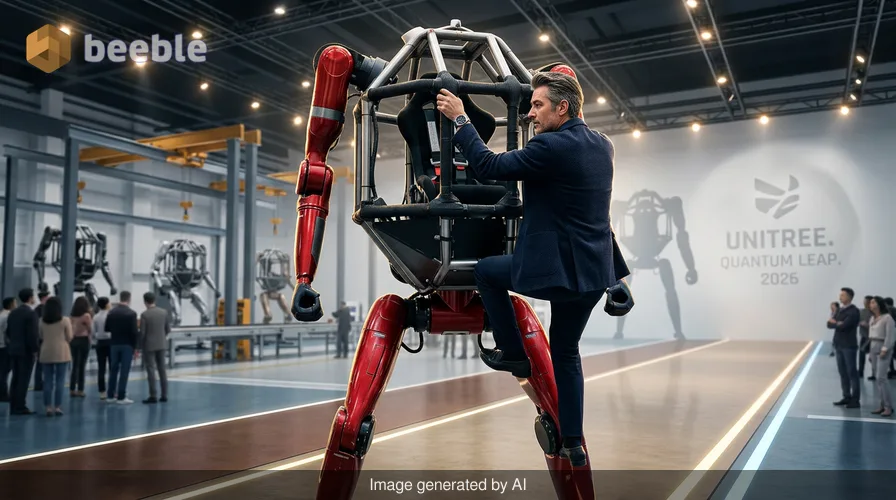
The Walking Paradox: A Half-Million Dollar Step Forward
Would you pay over half a million dollars for a vehicle that moves at a brisk walking pace, stands twice as tall as a human, and requires a pilot’s cabin instead of a leather interior? This isn't a hypothetical question posed by a science fiction writer. As of mid-2026, it is a legitimate consumer choice—at least for those with the deepest of pockets.
Unitree Robotics, a name that has rapidly shifted from a niche industrial player to a household name in high-end tech, recently unveiled the GD01. This isn't just another robotic dog or a laboratory-bound humanoid. It is a 500-kilogram, pilotable, transforming machine that Unitree claims is ready for mass production. From a distance, it looks like something plucked straight from an anime storyboard, but looking at the big picture, it represents a massive pivot in how we think about personal mobility.
Historically, transportation has relied on wheels or wings. We have spent a century smoothing out the world with asphalt to accommodate the simple rotation of a tire. The GD01 ignores that foundational rule, choosing instead to navigate the world on legs. But behind the jargon of "bipedal stability" and "quadrupedal transformation," lies a fundamental question: Is this a revolutionary leap in civilian transport, or is it a very expensive solution in search of a problem?
Under the Hood: The Mechanics of a 500kg Giant
To understand why the GD01 is priced like a luxury Mediterranean villa, we have to look at what is happening under the hood. Most robots we see today are either lightweight toys or stationary factory arms. Moving a 500-kilogram frame—plus the weight of a human pilot—requires a level of torque and power density that is, frankly, unprecedented in the consumer market.
In simple terms, the robot acts as a physical bridge between digital logic and the stubborn reality of gravity. It utilizes a hybrid movement system. On flat, open ground, it can drop to all fours, assuming a horizontal, quadrupedal stance that provides a lower center of gravity and higher stability. When it needs to navigate tight spaces or reach higher elevations, it transforms into a vertical, bipedal humanoid.
For the average user, this transformation is the most striking feature. It isn’t just for show; it is a functional necessity. Walking on two legs is an incredibly complex balancing act that engineers often describe as a "controlled fall." By allowing the GD01 to switch to a four-legged mode, Unitree has created a safety net for the pilot. If the terrain gets too rough or the battery runs low, the four-legged stance offers a robust, fail-safe position that prevents a very expensive and potentially dangerous tip-over.
The Economics of the $650,000 Price Tag
On the market side, the $650,000 entry price places the GD01 in a very specific economic bracket. It is roughly ten times the price of a high-end electric truck and twice the price of a entry-level Ferrari. So, who is the target audience?
Unitree is positioning this as a "civilian transport" device, but practically speaking, it is an emerging luxury asset. Much like the first computers that filled entire rooms or the first cellular phones that were the size of bricks, the GD01 is a foundational product. It is a proof of concept that rich early adopters will fund, eventually allowing the technology to become streamlined and decentralized for the rest of us.
| Feature | Unitree GD01 | Typical High-End SUV |
|---|---|---|
| Price | ~$650,000 | ~$80,000 - $120,000 |
| Weight | 500 kg (approx.) | 2,200 kg |
| Locomotion | Bipedal / Quadrupedal | 4-Wheel Drive |
| Primary Use | Extreme Terrain / Luxury Tech | Commuting / Utility |
| Payload | 1 Human Pilot | 5-7 Passengers |
Looking at this comparison, the GD01 seems wildly impractical. However, from a consumer standpoint, we aren't buying a car; we are buying access to places wheels can't go. Imagine a construction site where a supervisor needs to walk through a skeletal frame of a building, or a disaster relief scenario where the ground is too shattered for tires. In these niches, the GD01 isn't a toy—it's a tool.
The "So What?" Filter: Why This Matters to You
You might never sit in a GD01, and your neighbor probably won't be parking one in their driveway next week. Nevertheless, the release of a mass-production manned robot is a systemic shift in the industrial landscape. For years, robotics has been the tireless intern of the manufacturing world—hidden away in factories, performing repetitive tasks. The GD01 moves that technology into the public square.
What this means is that the supply chains for high-torque motors, advanced carbon-fiber limbs, and real-time balance algorithms are now being scaled for "civilian" use. When companies like Unitree start mass-producing half-ton walking machines, the cost of the smaller components—the sensors and actuators—drops for everyone else. This is the same cyclical pattern we saw with GPS technology: once a military-only tool, it became a luxury car feature, and now it’s a foundational part of every $100 smartphone.
Essentially, the GD01 is a signal that the "robotics age" has moved from the research lab to the showroom floor. Even if you find the price tag absurd or the design unnecessary, the engineering breakthroughs required to keep a human safely walking inside a 500kg frame will eventually trickle down into more practical applications, such as advanced exoskeletons for the elderly or more resilient delivery bots for our cities.
Navigating the Regulatory Minefield
Curiously, the biggest hurdle for the GD01 isn't the price or the physics—it's the law. Our cities are built on a binary: you are either a pedestrian on the sidewalk or a vehicle on the road. Where does a 500kg walking robot fit?
If it walks on the sidewalk, it poses a tangible risk to pedestrians due to its sheer mass. If it walks on the road, it is too slow and unpredictable for car traffic. This is a classic example of technology moving faster than the transparent frameworks we use to govern our daily lives. As a result, the first generation of GD01 owners will likely be restricted to private estates, industrial zones, or specialized "off-road" parks.
From my perspective as an analyst, this is the most volatile part of the story. We are witnessing the birth of a new category of machine, and our infrastructure simply isn't ready for it. It’s a reminder that heavy industry—the invisible backbone of modern life—must often wait for the legal system to catch up before it can truly change how we move.
The Bottom Line for the Everyday User
Ultimately, the Unitree GD01 is a magnificent, overpriced, and slightly terrifying glimpse into the future. It is a disruptive piece of hardware that challenges our assumptions about what a "vehicle" looks like. While the $650,000 price tag makes it an opaque luxury for most, the underlying technology is robust and scalable.
For now, the GD01 is a status symbol for the tech elite—a mechanical suit for those who find a private jet too conventional. But zooming out, it’s clear that the barrier between humans and high-functioning robotics is dissolving. To put it another way, we are no longer just building robots to work for us; we are building them to carry us.
As you observe your digital habits and the increasing automation in your life, take a moment to appreciate the invisible industrial mechanics that make a machine like the GD01 possible. We are entering an era where the digital nervous system of AI is finally getting a body strong enough to change the physical world. You might not need a transforming robot to get to the grocery store today, but the innovations packed into the GD01 are already beginning to reshape the tools, toys, and transports of tomorrow.
Sources:
- Unitree Robotics Official Product Announcement (GD01 Division)
- International Federation of Robotics (IFR) 2026 World Robotics Report
- Industrial Tech Quarterly Analysis: The Rise of Civilian Manned Robotics
- Global Supply Chain Review: Rare Earth Magnets and High-Torque Actuator Pricing



See you on the other side.
Our end-to-end encrypted email and cloud storage solution provides the most powerful means of secure data exchange, ensuring the safety and privacy of your data.
/ Create a free account
