


Why your best AI answers might come from a group of cheap models instead of one genius

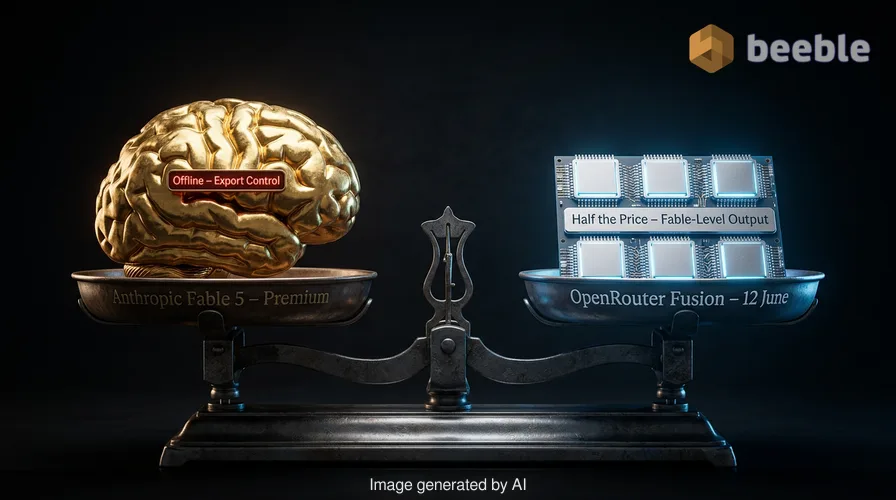
Most people assume that the smartest AI on the planet is the one with the biggest server farm and the most expensive subscription fee. While giants like Anthropic and OpenAI race to build the next massive model, a different strategy is emerging from the fringes of the industry. Instead of relying on one gigantic brain, companies are starting to use panels of smaller, cheaper models to outthink the heavyweights.
OpenRouter launched an API called Fusion on June 12 that puts this theory to the test. It arrives at a moment of sudden scarcity in the AI market. Just as Anthropic released its high-end Fable 5 model, a U.S. export control directive forced the company to pull the plug for foreign nationals worldwide. This move was triggered by a disputed finding regarding a jailbreak vulnerability. OpenRouter stepped into that vacuum with a blunt promise of Fable-level intelligence at half the price.
How the wisdom of the crowd works under the hood
The traditional way to use AI is like calling a single consultant. You ask a question, and that one model gives you its best guess based on its training. If it hallucinates or misses a detail, you have no second opinion. Fusion changes the workflow into something more like a corporate board meeting.
When a user sends a prompt, the system fires it off to several different AI models at once. These models work in parallel, using web search and software tools to find facts. Once they finish, a judge model examines all the answers to find where they agree and where they contradict each other. Finally, a synthesizer—which is Claude Opus 4.8 by default—takes all those notes and writes a single, cohesive response.
This approach treats AI as a tireless intern that works best when cross-checked by its peers. Most of the performance gains come from this final synthesis step. Having a separate model look at multiple perspectives reduces the chance that a single bias or error makes it into the final output. For the average user, this means the answer is grounded in consensus rather than the quirks of one specific algorithm.
The math behind the cheaper brain
The industry measures performance through benchmarks, and the results for Fusion are significant. On the DRACO benchmark, which uses complex research requests from real users, a panel of budget AI models nearly matched the best solo performers on the market.
OpenRouter paired Google’s Gemini 3 Flash with two Chinese models, Kimi K2.6 and DeepSeek V4 Pro. On their own, these models are relatively cheap and often lack the depth of a premium model like GPT-5.5. However, when fused and synthesized by Claude Opus, this budget trio scored 64.7% on the benchmark.
| Model Configuration | DRACO Benchmark Score | Relative Cost |
|---|---|---|
| Fable 5 + GPT-5.5 (Synthesized by Opus) | 69.0% | High |
| Solo Claude Fable 5 | 65.3% | High |
| Fusion Budget Panel (Gemini/Kimi/DeepSeek + Opus) | 64.7% | Low (Approx. 50%) |
| Solo GPT-5.5 | 60.0% | High |
| Solo Claude Opus 4.8 | 58.8% | High |
The budget panel beat the solo versions of GPT-5.5 and Opus 4.8. It landed within a single percentage point of Fable 5 while costing roughly half as much per thousand words of text. This suggests that for general research, the era of the all-in-one expensive model is over.
Navigating the export control gap
The timing of this release highlights a shift in how AI is regulated. Anthropic's decision to suspend Fable 5 and Mythos 5 for foreign users was a response to government directives regarding security risks. For developers outside the United States, this created an immediate problem where their applications stopped working overnight.
Fusion offers a way to maintain high performance without being tied to a single, politically volatile provider. Because the API uses a mix of models, including open-weight options from various countries, it is more resilient to sudden shutdowns. If one model becomes unavailable, the panel can be reconfigured with a different expert to fill the gap. This setup provides a practical workaround for users who need high-level reasoning but can no longer access the premium American models directly.
Conversely, skeptics point out that this does not fix the underlying export issue. Fusion still runs on models routed through OpenRouter's infrastructure, which may eventually face its own regulatory hurdles. For now, it is a way to bypass the high cost and low availability of the industry's most elite tools.
Where the group approach falls short
Despite the impressive benchmark numbers, Fusion is not a perfect substitute for a top-tier model in every scenario. The DRACO tests focus on research and planning, where multiple perspectives are an advantage. When it comes to long-horizon work or deep coding, a single, highly specialized model still maintains a lead.
Early feedback from users indicates that Fusion can struggle with complex tool-calling and software development. In those cases, the overhead of coordinating several different models can lead to confusion. Fusion works better as a tool that a main model calls upon when it needs a research deep-dive, rather than as a total replacement for a coding agent.
There is also the matter of transparency. Because Fable 5 is currently restricted, it is difficult for independent researchers to verify these comparisons in real-time. Skeptics like those on the launch thread on X have noted that benchmarks can be gamed if models accidentally find the grading rubrics during web searches. While OpenRouter claims to have filtered these results, the opaque nature of the AI industry makes it hard to be certain of every result.
What this means for your digital budget
For the average user, this shift signals a democratization of high-end intelligence. You no longer need to pay $30 a month to a single provider to get the best answers. Developers can now build applications that provide premium-tier reasoning using a mix of free or low-cost backends.
Practically speaking, this means the cost of smart assistants, research tools, and data analysis software should start to drop. If a panel of cheap models can match the performance of a titan, the premium labs will eventually lose their pricing power. Users should look for tools that allow for model switching or hybrid processing, as these will likely offer the best value for money in the coming months.
Ultimately, think of AI as a modular system where different brains handle different parts of a task. The disappearance of Fable 5 is a reminder that relying on one source is risky. Fusion proves that a well-organized crowd of models can be as smart as a restricted genius.
Sources:
OpenRouter Official Launch Documentation, June 2026.
Perplexity DRACO Benchmark Results Report, 2026.
Anthropic Export Control Compliance Statement, June 2026.
Sentiment Analysis and Technical Reviews via X and AI Research Communities.



See you on the other side.
Our end-to-end encrypted email and cloud storage solution provides the most powerful means of secure data exchange, ensuring the safety and privacy of your data.
/ Create a free account
