


Why your ChatGPT might feel smarter and slower at the same time

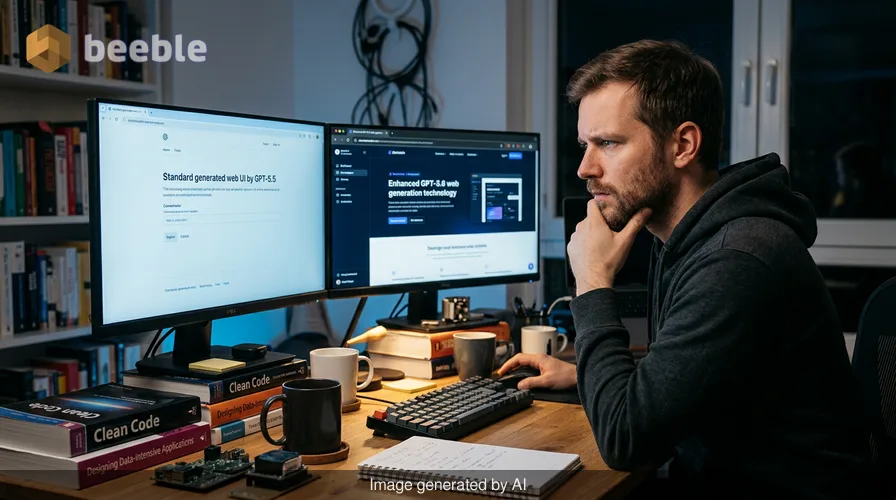
The internet is currently full of people who think their software is gaslighting them. Over the last 48 hours, a specific subset of ChatGPT users began reporting that the AI had suddenly developed a much higher IQ. These users claim the system is now capable of building complex 3D video games from a single prompt and designing high-end web interfaces that look professional rather than robotic. At the same time, these users are waiting up to an hour for a single response.
While popular narratives usually suggest that technology always gets faster as it improves, the current situation inside OpenAI suggests the opposite is true. The rumors point toward a stealth rollout of a model called GPT-5.6. While OpenAI has not confirmed a release, the data from independent testers suggests that we are witnessing a fundamental shift in how these digital brains operate. This is not a simple speed boost. It is a change in the weight of the thoughts the machine is capable of processing.
The reality of stealth testing in plain sight
OpenAI has a history of testing new technology without a formal announcement. This process is called A/B testing. In this scenario, the company gives a small percentage of its millions of users a new version of the software while the rest of the world continues with the old one. The goal is to see if the new version actually performs better in the wild without the risk of a global failure.
Developer Anshu Chimala recently shared evidence of this experience. He posted a comparison of landing pages generated by the AI, claiming he was one of the few with early access to a "Pro" version of the 5.6 model. His results showed a level of design polish that the current public version, GPT-5.5, rarely achieves. Other developers like Dobroslav Radosavljevič noted that the coding assistant Codex feels entirely different this week.
When a model feels different to a power user, it usually means the underlying architecture has changed. For the average person, this is like a restaurant swapping its standard house coffee for a premium roast without changing the price or the sign on the door. You might not know why the coffee tastes better, but you notice the difference in your morning routine.
Why better logic takes much longer to process
The most consistent evidence for a new model is the clock. In the world of AI, speed is usually the priority. However, users like Conor Dart report that a 3D browser game prompt that used to take 10 minutes now takes over an hour. This massive slowdown is a trade-off for quality. The suspected GPT-5.6 model is not just guessing the next word. It is engaging in what researchers call reasoning effort.
Think of this like a tired intern. If you ask a question and demand an answer in five seconds, the intern will give you the first thing that comes to mind. If you give that same intern an hour to think, they can check their work, look for errors, and build something much more stable.
Leaked details from sources like Pankaj Kumar suggest that OpenAI has raised a setting called Juice Value from 768 to 960. In simple terms, this value represents the computational budget the AI is allowed to spend on a single task. A higher budget means the AI is more thorough. It checks the physics of a 3D game or the geometry of a spaceship before it shows you the result. This is why a tester named Chris saw his spaceship generation time jump from 34 minutes on GPT-5.5 to 87 minutes on the suspected new model. The AI is doing more work behind the scenes.
The battle for the top of the market
OpenAI is not working in a vacuum. The timing of this suspected rollout is a reaction to global competition. China has a new open-source model called GLM-5.2 that is currently beating GPT-5.5 on engineering benchmarks. These benchmarks measure how well an AI can handle a multi-hour project without losing track of the goal. If OpenAI loses its lead in engineering, it loses its grip on the high-end developer market.
Anthropic, the creator of the Claude AI, is also a major factor. Their top models, Mythos 5 and Fable 5, are currently caught in a political battle over export controls. This has created a temporary vacuum at the top of the industry. OpenAI has a window of opportunity to capture users who are frustrated by Anthropic's unavailability.
There is also a financial clock ticking. Both OpenAI and Anthropic are preparing for potential initial public offerings. To attract investors, OpenAI needs to prove it can still innovate faster than its rivals. This pressure explains why the company might be willing to release a model that is slower but significantly more capable. High-end users will pay for quality even if they have to wait for the result.
What this means for your digital life
For the average person, these rumors signal a change in how we use AI tools. We are moving away from the era of instant, shallow answers and into an era of slow, deep work. Practically speaking, this change will affect your workflow and your wallet.
If these reports are accurate, the next version of ChatGPT will handle the December 2025 knowledge cutoff. It will also be much better at visual tasks like SVG design and 3D modeling. This makes the AI a more useful tool for small business owners and creative professionals who need high-quality assets without hiring a full design team.
However, this power comes at a cost. OpenAI is reportedly considering price cuts for standard tokens, but the high-reasoning models will likely remain expensive. Users should expect a tiered system where you pay more for the "Juice Value" required to solve hard problems. If you just need a quick email draft, the fast, cheap model stays. If you need a functional 3D simulation, you will have to wait—and potentially pay a premium.
Practical takeaways for the week ahead
As the rumored June 25 launch date approaches, there are a few things you can do to test the waters. First, check your settings in ChatGPT if you have a Pro account. Some users report that selecting the 5.5 Pro model is where the stealth testing occurs. If your response times suddenly spike while your output quality improves, you are likely part of the A/B test group.
Second, observe your digital habits. If the AI is taking 40 minutes to generate a response, you cannot use it for live chat. You have to treat it like a collaborator. You give it a task, walk away to do something else, and return when the work is done. This change in pace is the reality of the next generation of large language models.
Ultimately, the arrival of GPT-5.6 is about maturity rather than just speed. The AI industry is moving past the novelty phase and into a period where the tools are capable of professional-grade labor. Whether OpenAI confirms the model next week or continues to test it in the shadows, the shift toward higher reasoning is already here.
Sources
- Internal reports from The Information regarding Chief Scientist Jakub Pachocki's staff memo.
- Technical benchmark data from FrontierSWE regarding GLM-5.2 and GPT-5.5 performance.
- Market analysis from The Wall Street Journal on OpenAI and Anthropic IPO preparations.
- U.S. Department of Commerce export control directives from June 12, 2026.
- Social media reports and video evidence from developers Anshu Chimala and Dobroslav Radosavljevič.



See you on the other side.
Our end-to-end encrypted email and cloud storage solution provides the most powerful means of secure data exchange, ensuring the safety and privacy of your data.
/ Create a free account
