


Why your crypto wallet is safe from quantum hackers for now

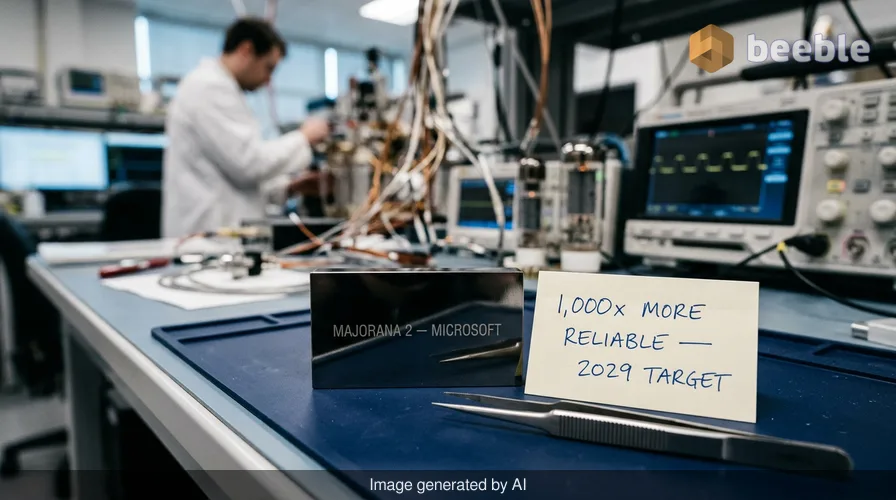
While headlines often paint quantum computing as a looming apocalypse for digital privacy, the reality is much slower and more methodical. Microsoft’s recent reveal of the Majorana 2 chip is a massive leap forward, but the announcement serves as a reminder of the enormous technical hurdles that still remain. Most people hear the phrase 1,000 times more reliable and assume the digital master key to every encrypted vault on earth is already in production. In truth, we are transitioning from a period of experimental theory into an era of early industrial engineering.
Microsoft claims its new chip is a foundational step toward a scalable quantum computer by 2029. This timeline matters because it gives the world a window to prepare. The current encryption that protects your bank account, your private messages, and your Bitcoin relies on math problems that today’s fastest supercomputers would take trillions of years to solve. A quantum computer works differently. Instead of checking every possible key one by one, it explores all possibilities at once. This makes it a potential threat to the bedrock of the modern internet, but Microsoft is the first to admit that building these machines is like trying to balance a thousand needles on their tips during an earthquake.
The lead breakthrough and the 20-second milestone
Under the hood, the Majorana 2 chip represents a shift in how Microsoft builds the smallest units of quantum information, known as qubits. For years, the industry used aluminum-based designs. Aluminum is a great superconductor, but it is sensitive to the slightest magnetic or thermal noise. This noise causes decoherence, which is a fancy way of saying the qubit forgets its information and crashes. If a computer crashes every few milliseconds, it cannot finish a complex calculation.
Microsoft swapped aluminum for lead in the Majorana 2. Lead is a heavier, more resilient material that provides a better shield against the environmental interference that plagues quantum systems. As a result, Microsoft says average qubit lifetimes reached 20 seconds, with some lasting up to a full minute. While 20 seconds sounds short for a human, it is an eternity in the quantum world. This stability is what allows the chip to be 1,000 times more reliable than the first Majorana generation.
This reliability is the difference between a car that breaks down every inch and a car that can actually drive around the block. We are not at the point of a cross-country road trip yet, but the engine is finally staying cool long enough to perform meaningful work. This stability is the primary reason Microsoft is confident enough to put a 2029 date on its roadmap for a commercial-grade machine.
AI as the tireless intern in the laboratory
One of the most interesting parts of this announcement is how Microsoft reached the finish line. The company did not just rely on human physicists staring at chalkboards. It used agentic AI tools to act as a tireless intern, sifting through decades of research and running simulations that would take humans lifetimes to complete.
This AI platform, known as Microsoft Discovery, analyzed materials at a molecular level to find the lead-based combination used in the new chip. The AI also helped automate the manufacturing process. In the past, fabricating these chips was a manual, error-prone process. The AI identified manufacturing flaws that the human eye missed, which allowed for a more streamlined production cycle. Practically speaking, AI is acting as a catalyst that compresses the time needed for scientific discovery.
Historically, industrial revolutions take decades to move from the lab to the factory. Steam power and electricity followed this slow arc. However, with AI handling the grunt work of materials science, the quantum revolution is moving at a pace that is unprecedented in the history of heavy industry. This partnership between two of the most hyped technologies of our time is actually producing tangible hardware rather than just software demos.
The real threat to Bitcoin and blockchain
Bitcoin sits at the center of the quantum panic because its security depends on the Elliptic Curve Digital Signature Algorithm (ECDSA). This is a mathematical lock that is currently impossible to pick. If a quantum computer becomes powerful enough, it could use something called Shor’s Algorithm to find the private key to any Bitcoin address just by looking at the public address.
Looking at the big picture, this threat is real but not immediate. To break Bitcoin’s encryption, a quantum computer needs millions of stable qubits. Microsoft’s Majorana 2 is a breakthrough because it is more reliable, but it is still working with a relatively small number of qubits compared to what is needed for a full-scale attack. The 2029 goal is for a scalable computer, which means it could start performing useful tasks in chemistry or physics, but it might still be years away from having the raw power to crack global financial systems.
For the average user, this means there is no need to panic-sell your crypto today. The developers behind major blockchains are already working on quantum-resistant upgrades. These are essentially new types of locks that even a quantum master key cannot open. The race is now between the engineers building the quantum computers and the coders building the new locks. Microsoft’s announcement just fired a loud starter pistol in that race.
How quantum stability compares across generations
To understand why a 1,000-fold improvement matters, we can compare the specs of the current generation against the previous experimental models. The jump in reliability is not a small tweak; it is a fundamental shift in the architecture of the machine.
| Feature | Majorana 1 (Previous) | Majorana 2 (New) |
|---|---|---|
| Primary Material | Aluminum-based | Lead-based |
| Qubit Lifetime | Milliseconds | 20 to 60 Seconds |
| Reliability | Experimental baseline | 1,000x Improvement |
| Discovery Method | Human-led research | AI-driven Material Discovery |
| Target Application | Laboratory proof | Scalable Commercial (2029) |
What this means for your digital life
From a consumer standpoint, the arrival of more reliable quantum chips signals a countdown for the current internet security model. This does not mean the internet will stop working, but it does mean the invisible backbone of our digital life is about to undergo a massive renovation. In the coming years, you will likely see your bank or your email provider ask you to update your security settings. These updates will quietly move your data behind quantum-resistant walls.
On the market side, this news reinforces Microsoft’s position as a leader in the hardware race. While companies like IBM and Google are taking different paths to quantum computing, Microsoft’s focus on topological qubits—which are naturally more resistant to noise—seems to be paying off. If they hit their 2029 target, we could see a volatile shift in how companies value data. Information that is encrypted today but could be decrypted in five years is suddenly a liability.
Ultimately, the Majorana 2 is a victory for industrial engineering. It shows that the obstacles to quantum computing are not impossible laws of physics, but rather difficult problems of material science and manufacturing. With AI now helping to solve those problems, the digital crude oil of quantum power is closer to being refined than ever before.
Practical takeaways for the reader
- Your current encryption is safe for the next few years, but the era of permanent privacy for today's data is ending.
- Pay attention to security updates from financial institutions over the next three years, as they will begin transitioning to post-quantum standards.
- Bitcoin and other cryptocurrencies will need to migrate to new signature schemes before 2029 to avoid systemic risks.
- AI is no longer just for writing emails; it is now the primary tool for creating the next generation of physical hardware.
Sources: Microsoft Build 2026 Keynote, Microsoft Quantum Research Blog, Technical reports on Majorana 2 lead-based superconductors.



See you on the other side.
Our end-to-end encrypted email and cloud storage solution provides the most powerful means of secure data exchange, ensuring the safety and privacy of your data.
/ Create a free account
