


Why Your 'Decentralized' TON Wallet Might Be Tethered to One Man’s Phone

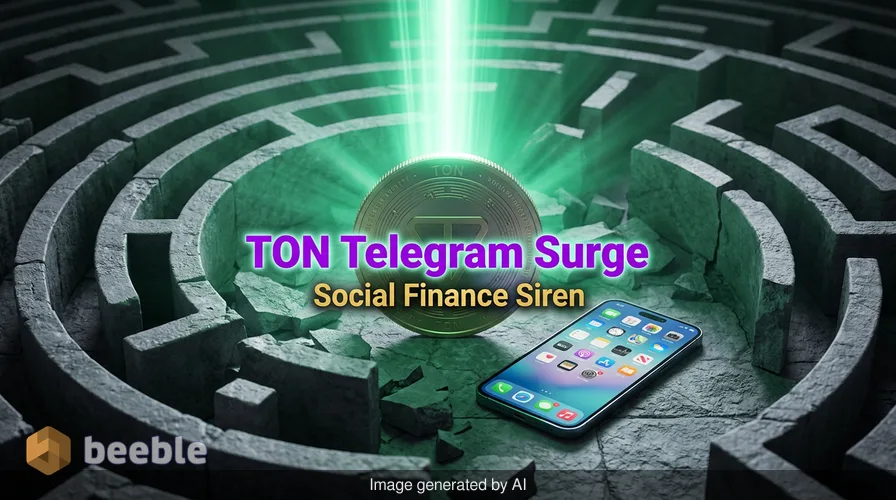
A few weeks ago, a friend of mine tried to send money to his sister across the border to help with an unexpected medical bill. He navigated the familiar, labyrinthine corridors of traditional banking: the SWIFT codes that look like ancient incantations, the three-day waiting period that feels like an eternity in a crisis, and the predatory fees that nibble away at the principal amount like termites in a wooden house. It was a mundane financial frustration that billions share. Then, he discovered he could bypass the entire ordeal by tapping a button inside a messaging app he already used to send memes. In ten seconds, the transaction was finished.
This is the siren song of the TON (The Open Network) ecosystem, which has recently staged a dramatic revival under the indirect stewardship of Telegram founder Pavel Durov. On a macro level, we are witnessing a profound collision between social media and sovereign finance—a merger that has propelled Toncoin (TON) through a staggering 100% surge in price over the last quarter. Yet, as the numbers climb and the "buy" buttons proliferate, a nuanced set of risks is emerging beneath the surface of this shiny new digital economy.
The One-Click Revolution
Historically, the barrier to entry for cryptocurrency was a jagged cliff; today, thanks to TON’s integration into Telegram, it is a frictionless slide. For years, the crypto world lived in a fragmented landscape of complex seed phrases and clunky browser extensions. To the average person, entering the market felt like trying to perform surgery on their own wallet. Zooming out, we can see that TON’s success isn’t just about technical superiority—it’s about behavioral economics. It leverages the "familiarity heuristic," the psychological tendency to trust things that are already part of our daily lives.
When a user sees their crypto balance sitting right next to their family group chat, the psychological weight of the asset changes. It stops being a speculative digital token and starts feeling like tangible, spendable money. This transition is pervasive because it removes the cognitive load of "learning crypto." Paradoxically, the very ease of use that is driving this 100% surge is also what makes it potentially dangerous for the uninitiated retail investor.
The Anatomy of the Surge
To understand why TON is suddenly ubiquitous, we have to look at the structural shifts in how Telegram has monetized its platform. Previously, Telegram was a massive, expensive-to-run utility that avoided traditional ad models. Now, the platform has pivoted, using TON as the plumbing for its ad-revenue sharing program and the purchase of digital goods.
In practice, this creates a closed-loop economy. Advertisers buy credits using TON, and channel owners receive their payouts in the same currency. This isn't just a speculative bubble; it's a functioning ecosystem with a massive, 900-million-strong captive audience. Consequently, the demand for the token has shifted from purely speculative to functional. The market, acting like a global mood ring, has responded to this utility with a massive influx of capital, pushing the valuation into the top tier of all digital assets.
The Illusion of Decentralization
As we analyze this growth, we must confront a sobering reality: the "glass bank vault" of blockchain is only as secure as the person holding the blueprints. While TON is technically a decentralized network, its fate is deeply rooted in the success and regulatory standing of a single private company: Telegram.
Through this economic lens, we see a paradox. If Telegram faces a systemic outage or a legal crackdown, the "decentralized" network it hosts could become a stranded asset. Unlike Bitcoin, which is a global, leaderless entity, TON behaves more like a hybrid. It is a digital wild west where the sheriff, the mayor, and the landowner all happen to be the same organization. For the everyday user, this creates a hidden concentration of risk. You might think you have escaped the centralized control of a big bank, but you have essentially traded one form of institutional reliance for another.
| Feature | Traditional Banking (TradFi) | TON Ecosystem (Social DeFi) |
|---|---|---|
| Transaction Speed | Slow (Days for international) | Near-Instant (Seconds) |
| Ease of Access | High friction (ID, physical branch) | Zero friction (In-app toggle) |
| Control | Centralized (Bank/Government) | Hybrid (Platform-dependent) |
| Transparency | Opaque (Internal ledgers) | Transparent (On-chain records) |
| Systemic Risk | Banking sector collapse | Platform/Regulatory crackdown |
The Regulatory Shadow and Hidden Risks
Experts are now warning that the very features making TON a retail darling—privacy and ease of transfer—are drawing the skeptical gaze of global regulators. From a consumer standpoint, sending money as easily as a text message is a dream; from a regulatory standpoint, it looks like a potential nightmare for anti-money laundering (AML) compliance.
In the past, Pavel Durov faced the wrath of the SEC, which effectively halted the original "Gram" token launch in 2020. While the project was revived by an independent community and subsequently re-embraced by Telegram, that historical trauma remains a structural weakness. If a major economy decides that Telegram’s wallet feature facilitates illicit finance, they could demand the app be removed from major app stores. Suddenly, that "frictionless" access becomes a brick wall.
Furthermore, the current surge is fueled by high levels of speculation. Much of the 100% gain is driven by retail FOMO—the fear of missing out on the next big social media coin. This creates a volatile environment where the price is not just reflecting utility, but an emotional consensus that can shift overnight. Financially speaking, when an asset becomes a cultural phenomenon, the price often outpaces the actual technical development of the network.
The Behavioral Trap: Familiarity vs. Safety
Why do we ignore these risks? Behavioral economics suggests that when we are comfortable, we become less critical. When we use an app every day to talk to our parents or colleagues, we develop an emotional bond with the interface. This bond can blind us to the systemic fragility of the financial tools embedded within it. Inflation is an invisible leak in our wallets, but a sudden platform collapse is more like a flash flood.
Ultimately, the revival of TON represents a pivotal moment in the evolution of digital money. It marks the end of the era where crypto was a niche hobby for tech enthusiasts and the beginning of an era where it is a mundane feature of our social lives. But as we transition into this new world, we must remember that just because a financial tool is convenient doesn't mean it is safe.
Towards Financial Mindfulness
As you look at your digital wallet today, consider the invisible threads connecting your small balance to the larger global stage. The 100% surge in Toncoin is a symptom of a world hungry for financial alternatives, but it is also a reminder that every shortcut comes with a trade-off.
Instead of chasing the next green candle on a chart, perhaps it’s time to practice a bit of financial mindfulness. Ask yourself: if the app you use to chat disappeared tomorrow, would your savings disappear with it? Understanding the plumbing of your own wallet is the first step toward true financial autonomy. The goal shouldn't just be to make transactions faster; it should be to make our understanding of risk deeper. In this shifting economic landscape, the most resilient asset you own isn't the coin in your wallet—it's the skepticism in your mind.
Sources:
- TON Foundation Ecosystem Report (Q1 2026)
- Telegram Official News Channel: Ad Revenue and Monetization Update
- CoinMarketCap: Toncoin (TON) Historical Performance Data
- Bank of International Settlements (BIS): Report on the Integration of Social Media and Financial Services
- Journal of Behavioral Economics: The Familiarity Heuristic in Digital Asset Adoption



See you on the other side.
Our end-to-end encrypted email and cloud storage solution provides the most powerful means of secure data exchange, ensuring the safety and privacy of your data.
/ Create a free account
