


Why Your Favorite Apps Are Quietly Becoming Their Own Bosses

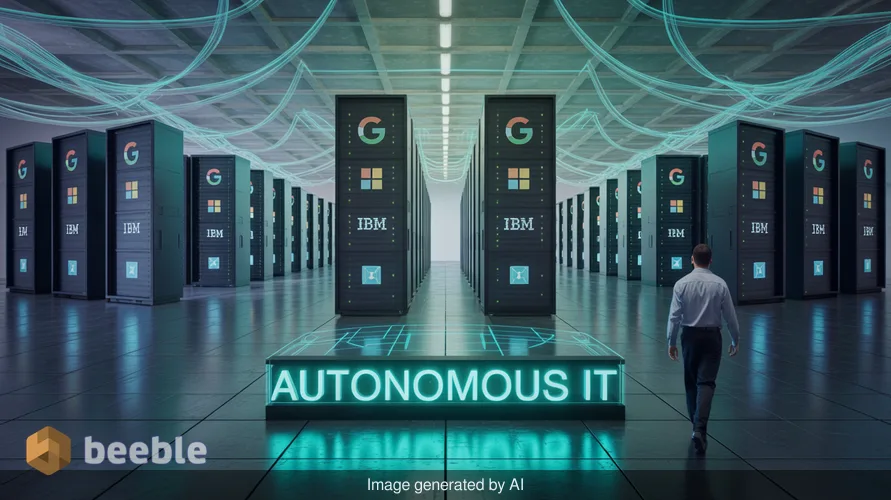
While the world remains fixated on AI’s ability to write poetry or generate surreal images, a far more disruptive shift is happening behind the curtain. We are moving away from an era where humans manage technology and into an age where technology manages itself. This isn't science fiction; it is the rise of autonomous IT, a systemic transformation led by the industry’s three heavyweights: Google, IBM, and Microsoft.
For years, the popular narrative has been that AI is a clever chatbot or a helpful assistant. While that seems true on the surface, the reality is that the most significant impact of AI isn’t in the words it produces, but in the invisible backbone of modern life—the data centers, networks, and cloud infrastructures that keep our digital world spinning. We are witnessing the birth of the self-healing, self-securing, and self-optimizing digital ecosystem. Practically speaking, the "IT guy" isn't just getting a faster computer; the computer is becoming the IT guy.
Behind the Jargon: From Automation to Autonomy
To understand this shift, we have to distinguish between simple automation and true autonomy. Historically, we’ve used automation for decades. If a server gets too hot, a script tells the fan to spin faster. That is automation—a simple if-then command.
Autonomous IT, however, behaves more like a tireless intern with a PhD in predictive analytics. Instead of waiting for a problem to occur, these systems use machine learning to observe patterns and anticipate trouble before it manifests. To put it another way, if automation is a thermostat that turns on the heater when it gets cold, autonomy is a smart home system that checks the weather report, realizes a cold snap is coming, and seals the windows before the temperature even drops.
Google, Microsoft, and IBM are no longer just selling space on their servers; they are selling systems that can rewire themselves in real-time. For the average user, this means the apps you rely on—from banking to streaming—are becoming more resilient. They are learning to stay upright even when the digital equivalent of a hurricane hits.
How the Giants are Rebuilding the Engine
Each of the major players is approaching this transition through a slightly different lens, reflecting their overarching corporate DNA. Looking at the big picture, we can see a clear division in how they intend to manage the world's data.
| Feature | Google (Vertex AI/DeepMind) | Microsoft (Azure Automanage) | IBM (Watsonx/AIOps) |
|---|---|---|---|
| Core Strength | Data-heavy predictive modeling | Seamless integration with daily tools | High-stakes security and compliance |
| Primary Goal | Efficiency and speed | Accessibility for all businesses | Bulletproof reliability for industry |
| Consumer Impact | Faster, more intuitive apps | Fewer service outages | Better protection of sensitive data |
Google is leveraging its history with DeepMind to create systems that optimize energy and processing power with unprecedented precision. They treat the data center like a living organism. Microsoft, conversely, is focusing on democratization. Through its Azure Automanage and Copilot integrations, it is making it possible for a small business to run a global-scale website without needing a team of twenty engineers.
IBM remains the foundational choice for heavy industry. Their focus is on the "closed-loop" system, where the AI manages regulatory compliance and cybersecurity in sectors like banking and healthcare—areas where a single mistake can be catastrophic. Behind the jargon, IBM is trying to eliminate human error from the most sensitive parts of our global infrastructure.
The Global Air Traffic Controller: A New Metaphor for IT
Think of the internet not as a series of cables, but as a global air traffic control system. In the past, every plane (or piece of data) needed a human controller to guide it to the gate. As the number of planes grew into the billions, humans became the bottleneck. We simply couldn't think fast enough to prevent every collision or delay.
Autonomous IT acts as a decentralized, digital air traffic controller. It can track millions of data packets simultaneously, rerouting them around digital "storms" (like cyberattacks) or heavy traffic (like a viral video launch) without needing a person to click a button. This shift is foundational because it allows the digital economy to scale beyond human limitations. Historically, the limiting factor of a company’s growth was how many IT staff they could hire. That ceiling is currently being dismantled.
What This Means for Your Daily Life
It is easy to view these developments as corporate housekeeping, but the ripple effects eventually reach the consumer’s wallet and device.
First, there is the issue of reliability. Have you noticed that major platform outages, while they still happen, feel shorter or more localized than they did five years ago? That is the result of self-healing systems. When a server node fails in 2026, the autonomous system simply moves the data elsewhere and spins up a replacement before the user even sees a loading spinner.
Second, there is a tangible impact on cost. Running massive digital services is incredibly expensive. By using AI to slash energy consumption and hardware wear-and-tear, companies can keep subscription prices more stable in a volatile market. Essentially, autonomous IT is a slow leak-fixer in the tire of inflation.
However, from a consumer standpoint, there is a tradeoff. As these systems become more opaque, understanding why a certain decision was made becomes harder. If an autonomous security system decides to lock you out of your account because it detected a "pattern" it didn't like, getting a human to overturn that decision might become increasingly difficult. We are trading transparency for efficiency.
The "So What?" Filter: Practical Implications
Zooming out, the shift led by Google, IBM, and Microsoft is a signal that we have reached the end of the "manual" internet. For professionals, this means the skills required to work in tech are shifting. It’s no longer about knowing how to fix a specific bug; it’s about knowing how to manage the AI that fixes the bug.
For the rest of us, it means our digital experiences will become smoother and more intuitive, but also more decentralized. We are moving toward a world where your refrigerator, your car, and your work computer are all part of a robust, self-managing web that requires very little of your attention.
Ultimately, the bottom line is that the "tech support" of the future won't be a person asking if you've tried turning it off and on again. It will be a silent, invisible process that fixed the problem ten minutes before you even realized something was wrong.
As we move forward, the most important thing you can do is observe your own digital habits. Notice how rarely you have to "manage" your tech anymore. While this convenience is a luxury, it also requires a new kind of digital literacy—an awareness that while the machines are managing themselves, we are the ones who must still decide where they are going. We are moving from being the drivers of the car to being the passengers who choose the destination. It’s a comfortable ride, but we should probably keep our eyes on the road.
Sources:
- Google Cloud official technical announcements (Vertex AI updates).
- IBM Institute for Business Value: "The Evolution of AIOps."
- Microsoft Azure Automanage Service Documentation and Roadmap 2025-2026.
- Technology Magazine: Analysis of Enterprise Autonomous Systems.



See you on the other side.
Our end-to-end encrypted email and cloud storage solution provides the most powerful means of secure data exchange, ensuring the safety and privacy of your data.
/ Create a free account
