


Why your freelance AI art now carries a 15 million euro risk

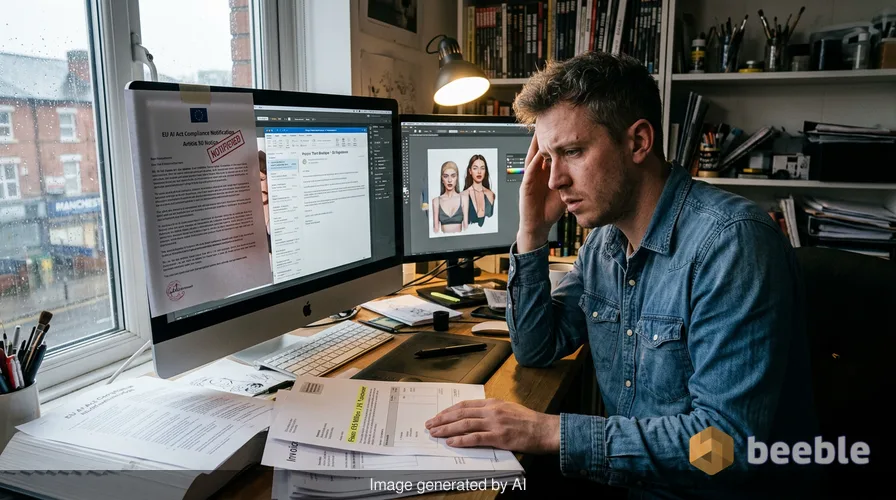
A freelance illustrator in Manchester recently finished a set of promotional images for a small boutique in Paris. He used a popular generative AI tool to create the lighting effects and to swap the models' hair colors. He hit send and moved on to his next project. Under the rules that took effect on August 2, 2026, he is now standing on a legal landmine. The EU AI Act is no longer just a problem for Silicon Valley giants. It is a set of rules that sits right on the desk of every creator, influencer, and small business owner whose work reaches European soil.
For months, the conversation around artificial intelligence regulation focused on high-risk systems like facial recognition in policing or automated hiring tools. Many individual users assumed these laws were for the architects of the technology, the billion-dollar companies that build the models. That assumption changed this month. Sweeping new transparency rules under Article 50 of the Act have entered full force. These rules catch a wide net of actors. If you create, publish, or deploy AI-generated content used in the EU market, you have fresh obligations to meet. Failure to follow these steps carries a heavy price. Fines reach up to 15 million euros or 3% of your total worldwide turnover.
The reach of the new transparency mandate
Jurisdiction in the digital age is rarely limited by physical borders. The EU transparency rules apply to individuals and companies based inside the European Union. They also apply to anyone outside the EU if their AI-generated content is used within the EU market. This means a designer in New York or a podcaster in Tokyo must comply if their work is available to European consumers. The law treats paid services and free content with equal weight. There is no loophole for hobbyists who distribute their work for free if that work has a commercial orientation or relates to matters of public interest.
From a legal standpoint, the law views these requirements as a digital passport for content. Just as a physical product needs a label of origin, AI content needs a mark of its creation. The goal is to ensure that a natural person—a human being—knows when they are interacting with a machine or viewing something a machine made. This is the fundamental right to know the truth of a digital interaction.
The four pillars of article 50
The European Commission has set out four major groups that must now follow strict transparency guidelines. Understanding which group your work falls into is the first step in avoiding litigation.
First, Article 50(1) covers AI systems that interact directly with people. This includes chatbots, AI-enabled voice assistants, and AI companions. If you run a website with a customer service bot, you must design that bot so the user knows they are not talking to a human. The interaction must be clear from the start.
Second, Article 50(2) focuses on systems that manipulate images, video, audio, or text. This is the heart of the generative AI boom. If you use AI to create a synthetic image or a video, the output must be marked in a format that machines can read. This allows social media platforms and browsers to detect the AI origin of the file.
Third, Article 50(3) addresses emotion recognition and biometric systems. If you use a system that attempts to read a person's mood or identify them through physical traits, you must inform the person that they are being exposed to such a system. This applies in both physical workplaces and digital environments.
Fourth, Article 50(4) targets deepfakes and text meant to inform the public. If you publish a deepfake or a text that discusses matters of public interest, you must disclose that the content is manipulated. This rule aims to protect the integrity of public discourse and prevent the spread of deceptive media.
Obligations for social media influencers and creators
If you are a social media influencer or a blogger, the new rule of thumb is to mark everything. The law is particularly interested in content that touches on public interest. This includes topics like public health, the economy, law enforcement, and fundamental rights. If you use AI to summarize a legal document or to write a blog post about environmental policy, that content needs a clear label.
For those who love face-editing apps, the legal line is drawn at substantial modification. Minor edits for personal use are generally safe. However, if you replace faces or perform extreme body alterations for a commercial post, the transparency rules apply. The law considers these substantial changes because they alter the intent and messaging of the image. Graphic designers face similar requirements. If you remove objects from a video or change the skin color of a person using AI, you must mark that content. The generation of events that never occurred is a major trigger for these disclosure rules.
Where the legal burden rests
In a professional setting, the question of who is liable often creates confusion. The law distinguishes between the employer and the employee. If you are a designer at an advertising agency, the agency is the legal deployer of the AI system. The individual employee is generally not liable for the fine as long as they act under the instructions of their employer. The responsibility stays with the legal entity that controls the operation.
This also applies to the relationship between an agency and a client. If a brand hires an agency to create a campaign and the agency chooses to use AI without the brand's direct control over the process, the agency bears the burden of compliance. However, if a freelancer acts on their own behalf and gains an economic benefit, they are the ones responsible for marking the content correctly. In practice, the person who holds the steering wheel of the AI tool is the one the law watches most closely.
Content that does not require a label
The law does not intend to punish every use of digital tools. Some activities remain exempt to allow for creative flow and technical utility. You do not need to mark content for minor grammar corrections or spellchecking. Stylistic polishing and general formatting do not count as substantial changes. If you use AI for video stabilization or to remove dust and spots from a photograph, you are in the clear. These are considered general editing tasks that do not mislead the viewer about the reality of the content.
There are also lighter rules for artistic and satirical work. If your AI-generated video is clearly a work of fiction or a parody, you have more breathing room. Caveats aside, if that satire is used for a professional purpose, a label is still the safest path. The distinction between art and professional promotion is often a matter for a court to decide. Precedent suggests that when money is involved, the law leans toward more transparency.
How to mark your content correctly
The European Commission is specific about what counts as a valid disclosure. You cannot simply bury a mention of AI in a long terms and conditions page. A hidden watermark that a human cannot see is also insufficient on its own. The disclosure must be clear and distinguishable. The goal is to inform the human user, not just a computer algorithm.
| Marking Type | Legal Status | Why it matters |
|---|---|---|
| Metadata / Watermarks | Mandatory for machines | Allows platforms to filter content automatically. |
| Visible Text Labels | Required for users | Ensures the average person knows they see AI work. |
| Terms and Conditions | Insufficient | Users rarely read these; disclosure must be direct. |
| Generic "Assistant" tag | Often Insufficient | Vague terms do not fulfill the duty to be clear. |
For writers and bloggers, a simple statement at the beginning of the text is effective. Phrases like "This summary was generated with the help of AI" provide the necessary clarity. For video creators, a persistent watermark or a clear spoken disclosure at the start of the audio ensures compliance. Ultimately, the burden of proof rests on the creator to show they made a good-faith effort to inform their audience.
Action steps for every digital worker
The transition into this new regulatory era requires a change in habits. You should start by auditing your current workflow. Identify every point where an AI tool modifies your final product. If that product is bound for a client or a public platform, prepare a standard labeling protocol. Do not wait for a warning letter from a regulatory body.
Second, update your contracts. If you are a freelancer, include a clause that specifies who is responsible for AI marking. This protects you if a client modifies your work later. If you are a business owner, ensure your employees understand the Article 50 requirements. The law is a shield for consumers, but it can be a heavy backpack for those who ignore the small print. Taking these steps today is the only way to ensure your creative work remains a professional asset rather than a legal liability.
Sources: EU AI Act (Regulation (EU) 2024/1689), European Commission Guidelines on Article 50 Transparency Obligations, European Data Protection Board (EDPB) summary on AI transparency.
Disclaimer: This article is for informational and educational purposes only. It does not constitute formal legal advice. You should consult a qualified attorney in your jurisdiction to discuss specific compliance issues regarding the EU AI Act and your business activities.



See you on the other side.
Our end-to-end encrypted email and cloud storage solution provides the most powerful means of secure data exchange, ensuring the safety and privacy of your data.
/ Create a free account
