


Why your interest in SpaceX futures explains the fragmentation of global markets

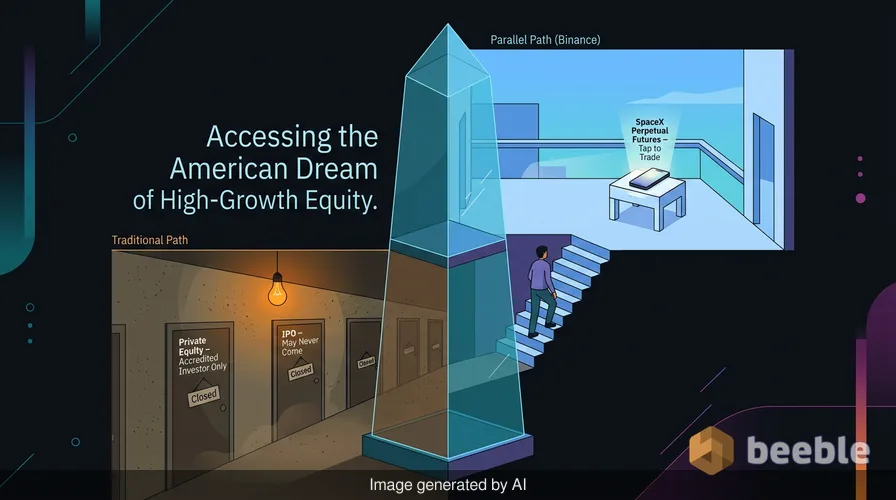
A few years ago, owning a piece of a revolutionary aerospace company meant navigating a maze of private equity firms or waiting for a traditional stock market debut that might never come. Today, a retail investor sitting in a coffee shop in Jakarta or a small apartment in Warsaw can speculate on that same company with a few taps on a smartphone. The recent surge in SpaceX perpetual futures on Binance highlights a profound shift in how we interact with value. These digital contracts are no longer niche experiments; they are the primary way a new generation of traders accesses the American dream of high-growth equity.
SpaceX perpetual futures recently became the second-largest product on Binance, trailing only Bitcoin in total activity. This milestone reflects more than just a passing interest in rockets or the public listing of a major tech firm. It represents the emergence of a parallel financial system that operates while traditional banks sleep. As of mid-June 2026, the volume for these contracts exceeded $5.6 billion in a single 24-hour period. To put that in perspective, that amount of money could fund several medium-sized space missions every single day. The activity is massive, yet the participants are often individuals who are technically barred from the very markets they are betting on.
The divide between access and ambition
There is a stark contrast between the rigid structures of the legacy financial world and the fluid nature of modern digital markets. In the old world, a resident of an emerging economy faced high fees and restrictive regulations when trying to buy U.S. stocks; in the new world, that same resident uses a crypto-funded account to gain identical price exposure. This is the macro reality behind the $9 billion in combined trading volume for the SpaceX contract. It is a symptom of a fragmented global economy where the desire for wealth creation outpaces the slow evolution of traditional brokerage systems.
Binance reports that 80% of the demand for its direct stock offerings comes from users who lack easy access to the U.S. equity markets. These individuals are not necessarily "crypto bros" looking for the next meme coin. They are often pragmatic savers and speculators who view the U.S. tech sector as a more resilient harbor for their capital than their own local currencies. When inflation acts as an invisible leak in a person's local bank account, they look for any vessel that can hold value. Paradoxically, they find that vessel in a volatile aerospace derivative rather than a government-backed savings bond.
The mechanism of the digital vault
To understand why this product is dominating the charts, we have to look at the plumbing of the trade. A perpetual futures contract is not a stock. It is a derivative that never expires, designed to track the price of an underlying asset through a mechanism called a funding rate. When Binance introduced the SPCXUSDT contract, it initially functioned as a pre-IPO tool. This allowed traders to bet on the company's value before its Nasdaq debut, using a decentralized order book to determine the price. Once the company officially listed, the exchange converted the contract to track real-time Nasdaq data.
This conversion process is a perfect example of the blockchain acting as a glass bank vault. Every trade is visible, and the rules of the contract are enforced by code rather than by a room full of compliance officers. During the transition, SpaceX amended its filing to issue more shares, which would typically dilute the value for existing holders. Binance was the only major venue to automatically rebase its positions to account for this change. This level of transparency and technical agility is why these products are pulling liquidity away from traditional venues. The digital system moves at the speed of the internet, while the legacy system moves at the speed of a wire transfer.
Market psychology as a global mood ring
Financial markets often function as a global mood ring, reacting emotionally to headlines and cultural shifts rather than just balance sheets. SpaceX is the ultimate example of this phenomenon. It represents the intersection of human ambition, technological frontier, and the polarizing public image of its leadership. When a rocket successfully lands, the volume spikes; when a filing is amended, the price shifts. The heavy trading in these perpetuals suggests that retail investors use these products to express their belief in a specific version of the future.
This behavior is deeply rooted in the psychology of the modern investor. For many, the stock market feels like an opaque machine controlled by institutional giants. Crypto-based equity products feel more democratic, even if they carry higher systemic risks. The fact that SpaceX futures sit right behind Bitcoin in popularity tells us that the retail public views "high-tech aerospace" and "decentralized money" as two sides of the same coin. Both represent an exit from the mundane financial reality of the 20th century. Consequently, the volatility of these assets is not viewed as a deterrent but as a price of admission for potential growth.
The normalization of the synthetic asset
We are witnessing the pervasive integration of traditional securities into the digital asset ecosystem. Binance has expanded its offerings to include tokenized versions of Nvidia, Tesla, and Apple. These assets are backed one-to-one by the actual stocks, but they live on the blockchain. This allows them to be used in decentralized finance applications or moved to a self-custody wallet. In practice, this means your "stock portfolio" can now be used as collateral for a loan or traded for a stablecoin at three in the morning on a Sunday.
This shift creates a nuanced challenge for regulators and an opportunity for the everyday trader. On one hand, the lack of traditional oversight in the crypto-equity space can lead to predatory practices or liquidity crunches during market panics. On the other hand, it provides a level of financial inclusion that the legacy system has failed to deliver for decades. The stock market is no longer a physical building on Wall Street; it is a distributed network of price feeds and smart contracts. Through this economic lens, we see that the definition of "ownership" is becoming increasingly symbolic.
Reflections on financial mindfulness
As we watch billions of dollars flow into aerospace derivatives, it is worth pausing to reflect on our own financial habits. It is easy to get swept up in the narrative of a "space race" or the thrill of a 24-hour market. However, every trade represents a choice about how we value our time and our labor. The rise of SpaceX perpetuals is a reminder that while the tools we use to manage money are changing, the fundamental rules of risk and reward remain the same. Speculating on the future of Mars does not exempt us from the mundane requirements of a balanced budget today.
The convenience of these digital platforms should not mask the underlying complexity of what we are trading. A perpetual contract is a powerful instrument, but it is also a volatile one. Reclaiming a sense of control over our economic future requires more than just access to new products; it requires the discipline to understand them. As the lines between the Nasdaq and the blockchain continue to blur, the most valuable asset any investor can hold is not a specific stock or a token, but a grounded understanding of the systems that move them.
Sources
- Binance Exchange Market Data (June 2026 Rolling Volume Reports)
- Nasdaq Real-Time Equity Pricing Indices
- SpaceX S-1 Registration Statement and Subsequent Amendments
- Crypto.news report on U.S. Equities Platform Daily Turnover (June 2026)
- SEC Filings regarding Public Listing and Share Dilution Data



See you on the other side.
Our end-to-end encrypted email and cloud storage solution provides the most powerful means of secure data exchange, ensuring the safety and privacy of your data.
/ Create a free account
