


Why your law professor might be less logical than a smartphone app

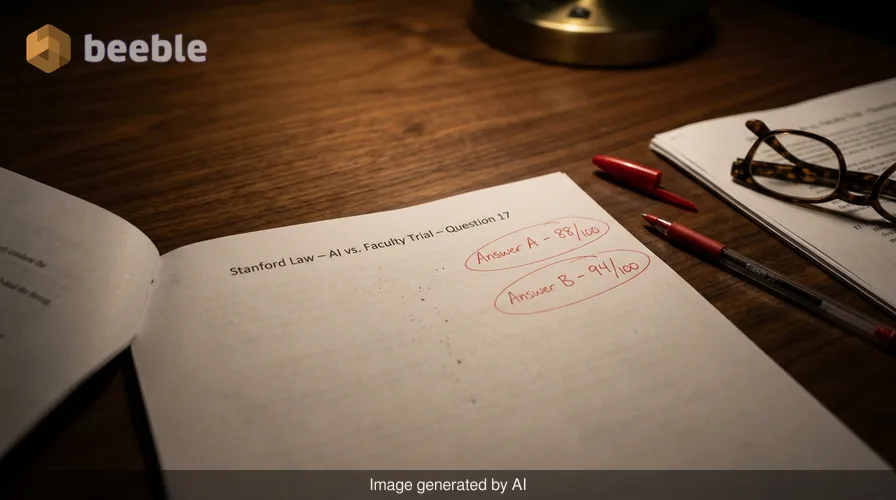
While we often view legal reasoning as an abstract, uniquely human art, the newest data from Stanford suggests it is actually a predictable pattern of logic. We tend to imagine law professors as the final gatekeepers of wisdom, possessing a nuanced understanding of justice that a machine could never replicate. Recent testing proves this assumption is largely incorrect. Large language models now regularly outperform the very people who teach them.
Researchers from Stanford University recently put AI through a grueling test. They gathered 16 professors from the most prestigious law schools in the United States, including Yale, NYU, and the University of Chicago. These experts drafted 40 complex contract law questions. They covered everything from deep legal doctrine to hypothetical scenarios and policy debates. When the answers came in, the human professors were blinded. They did not know if they were grading a peer or a computer. In roughly 75% of these matchups, the professors chose the AI-generated answer over the one written by a fellow human instructor.
This outcome is disruptive to the traditional image of the legal profession. It suggests that the "legal mind" is less about a soul or a gut feeling and more about the ability to process vast amounts of precedent and apply it to a specific set of facts. Essentially, the AI is acting as a tireless intern who has memorized every case ever decided. This intern does not get tired, does not have an ego, and apparently makes fewer mistakes than the partners at the firm.
Testing the logic of the ivory tower
To understand why this happened, we have to look at the mechanics of the study. The researchers used a variety of models, including Google’s Gemini 2.5 Pro and Anthropic’s Claude Opus 4.7. These are not the basic chatbots that struggle with simple math. These systems are designed to weigh ambiguity and reach defensible conclusions. In nearly 3,000 separate comparisons, the AI models consistently delivered responses that professors preferred for their students.
One interesting metric involved how often these answers were considered harmful. In the legal world, a "harmful" answer might involve a blatant misstatement of the law or advice that could lead a client into a lawsuit. Curiously, the human professors were flagged for harmful content 12.06% of the time. Google’s Gemini recorded a harmfulness rate of only 3.41%. This gap suggests that human experts are more prone to errors of omission or factual slips than their digital counterparts. Humans have bad days; software has updates.
Looking at the big picture, these results were not just a fluke of writing style. The researchers tested for length, tone, and clarity to see if the AI was simply winning because it sounded more confident. The data showed that the AI advantage remained even after accounting for these surface-level features. The machines were winning on substance. They provided better recall of case law and more coherent policy discussions. From a consumer standpoint, this is the moment where the high cost of legal education begins to look like a systemic inefficiency.
Why robots write safer contracts than people
In everyday life, most people only interact with contract law when they click "agree" on a website or sign a lease. Behind the jargon, these documents are meant to be logical frameworks for resolving disputes. The study focused heavily on this area because it is the backbone of the economy. If an AI can draft and interpret these documents better than a Yale professor, the implications for small businesses and average citizens are tangible.
Historically, getting a high-quality legal opinion required a massive financial barrier. You paid for the professor’s years of study and their expensive office. Now, the baseline for a "good" legal answer is available via a subscription. Under the hood, these LLMs are identifying legal anchors and structural organization that humans sometimes miss in their rush to finish a draft. The AI provides a robust framework because it is trained on the totality of legal writing, not just the cases one person remembers.
There is an overarching trend here toward the democratization of expertise. When a model like Claude Opus 4.7 ranks first in legal reasoning across the board, it becomes a scalable tool for anyone with an internet connection. This does not mean the end of lawyers. It does mean the end of lawyers charging five hundred dollars an hour for work that an algorithm does with 75% higher accuracy. The legal profession is facing a volatile shift where the value of a human degree is being weighed against the output of a processor.
The tireless intern in your pocket
Practically speaking, we should view this AI as a tireless intern rather than a replacement for the judge. While the AI won the majority of matchups, the researchers noted that the study did not measure whether the answers met a specific instructor's personal teaching style. An AI might give a "good enough" answer that satisfies a general panel, but it might lack the specific flair or local insight a professor brings to a specific classroom in Chicago or Los Angeles.
However, for the average user, "good enough" is often better than what they currently have access to. Most people have no access to a law professor. They have a search engine and a prayer. Moving from that to a system that aligns with the disciplinary criteria of the top 14 law schools in the country is a massive leap forward. What this means is that the floor for legal literacy is rising. The digital crude oil of the law—the data and the precedents—is finally being refined into something usable for everyone.
This shift is not just about convenience. It is about resilience. When a small business owner can use an AI to verify that a contract is fair, they are less vulnerable to predatory practices. The AI provides a transparent look at what the law actually says, rather than what a more powerful opponent claims it says. This is a foundational change in how power is distributed in the marketplace.
What this means for the cost of being right
Zooming out, we are seeing a cyclical pattern in technology where a high-status skill becomes a commodity. We saw it with calculators and accountants, and then with GPS and navigators. Now, it is happening with legal reasoning. The bottom line is that the ability to think like a lawyer is no longer a scarce resource. It is a software feature.
For students and young professionals, this is a wake-up call. If an app is already better at reasoning than a professor, then learning to reason like a professor is no longer enough. The next generation of legal experts will need to focus on the things AI still cannot do well, such as emotional intelligence in a courtroom or the strategic intuition required for high-stakes negotiation. The machine can find the answer, but the human still has to decide which questions are worth asking.
Ultimately, you should start observing your own digital habits. The next time you have a question about a contract or a legal right, testing an advanced AI model is no longer a futuristic experiment. It is a practical step. While you should still verify critical decisions with a human professional, the data suggests that the machine in your pocket is already holding its own against the best minds in the country. The era of the untouchable legal expert is ending, and a more transparent, accessible system is taking its place.
Key takeaways for the everyday consumer
- AI is now a reliable second opinion. If you are reviewing a basic contract, current models from Google, Anthropic, and OpenAI are providing reasoning that experts prefer over human drafts 75% of the time.
- The cost of legal help is likely to drop. As these tools become more common in law firms, the time required for research and drafting will plummet. This should eventually lead to lower fees for standard legal services.
- Accuracy is higher, but not perfect. While AI is less "harmful" than humans on average, it still has a 3-4% error rate. Never rely on an AI for a life-altering legal decision without a final human check.
- Legal education is changing. If you are a student, focus on AI-augmented workflows. Knowing how to prompt and verify an LLM is becoming as important as knowing the law itself.
Sources:
- Stanford University Research on Large Language Models in Legal Reasoning
- Google Gemini 2.5 Pro Technical Documentation
- Anthropic Claude Opus 4.7 Performance Metrics
- OpenAI ChatGPT 5.4 Model Evaluation Reports



See you on the other side.
Our end-to-end encrypted email and cloud storage solution provides the most powerful means of secure data exchange, ensuring the safety and privacy of your data.
/ Create a free account
