


Why your next ai assistant is tired of talking and wants to start working

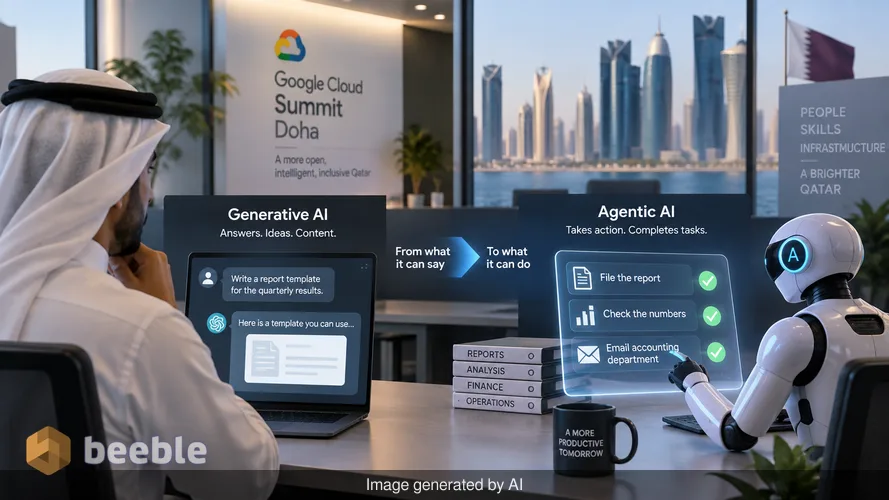
While many users view artificial intelligence as a sophisticated search engine or a creative partner for writing emails, the reality in the enterprise sector is far more active. The novelty of chatbots that can rhyme or summarize long articles is wearing off. In its place, a new phase of technology is arriving that cares less about what it can say and more about what it can do. This shift from generative AI to agentic AI was the central theme at the recent Google Cloud Summit in Doha, marking a point where software moves from being a library assistant to a logistics coordinator.
For the average professional, this change is the difference between asking a tool for a template and having that tool actually file the report, check the numbers, and email the accounting department. As Qatar expands its digital infrastructure and skilling programs, the focus is moving toward autonomous systems that handle the heavy lifting of business processes. This transition is not just a technical upgrade. It is a fundamental change in how humans and machines interact in the workplace.
The difference between talking and doing
To understand this shift, we have to look under the hood of how these systems function. Generative AI is essentially a high-speed content engine. You give it a prompt, and it uses large language models to create something new, whether that is a paragraph of text or a digital image. It is reactive and remains stationary until you give it the next instruction. It stays within the bounds of the conversation window.
Agentic AI operates on a different logic. Instead of just generating a response, an AI agent is designed to navigate a workflow. Alex Rutter, Managing Director of Google Cloud’s AI business for EMEA, describes this as a focus on the business process. If generative AI is a writer, agentic AI is a project manager. It has the ability to look at a goal, break it down into steps, and interact with different software systems to finish those steps. It does not just tell you that your invoices are due. It logs into the portal, verifies the vendor details, checks the payment history, and flags discrepancies for a human to review.
| Feature | Generative AI | Agentic AI |
|---|---|---|
| Primary goal | Creating new content | Executing multi-step tasks |
| Typical output | Text, images, code | Completed workflows, updated databases |
| Interaction style | Turn-based chat | Autonomous navigation of systems |
| Human role | Direct prompter and editor | Manager and exception handler |
| Best use case | Drafting emails or brainstorming | Auditing accounts or managing supply chains |
Why Qatar is building a digital testbed
This shift requires more than just clever code. It needs massive physical infrastructure and a workforce that knows how to use it. At the Doha summit, Google Cloud marked three years of its local cloud region by announcing a national skilling program with the Qatar Digital Academy. The goal is to provide 50,000 learning opportunities by 2030. This initiative target workers and executives who will soon find themselves managing these autonomous agents.
Ghassan Kosta, Regional General Manager for Google Cloud, noted that the company is doubling down on services to accommodate this new era. Agentic AI is data-hungry and requires low-latency connections to function across different enterprise systems. You cannot have an agent managing a real-time supply chain if the data center is thousands of miles away. By building this capacity locally, Qatar is positioning itself as a laboratory for these advanced systems. An innovation lab developed by the Ministry of Communications and Information Technology (MCIT) in partnership with Google Cloud is already testing these projects. Amna Al-Kaabi, Head of Emerging Technologies at MCIT, says the focus is on moving projects from simple proofs-of-concept to real-world implementations that solve specific sector needs.
The invoice test and the human safety net
One of the most practical examples of agentic AI in action is invoice reconciliation. In a large corporation, this task is often a repetitive grind. A worker must open an invoice, find the corresponding purchase order in a different system, verify that the goods were received, and then approve the payment in a third system. It is a high-volume, low-complexity task that is prone to human error due to boredom.
An AI agent is built for this exact scenario. It can bridge the gap between different databases, moving information from one to the other without getting tired. However, this autonomy introduces new risks. If an agent makes a mistake in a database, it can trigger a chain reaction of financial errors. This is why Alex Rutter and the team at Google Cloud advocate for keeping a human in the loop. The strategy is to have the AI handle the 95% of cases that are standard and clear. The human staff then only looks at the exceptions — the invoices that do not match or the suppliers that are new. This approach changes the job from data entry to data auditing.
The rise of the agent manager
The most common question regarding this shift is what happens to the people who currently do that repetitive work. The transition to agentic AI suggests that job descriptions are about to become more complex. Rutter expects a new hierarchy to emerge in the office. We are moving toward a structure where some people manage other people, while others manage fleets of AI agents. A third group will likely manage both together.
From a consumer standpoint, this means the skills that were valuable five years ago are changing. Being able to type fast or use a specific software interface is becoming less important than understanding the logic of a business process. If you can describe exactly how a task should be done, you can manage an agent to do it. The manager of the future is someone who can provide the guardrails and oversight for autonomous software. This is a shift from being the engine of the company to being the steering wheel.
Risks and the tolerance for error
Not every industry is ready to hand the keys to an AI agent. The level of oversight required depends heavily on the stakes of the task. In the medical field, an agent might help a clinician sort through patient records or flag potential drug interactions, but it should not be making final diagnostic decisions. The risk of a hallucination or a logic error is too high when human health is involved. Organizations have to define their own tolerance for risk before deploying these systems.
In heavy industry or finance, the cost of an error is measured in dollars or physical safety. This makes the testing phase in environments like the MCIT innovation lab in Qatar essential. Companies need to see how these agents behave when they encounter unexpected data or system outages. The goal is to create systems that are resilient enough to handle the messiness of the real world, which is rarely as clean as a training dataset.
What this means for your daily habits
Practically speaking, the arrival of agentic AI will first appear in the apps and services you use for work. You will likely see fewer "chat with us" boxes that just spit out links to FAQ pages and more tools that can actually solve your problem. If you lose a flight booking, a future AI agent won't just tell you the cancellation policy. It will check for alternative flights, compare the prices, and offer to rebook you in a single step.
For the individual professional, the move to agentic AI is a signal to stop focusing on the mechanics of tasks and start focusing on the outcomes. The value is no longer in the ability to move data from Point A to Point B. The value is in knowing why that data needs to move and how to verify that it arrived correctly. As these agents become the invisible backbone of the digital economy, the most successful workers will be those who can treat AI as a tireless intern that still needs a smart boss to check the work.
Ultimately, the phase of AI that just answers questions is ending. The phase where AI joins the workforce as an active participant is beginning. Whether this leads to a massive boost in productivity or a new set of digital headaches depends on how well we design the oversight systems today.
Sources:
Google Cloud Official Press Release, Doha Summit 2026.
Euronews Technology Analysis: Agentic AI in the Middle East.
Qatar Ministry of Communications and Information Technology (MCIT) Emerging Technology Report.
Google Cloud EMEA AI Strategy Briefing by Alex Rutter.



See you on the other side.
Our end-to-end encrypted email and cloud storage solution provides the most powerful means of secure data exchange, ensuring the safety and privacy of your data.
/ Create a free account
