


Why your next laptop might be an AI powerhouse that you cannot actually use

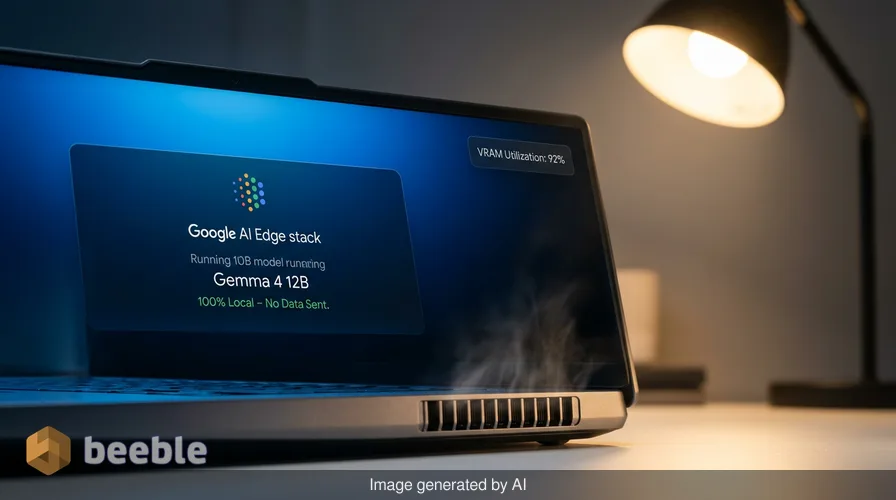
While the tech world promises that local AI is the ultimate fix for privacy and high cloud bills, the reality is a much more expensive trade-off. Google recently launched tools to run agentic AI workflows on everyday laptops using Gemma 4 12B. This 12-billion-parameter model comes from Google DeepMind and works with the Google AI Edge stack. It allows developers to build applications that process data, generate visual insights, and even create webpages without sending a single byte to a remote server.
On the surface, this is a victory for the average user. Your data stays on your device. The software is responsive because it does not wait for a data center thousands of miles away to think. However, the hardware inside the computer you bought last year is likely not strong enough to handle this new era of local intelligence. Moving AI from the cloud to your laptop is like moving a massive library into your home office. You have the books right there, but you have to pay the rent for the extra space and buy all the shelves yourself.
Moving the brain of the operation to your desk
Google designed Gemma 4 12B as a middle-ground model. It is large enough to handle complex logic but small enough to fit on portable hardware. The company also released the Google AI Edge Gallery for macOS. This allows developers to use the model to generate and run scripts for data analysis. Another addition is the Eloquent app, which provides voice dictation and editing that happens entirely on the device. It transcribes and edits text using local processing power.
To make this work, Google expanded LiteRT-LM, which is a lightweight command-line tool. It now has a serve command that turns a standard laptop into a local AI server. This allows other apps on the machine to talk to the AI model through a local endpoint. Practically speaking, this means a user can have a digital intern living inside their machine. This intern can look at a spreadsheet, write a summary, and draft an email based on that summary without an internet connection.
The high price of hardware memory
The biggest hurdle for this technology is not the code. It is the physical components inside the machine. Rishi Padhi, a Principal Analyst at Gartner, points out that enterprise IT infrastructure is largely unprepared for this shift. Even a highly optimized model like Gemma 4 12B requires roughly 16GB of unified memory or VRAM to run alongside other applications.
In the world of professional laptops, 8GB or 16GB of RAM is still the standard for many workers. If the AI model takes up 16GB just to exist, there is no room left for a web browser, a video call, or a presentation app. Most standard-issue laptops lack the memory bandwidth and specialized AI chips, known as NPUs, required for smooth performance. For the average user, trying to run a local agent on a 2024-era machine would result in a sluggish experience that drains the battery in record time.
A hidden gap in digital security
When AI stays local, many people assume it is automatically safer. While it prevents data leaks to third-party cloud providers, it creates a new set of headaches for company security teams. Agentic AI is different from a simple chatbot because it takes actions. It can write scripts, move files, and interact with other software. If a local model has access to an employee's sensitive files, it creates a risk that is hard to monitor.
Auditing becomes a major problem when the AI is offline. Companies usually track how employees use AI by looking at cloud logs. If the work happens entirely on a laptop, those logs are harder to capture. Rishi Padhi notes that sandboxing these agents—essentially putting them in a digital cage so they cannot cause harm—often breaks their ability to be useful. Without a way to track model drift or ensure compliance, many large organizations will be hesitant to let these local agents run wild on employee devices.
Swapping monthly bills for expensive hardware
Running AI locally is often framed as a way to save money. Cloud companies charge for every single word an AI generates. Moving that work to a laptop removes those variable monthly bills. However, this is simply a shift from operating expenses to capital expenses. Instead of paying a subscription, a company must now spend thousands of dollars more on every single laptop it buys.
This trend arrives at a difficult time for IT budgets. Many businesses already spent a lot of money in 2025 to refresh their PC fleets for Windows 11. Asking them to buy another round of premium, high-memory AI PCs just one or two years later is a tough sell. Hardware prices are already rising due to high demand for memory chips. This memflation means the price of a mid-range laptop is creeping toward the price of what used to be a high-end workstation.
Where local AI actually makes sense
Local AI will not replace the cloud. Instead, the two will work together based on the specific needs of a task. Anand Joshi, an AI analyst at TechInsights, suggests that local agents will handle tasks that require high privacy or very fast response times. If you are editing a video or analyzing a private financial document, you want the AI to work on your machine.
Conversely, if you need to search the entire internet or query a massive corporate database, the cloud is still the better tool. A laptop can usually only run one instance of a model at a time. A data center can run thousands. The market is still figuring out where the line is between these two worlds. In the next two or three years, we will likely see a split where simple text generation stays in the cloud, but deep file analysis moves to the edge.
What this means for your next tech purchase
For the average consumer or office worker, the release of Gemma 4 12B is a signal to stop buying laptops with 8GB of RAM. In the very near future, 32GB will likely become the new baseline for anyone who wants to use AI tools effectively. If you buy a machine with low memory today, you are essentially locking yourself out of the next wave of software features.
Looking at the big picture, the push toward local AI agents is a fundamental change in how we relate to our computers. We are moving away from the era where the laptop was just a window into the internet. It is becoming a standalone brain. But as with any major upgrade, the cost of that brain is a bill that the user has to pay upfront.
Ultimately, you should observe your own habits before chasing the local AI trend. If you spend most of your time in a web browser, you do not need an expensive AI PC yet. But if you work with sensitive data or need to automate complex tasks while offline, the hardware requirements for models like Gemma 4 are the new reality of modern computing.
Sources: Google DeepMind, Gartner Market Research 2026, TechInsights AI Hardware Report.



See you on the other side.
Our end-to-end encrypted email and cloud storage solution provides the most powerful means of secure data exchange, ensuring the safety and privacy of your data.
/ Create a free account
