


Why your next roommate might be a hundred-pound machine in a panda suit

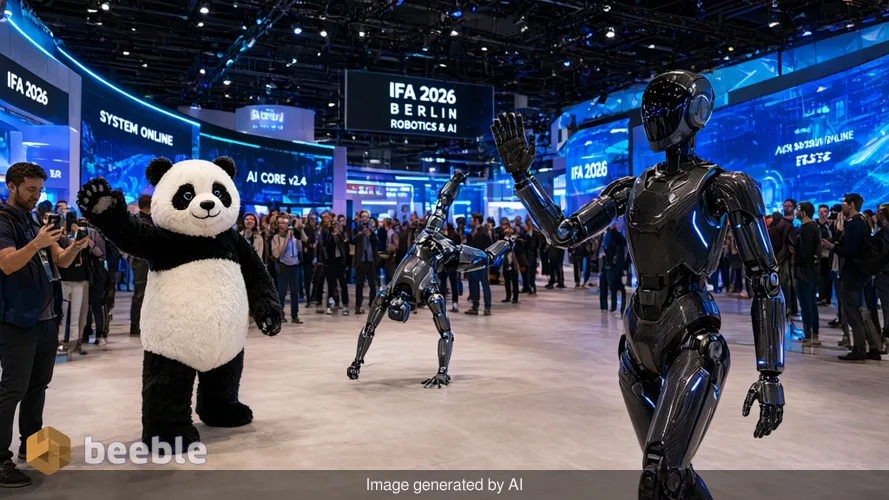
Would you trust a machine to handle your morning coffee and your delicate laundry? This question moved from science fiction to the trade show floor this week at IFA 2026 in Berlin. While past years focused on thinner televisions and faster air fryers, the current exhibition halls are full of machines that walk on two legs and wave at passersby. Some wear sleek carbon fiber shells while others sport oversized panda costumes to appear more approachable.
Behind the spectacle of robots performing backflips for crowds, a serious industrial shift is happening. The technology has reached a point where humanoid machines are no longer just laboratory experiments or expensive toys for tech billionaires. They are emerging as a new category of home appliance. Leif Lindner, the CEO of IFA Management GmbH, noted that robotics joined artificial intelligence as a primary focus for this year's event. The development speed is high, and the distance between a trade show demo and a living room floor is shrinking.
The tireless intern in the laundry room
Practically speaking, the most impressive feat at IFA 2026 was not a high-speed backflip. It was a robot carefully picking up a wrinkled shirt and placing it in a basket. For a human, this task is mindless. For a robot, it requires a massive amount of data processing. A machine must understand the friction of the fabric, the weight of the cloth, and the specific way a sleeve behaves when gravity takes over.
In simple terms, AI acts as a tireless intern for these machines. Older robots followed strict scripts. If an object moved one inch to the left, the robot failed. The new generation uses physical AI to see and react to the world in real time. When a visitor at the Figure AI booth threw a towel onto a table, the robot paused, recalculated its path, and grabbed the corner of the fabric without a manual reset. This ability to handle messy, unpredictable environments is the foundational requirement for any machine intended for the home.
Historically, robotics focused on the factory floor where everything is bolted down and predictable. Bringing that same precision to a home with pets, children, and scattered shoes is a much harder problem. The robots at IFA 2026 show that we are closer to solving this than most people realize. The sensors in their fingertips now have enough sensitivity to detect the difference between a glass bottle and a plastic cup. This tactile feedback prevents the machine from crushing the very objects it is supposed to clean.
Why the backflip matters for your kitchen
It is easy to dismiss a robot doing a backflip as a publicity stunt. The Unitree and Boston Dynamics displays drew the largest crowds, mostly because people enjoy seeing machines mimic Olympic athletes. However, the engineering required for a 130-pound machine to launch itself into the air and land safely is exactly what makes it useful in a house.
Balance is the invisible backbone of mobile robotics. A robot that can land a backflip is a robot that can navigate a narrow hallway or step over a vacuum cleaner without falling. If a machine falls in a factory, a technician fixes it. If a humanoid robot falls in your kitchen, it could break your furniture or injure a family member. The high-energy stunts at IFA are a way for companies to prove their balance algorithms are resilient.
Looking at the big picture, these movements demonstrate the power of modern actuators. Actuators are the motors that act like digital muscles. To perform a backflip, these motors must release a massive amount of energy in a fraction of a second and then immediately switch to a mode that absorbs the impact of the landing. This same technology allows a robot to walk up a flight of stairs while carrying a heavy tray of dishes. The power density of these parts has increased by nearly 40% over the last two years, which allows for smaller, lighter machines that do not look like industrial cranes.
The panda suit and the problem of trust
Curiously, several companies chose to dress their high-tech machines in soft costumes. One Chinese manufacturer presented a humanoid in a full panda suit that spent the afternoon hugging children and posing for photos. This is a deliberate strategy to solve the uncanny valley problem. This term describes the eerie feeling humans get when a robot looks almost — but not quite — like a person.
From a consumer standpoint, trust is the biggest barrier to adoption. Most people are comfortable with a disc-shaped vacuum that bumps into their baseboards. They are less comfortable with a six-foot-tall metallic figure walking through their bedroom at night. By adding soft textures and friendly faces, companies hope to make these machines feel like members of the household rather than pieces of heavy equipment.
Under the hood, these social robots are testing communication layers. They use large language models to understand spoken commands. You do not program them with code. You tell them to go to the kitchen and find the blue mug. The machine must then identify the room, locate the specific object, and understand the context of the request. At IFA, these interactions were mostly smooth, though some robots still struggled with the background noise of a crowded exhibition hall. The bottom line is that the hardware is currently ahead of the social software. We can build a machine that walks, but making it a pleasant companion is a work in progress.
The cost of a digital butler
Zooming out to the market side, the question of price remains the most significant hurdle for the average user. A high-end humanoid robot currently costs as much as a luxury car. Tesla and Figure have both stated their goals to bring prices down to the level of a mid-sized sedan, roughly $20,000 to $30,000, within the next few years.
| Feature | 2024 Generation | 2026 Generation (IFA) |
|---|---|---|
| Battery Life | 60 - 90 minutes | 4 - 6 hours |
| Hand Degrees of Freedom | 6 to 11 | 16 to 22 |
| Primary Interface | Tablet/App | Natural Voice |
| Price Range | $100k - $250k | $50k - $90k |
| Task Capability | Single-task demo | Multi-task autonomous |
For most households, this price is still too high for a machine that mostly folds laundry. However, the economics change when you consider the aging population in Europe and East Asia. These robots are not just for folding shirts. They are being positioned as care assistants. They can help a person stand up, remind them to take medication, and provide a basic level of monitoring. When viewed as a medical or safety device, the price tag becomes more justifiable for families caring for elderly relatives.
Conversely, the decentralized nature of the supply chain is helping to lower costs. Five years ago, every company had to build their own sensors and motors from scratch. Today, there is a growing market for standardized robot parts. This is similar to how the smartphone industry matured. Once the screens and batteries became cheap, generic components, everyone could build a decent phone. We are seeing the same trend in robotics, where the digital crude oil of specialized sensors is becoming a mass-produced commodity.
Practical foresight for your home
What this means for you is that the robot revolution will likely happen in stages. You will not wake up tomorrow with a mechanical butler. Instead, you will see these technologies appear in specific, specialized tools. Your next vacuum might have a single robotic arm to pick up socks. Your lawnmower might use the same balance sensors seen at IFA to navigate steep hills.
Ultimately, the humanoid form is a choice based on the fact that our world is built for humans. Our stairs, door handles, and cupboards are designed for creatures with two legs and two hands. Rather than rebuilding our houses to accommodate machines, we are building machines to accommodate our houses.
As a consumer, you should observe the development of battery density and voice recognition over the next twelve months. The robots at IFA 2026 proved they have the physical ability to work in our homes. The next step is proving they have the digital intelligence to stay there without being a nuisance. You should expect the first wave of truly useful home humanoids to enter the market by late 2027. These early models will focus on repetitive chores and basic security. They will be expensive, they will be heavy, and they will occasionally get stuck in a corner. But as the displays in Berlin showed, the days of the backflipping panda are just the beginning of a much larger shift in how we manage our daily lives.
Sources:
IFA Management GmbH Official Press Release 2026
Figure AI Hardware Specification Sheet
Unitree H1 Evolution Report
Tesla Investor Day Robotics Update



See you on the other side.
Our end-to-end encrypted email and cloud storage solution provides the most powerful means of secure data exchange, ensuring the safety and privacy of your data.
/ Create a free account
