


Why your next supercomputer will run on salt water and DNA

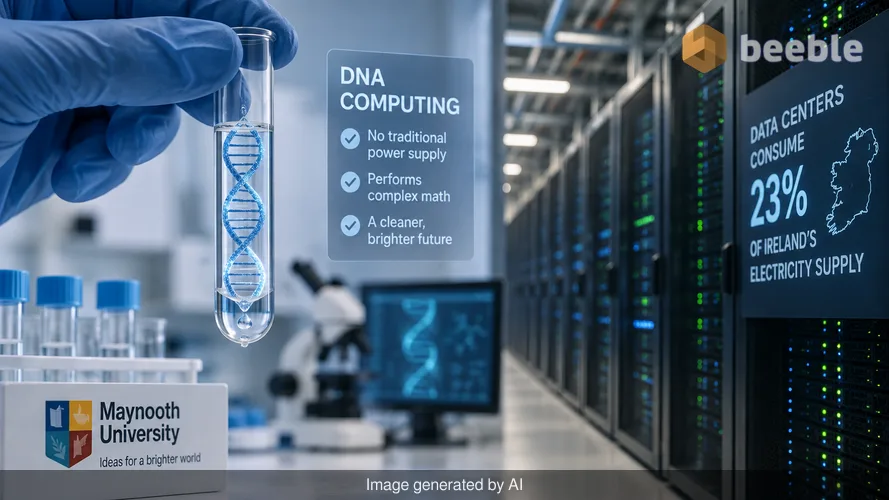
Could a few drops of water in a test tube eventually replace the hum of a massive, electricity-hungry data center? It sounds like the plot of a science fiction novel, yet researchers at Maynooth University recently demonstrated that this is a tangible scientific reality. The team has built a world-first DNA computer that performs complex math without a traditional power supply.
We have long viewed the silicon chip as the digital crude oil of the modern age. It powers everything from your toaster to the servers that host your social media feeds. However, this reliance comes at a steep price. Silicon-based computing is an energy glutton. In Ireland, data centers and storage facilities now consume 23% of the national electricity supply. As we push for more artificial intelligence and larger data sets, the current hardware model is hitting a wall. The breakthrough at Maynooth University offers a different path, using the basic building blocks of life to process information.
How a liquid computer finds the right answer
Traditional computers work by moving electrons across tiny gates on a silicon board. The DNA computer developed by Professor Damien Woods and his team at the Hamilton Institute operates on a completely different set of rules. Instead of electricity, this system uses chemistry. The researchers start with a small droplet of water and salt. They add short pieces of DNA and a longer DNA scaffold into a test tube.
To start the computation, the mixture needs a small amount of heat. As the liquid cools, the DNA strands begin to interact. They do not just float around aimlessly; they are programmed to bind together in specific ways. Dr. Abeer Eshra, a lead researcher on the project, explains that trillions of DNA strands in a single drop work together. The molecules form a physical structure, and that finished structure is the mathematical answer.
This process is essentially a form of self-assembling logic. Imagine a box of Lego bricks that can only snap together if they solve a math problem correctly. You shake the box, and when you open it, the bricks have formed the number 13 because that was the sum of the equation you gave them. In the Maynooth experiment, the team ran ten different programs, including addition and division. They successfully performed 100-bit computations, which is a level of complexity rarely seen in molecular computing.
The trade-off between speed and efficiency
For the average user accustomed to instant results, the speed of DNA computing might seem underwhelming at first. When the team asked the system to add 10 and 3, it took 30 seconds. A more complex calculation involving numbers between 11 million and 34 million took 14 hours to complete. Your smartphone could do this in a fraction of a millisecond.
However, comparing a DNA computer to a gaming laptop misses the point of the technology. The goal is not to win a sprint; the goal is to move a mountain of data with almost zero energy. Once the initial heat kick-starts the reaction, the DNA molecules find the answer naturally without needing a constant stream of power. This makes the system incredibly energy-efficient.
Furthermore, this specific DNA computer is the fastest of its kind. While it is slower than silicon, it is much faster and more durable than previous biological computers. The team proved the system is reusable, performing 25 different calculations in a row. This resilience is a departure from older molecular systems that often broke down after a single use.
| Feature | Silicon Computing | DNA Computing |
|---|---|---|
| Energy Source | Continuous electricity | Chemical bonds / slight heat |
| Storage Density | Moderate | Extremely high |
| Speed | Nanoseconds | Seconds to hours |
| Operating Environment | Dry, cooled hardware | Liquid droplets |
| Longevity | 5-10 years (hardware) | Thousands of years (data) |
Why the tech industry is looking at test tubes
Practically speaking, we are seeing the emergence of a new tier of infrastructure. The €4 million DISCO project, led by Professor Woods and supported by the European Innovation Council, is looking at how to bridge the gap between these test-tube experiments and real-world storage. DNA is an incredibly dense medium for saving information. You could theoretically store all the world's digital data in a few liters of DNA liquid.
Looking at the big picture, this technology addresses the systemic problem of data decay. Hard drives and magnetic tapes degrade over decades. DNA, if kept in the right conditions, stays readable for thousands of years. We have successfully sequenced DNA from woolly mammoths that died eons ago. We cannot say the same for a USB stick left in a drawer for twenty years.
On the market side, this shift could change how companies approach long-term archiving. Instead of massive warehouses filled with humming, heat-generating servers, a company might store its historical records in a stable, cold-storage biological format. It is a slow-burn solution for a world that produces more data than it knows how to keep.
From test tubes to the human body
Beyond data centers, the most disruptive potential for this research lies in medicine. Because this computer is made of the same material as our own genetic code, it is naturally compatible with biological systems. Professor Woods suggests that, in time, molecular systems could operate inside living cells.
In everyday life, this might look like a smart diagnostic tool that lives in your bloodstream. A DNA-based computer could be programmed to detect the chemical signatures of a disease, perform a logic check to confirm the diagnosis, and then trigger the release of a specific protein to treat the issue. This is a level of precision that traditional silicon hardware cannot achieve because you cannot easily put a microchip inside a single cell without damaging it.
This is why the Maynooth University research is so significant. It moves DNA computing out of the realm of abstract theory and into a functional, programmable reality. The team has shown that biological hardware is not just a curiosity; it is a scalable technology that can handle multi-step logic.
The bottom line for consumers
What this means for you today is a shift in how we think about the future of the internet. We are currently in a cycle where every tech advancement requires more power and more cooling. The Maynooth team is challenging that trajectory. They are proving that computing can be quiet, wet, and energy-neutral.
We are unlikely to see "DNA Inside" stickers on our laptops anytime soon. Silicon will remain the king of high-speed tasks like video editing, gaming, and real-time communication. However, the foundational layers of our digital world—the archives, the medical diagnostics, and the long-term data storage—are prime candidates for a biological takeover.
Ultimately, this research invites us to appreciate the invisible industrial mechanics that keep our digital lives running. We are used to computers being rigid, hot, and electric. As we look toward the end of the silicon era, the most advanced machines on the planet might turn out to be the ones that look the most like us.
Sources
- Nature: "A programmable and reusable DNA computer for 100-bit computations"
- Maynooth University Hamilton Institute: DNA-based infrastructure for Storage and Computation (DISCO) project reports
- European Innovation Council: Grant announcements for molecular computing research
- Ireland Sustainable Energy Authority: Data center energy consumption reports 2024-2026



See you on the other side.
Our end-to-end encrypted email and cloud storage solution provides the most powerful means of secure data exchange, ensuring the safety and privacy of your data.
/ Create a free account
