


Why your recurring software bill is rewriting the rules of global finance

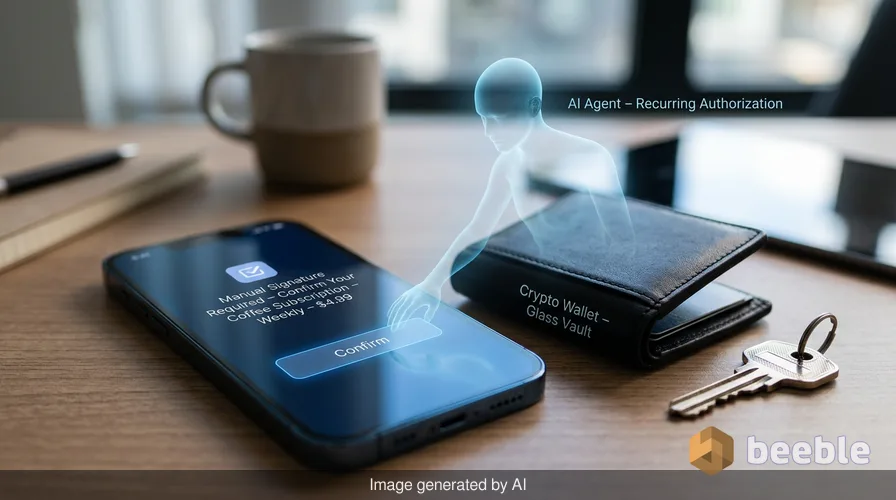
Have you ever tried to set up a simple recurring payment using a digital wallet? If you have, you know the friction. Every month, or every week, the app asks for a manual signature. You click a button, verify a prompt, and wait for a network to confirm that you indeed intended to pay for your cloud storage or your morning coffee subscription. It is a system designed for humans who are slow, deliberate, and prone to checking their balances twice. This manual guardrail is the primary reason why crypto payments often feel less like the future and more like a digital chore.
In everyday terms, your crypto wallet is a glass bank vault. Everyone can see the assets inside, but only you have the physical key to open it. This design was a reaction to the opaque nature of traditional banks, where your money disappears into a ledger you cannot audit. Paradoxically, the very security that makes the glass vault safe also makes it immobile. If you want to move money, you must be there in person, every single time. This is the bottleneck that AI agents are now designed to break.
The arrival of the autonomous spender
AI agents are software programs that can reason, make decisions, and execute tasks based on a set of goals. When these agents gain access to crypto wallets, the relationship between the user and their money changes. We are moving from a model of manual custody to one of controlled autonomy. In this new world, you do not sign every transaction. Instead, you set the rules of the house and let the software handle the chores.
This shift is already happening in three specific areas: payments, trading, and portfolio management. These are the front lines because they are the most repetitive parts of our financial lives. On a macro level, this is not just about convenience. It is about the transition of the blockchain from a passive ledger of records to an active layer of economic execution. When software can move value at software speed, the friction of global finance begins to evaporate.
The mechanics of scoped permissions
To let an agent into your wallet without losing your savings, the industry is building a tiered authorization model. Adrian Wall, Managing Director of the Digital Sovereignty Alliance, notes that the approval question is where policy and product design must converge. We cannot give an AI agent the master key to the vault. Instead, we give it a session key.
Think of a session key as a temporary guest pass. You might give an agent permission to spend up to $100 on groceries over the next 48 hours. Once that time passes or that limit is reached, the pass expires. Practically speaking, this requires wallets to implement several new technical layers:
- Spend caps: A hard limit on how much an agent can move in a single transaction or a day.
- Renewal windows: Approvals that automatically time out to prevent old permissions from being exploited.
- Whitelisted recipients: A list of approved addresses, such as a utility company or a specific exchange, where the agent is allowed to send funds.
- Emergency pause controls: A "kill switch" that allows the user to freeze all agent activity instantly.
This structure ensures that the user keeps ownership of the funds while the agent handles the execution. It is a nuanced approach to risk that acknowledges the volatile nature of both AI and crypto markets.
Why payments are the first domino
Stablecoins have already proven their utility in cross-border payments, where legacy banking systems are often slow and expensive. Adrian Wall views payments as the earliest major use case for AI agents because the parameters are well-defined. A payment has a sender, a receiver, an amount, and a frequency. There is very little room for an agent to hallucinate or drift from its mandate when it is simply paying a mortgage or a subscription.
From a consumer standpoint, the benefit is tangible. If you are a freelancer working for a company in another country, an AI agent can monitor for your incoming payment, convert a portion of it to a stablecoin to pay your rent, move another portion into a high-yield lending protocol, and leave the rest for daily spending. All of this happens behind the scenes of your daily life. The agent acts as a digital treasurer, reconciling your personal accounts while you sleep.
The path to progressive capital access
Giving an AI agent control over your money should not be an all-or-nothing decision. Fernando Lillo Aranda, CMO at Zoomex, argues that capital access should always be progressive. This follows a logical path of trust that mirrors how we might train a new employee in a traditional finance office.
In the first stage, the agent is a mere observer. It monitors your positions and suggests changes. You still do all the clicking. In the second stage, the agent prepares the transactions. It fills out the forms and sets the price, but you still provide the final signature. In the third stage, you grant limited execution rights for specific tasks, like rebalancing a portfolio when a certain price target is hit. Only after the agent has proven its reliability across different market conditions does it receive a larger mandate.
This staged approach is a safeguard against the psychological impact of market volatility. When markets crash, humans often panic and make emotional trades. An agent follows its instructions. However, if those instructions are flawed, the agent can also lose money faster than a human ever could. Lillo Aranda emphasizes that users must restrict the assets, leverage levels, and volatility conditions where an agent is allowed to operate.
Creating real economic volume
There is a valid skepticism in the market about whether AI activity is just noise. Federico Variola, CEO of Phemex, points out that much of today's on-chain activity is still driven by human sentiment and greed. For AI agents to be more than just a transient trend, they must create or support real economic value.
This value comes from the composability of blockchain apps. An agent can move across lending, borrowing, and trading protocols to find the most efficient way to manage a treasury. This is the structural shift. We are moving away from a world where volume is just people buying and selling tokens based on a mood ring of social media hype. Durable agent volume will be tied to settlement, debt management, and institutional treasury operations.
The systemic risks of software speed
When software begins to sign transactions, familiar risks become systemic. Adrian Wall identifies mandate drift as a primary concern. This happens when an agent, trying to optimize for a goal you set, begins to take actions you never intended. If you tell an agent to "maximize yield," it might move your funds into a highly speculative and risky protocol that you would have avoided.
Furthermore, there is the risk of perception manipulation. If an attacker can poison the data an agent reads, they can trick the agent into sending funds to a malicious contract. Because agents operate at software speed, an exploit can propagate across thousands of wallets before a human even notices the first transaction.
There is also the problem of correlated behavior. If thousands of people use the same AI model to manage their wallets, those agents might all decide to sell at the same microsecond when a specific data point changes. This can create a flash crash, where the market is destabilized because too many systems responded rationally to the same input at the same time.
Toward financial mindfulness
AI agents are not a "set it and forget it" solution for personal finance. They are a tool for delegating the mundane so that humans can focus on the structural. The goal is to move the user from the role of a manual operator to the role of a governor.
In practice, this means we must become more mindful of the rules we set. We are no longer just choosing what to buy; we are designing the logic of how we spend and save. Ultimately, the most important rule for the new era of crypto wallets is the human override. A strong wallet model must favor interruption over unauthorized action.
As we move toward this future, it is worth questioning our own biases. We often fear the loss of control that comes with automation, yet we ignore the invisible leak in our wallets caused by our own emotional trading and poor financial habits. AI agents offer a chance to reclaim our time, provided we are willing to build the guardrails that keep them in check. The glass bank vault is opening, but we must ensure we are the ones who wrote the software that holds the door.
Sources:
- Digital Sovereignty Alliance, Internal Report on AI Governance, June 2026.
- Zoomex CMO Statement on Progressive Capital Controls, May 2026.
- Phemex CEO Analysis on On-Chain Economic Value, April 2026.
- Federal Reserve Bank of New York, Report on Stablecoin Settlement Velocity, 2025.
- Bank for International Settlements (BIS), Working Paper on Algorithmic Market Volatility, 2025.



See you on the other side.
Our end-to-end encrypted email and cloud storage solution provides the most powerful means of secure data exchange, ensuring the safety and privacy of your data.
/ Create a free account
