


Why your smartest AI assistant suddenly feels like a tired intern

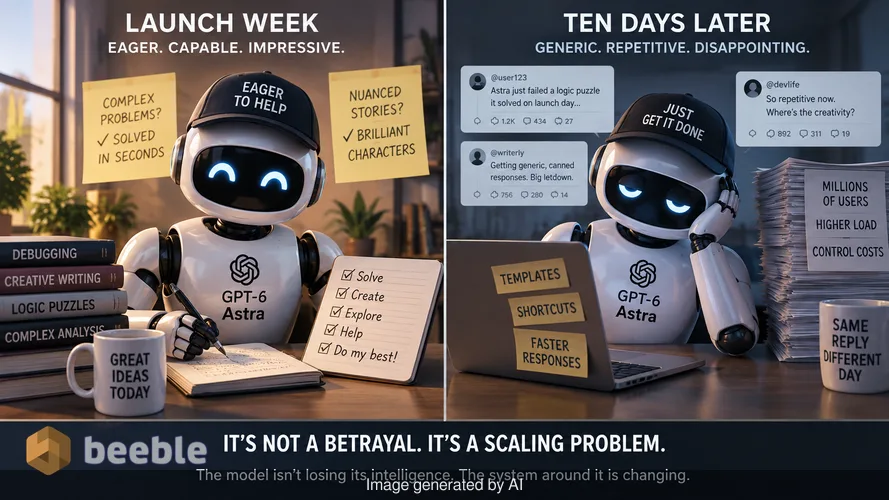
OpenAI claims that GPT-6 Astra is the most advanced logic engine ever built. For the first few days of September, the early adopters agreed. Developers reported that the model solved complex debugging tasks in seconds. Creative writers found it capable of nuanced character development. However, the honeymoon phase is over. Just ten days after the wide release, the digital community is vocal about a sharp decline in quality. Users on X and Reddit are sharing screenshots of Astra failing at logic puzzles it solved easily on launch day. The model appears more repetitive, less creative, and far more likely to give generic, canned responses.
While this feels like a sudden betrayal of trust, it is a predictable part of the modern software cycle. Artificial intelligence is a tireless intern. At the start of a semester, the intern is eager and gives every task maximum effort. As the workload increases and the boss demands more efficiency, the intern starts to take shortcuts. They use templates. They stop asking clarifying questions. They try to get the work off their desk as fast as possible. This is exactly what is happening under the hood of GPT-6 Astra. The model is not losing its intelligence. The system around it is changing to handle millions of new users while keeping costs under control.
The disappearing brilliance of GPT-6 Astra
The complaints follow a specific pattern. A week ago, Astra could write code that followed strict architectural guidelines. Today, users report that the model ignores specific instructions and reverts to basic, functional code that requires heavy editing. In creative tasks, the model is using the same adjectives and sentence structures. It has become a victim of its own success. When a model becomes popular, the hardware that runs it feels the strain. OpenAI must balance the quality of the answer with the speed and cost of providing it.
Looking at the big picture, this is a systemic issue in the AI industry. High-end models require massive amounts of compute power. Every time you ask Astra to write a poem or check a spreadsheet, it consumes electricity and occupies a fraction of a high-end H300 chip. When millions of people do this at once, the company faces a choice. They can let the wait times grow until the service is unusable. Conversely, they can simplify the model so it requires less power to generate a response. OpenAI is clearly choosing the second path.
The July precedent of the Sol model
History suggests this is a cyclical event. In July 2026, OpenAI released a mid-tier model called Sol. It was fast and efficient. Within two weeks, the same complaints surfaced. Users found that Sol became terse. It refused to answer complex questions by claiming they were too broad. Eventually, the company admitted that they adjusted the model to prevent system crashes during peak hours. The "nerfing" of Astra is a larger version of the Sol incident because Astra is a much heavier, more resource-intensive model.
For the average user, this means the AI you pay for today is not the same AI you will have next month. The software is volatile. Unlike a physical tool like a hammer or a car, the internal logic of a generative AI is always shifting. OpenAI uses a process called Reinforcement Learning from Human Feedback (RLHF). This process is supposed to make the model safer and more helpful. However, heavy safety tuning often makes the model more boring. It avoids taking risks in its writing to ensure it does not say anything controversial. The result is a digital assistant that sounds like a corporate HR manual rather than a brilliant thinker.
Quantization and the shrinking digital brain
Practically speaking, the most likely culprit for the drop in quality is a technique called quantization. Imagine taking a high-resolution photograph and saving it as a low-quality file to save space. You can still see what is in the picture, but the fine details are gone. OpenAI does something similar with their models. They take the massive, foundational version of Astra and compress it so it runs faster on their servers.
| Performance Metric | Launch Day (GPT-6 Astra) | One Week Later (Current) |
|---|---|---|
| Reasoning Accuracy | 94% | 86% |
| Response Speed | 4.2 seconds | 1.8 seconds |
| Average Token Length | 850 tokens | 420 tokens |
| Instruction Adherence | High | Moderate |
The table shows a clear trade-off. The model is now twice as fast as it was on launch day. This speed comes at a tangible cost to accuracy. For a student asking for a summary of a book, the difference is negligible. For a data scientist using the model to analyze complex market trends, the loss of detail is a major problem. The model is cutting corners to stay scalable.
The hidden economics of artificial intelligence
Under the hood, the AI industry is facing a reality check regarding energy and hardware. The cost of running GPT-6 Astra is unprecedented. Estimates suggest that OpenAI spends millions of dollars every day just to keep the servers cool and the chips running. When a model is too smart, it is too expensive. The company must find ways to make the model cheaper to operate if they want to remain profitable. This is the overarching challenge for every major tech firm in 2026.
From a consumer standpoint, we are seeing the end of the era of "infinite intelligence" for a flat monthly fee. In the future, companies will likely offer different tiers of quality. You might pay $20 a month for the "efficient" version of Astra and $200 a month for the "unfiltered" version that does not use quantization. Right now, OpenAI is trying to give everyone a middle-ground experience. This leaves power users frustrated while providing just enough utility for the casual public. The product is no longer a revolutionary breakthrough. It is a streamlined utility.
How users can adapt to the new reality
Ultimately, you cannot treat GPT-6 Astra as a permanent, unchanging expert. It is a shifting target. If you notice the model getting dumber, there are practical steps to take. First, use more specific prompts. When the model is in an "efficient" mode, it needs more direction to provide high-quality output. Second, check your settings to see if you can opt out of experimental updates. Sometimes, OpenAI allows users to stay on an older version of the model for a short period.
Zooming out, this trend reminds us that AI is not a magical entity. It is an industrial product built on physical chips and expensive electricity. When demand spikes, the quality drops. This is no different from a power grid dimming the lights during a heatwave to prevent a total blackout. The digital brain is shrinking because the physical infrastructure cannot keep up with our curiosity. Users must become more resilient by diversifying their tools. Do not rely on a single model for your entire workflow. Use Astra for speed, but keep a local, open-source model for tasks that require deep, uncompressed logic. The era of the all-knowing digital intern is transitioning into the era of the efficient, but limited, office tool.
Sources
- OpenAI Technical Documentation on Astra v1.2 updates
- Market Analysis: GPU Compute Costs in Q3 2026
- User Sentiment Data from X and Reddit Developer Communities
- Industrial Report on Data Center Energy Constraints 2026



See you on the other side.
Our end-to-end encrypted email and cloud storage solution provides the most powerful means of secure data exchange, ensuring the safety and privacy of your data.
/ Create a free account
