


Will a 3d printer replace your kitchen stove by 2035?

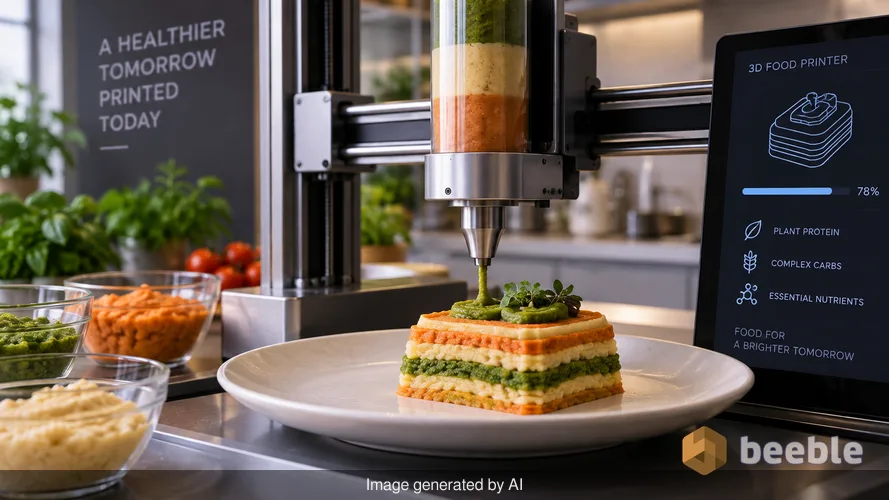
When was the last time you thought about your dinner as a digital file? For most people, cooking involves a heat source, a few pans, and a set of manual skills honed over years. However, a shift is occurring in the way we assemble nutrients. Instead of a chef with a knife, the future kitchen has a nozzle that deposits layers of food paste with mathematical precision. This is 3d food printing, a technology that has moved past the novelty of plastic toys to the serious business of human nutrition.
How a high-tech piping bag creates a meal
To understand food printing, think of a digital version of a pastry chef with a piping bag. The printer is a machine that extrudes soft ingredients through a thin nozzle, building a three-dimensional object layer by layer. The process begins on a computer where the user designs the shape. Once the file is ready, the machine takes over. Manufacturers like the Ukrainian-Bulgarian company Chocola3D and Germany-based Print2Taste have developed systems that handle more than 26 different materials. These include chocolate, cheese, meat pastes, vegetable purées, and pea protein.
There are two main ways to feed these machines. Some use closed capsule systems, which function like coffee pods. Others, like the Chocola3D, allow users to fill refillable syringes with their own ingredients. This open system gives more freedom but requires the user to figure out the correct settings for thickness and speed. The price of these units varies, with consumer models costing a few hundred euros while professional machines for industry use cost several thousand.
Mario Jekle, a food technologist at the University of Hohenheim, notes that the basic chemistry remains the same as traditional cooking. You produce a fine paste, shape it, and then apply heat. The innovation is the digital preparation. The biggest hurdle is structural. A printed steak has to be soft enough to pass through a nozzle but firm enough to be eaten with a knife and fork. This usually requires a heating step in an oven or a specialized heated printing chamber to set the proteins or fats.
Precision medicine in the shape of a heart
While the technology is slow for a busy home kitchen, it is finding a home in clinical settings. At the University Medical Center Hamburg-Eppendorf, a medical team uses 3d printing to help children undergoing chemotherapy. Many young patients struggle with the taste and size of traditional pills. The hospital prints raspberry-flavored tablets in the shape of stars and hearts, which makes the medication less intimidating.
This application is about more than just aesthetics. It allows for exact dosing tailored to a patient's weight and metabolic rate. Beate Winkler, a senior physician at the hospital, has seen how this improves patient compliance. Similarly, trials are underway for Parkinson’s disease patients who require highly specific doses of medication throughout the day. A 3d printer can mix the exact amount of active ingredients into an edible base, reducing the risk of errors that occur with manual pill splitting.
Restoring dignity to the dinner plate
Another significant application is in care homes for the elderly. Many older adults suffer from dysphagia, a condition that makes swallowing solid food difficult or dangerous. The standard solution is to purée every meal into a shapeless mush. This often leads to a loss of appetite and malnutrition because the food looks unappealing.
Nutrition scientist Dorothee Volkert at Friedrich-Alexander University Erlangen-Nuremberg investigated whether 3d printing could solve this. By printing puréed ingredients back into the shape of a sausage or a chicken thigh, researchers found that patients were more likely to eat their meals. The printer also allows caregivers to fortify the food. They can add extra protein, healthy fats, or specific vitamins into the paste without changing the volume of the meal. In these trials, participants consumed more energy and protein, which directly improved their health outcomes.
The consumer hurdle and the meat alternative market
The jump from a hospital lab to a home kitchen is not a simple one. A 1,004-person survey by Bitkom in 2025 showed that 24 percent of people in Germany are open to eating cultivated meat produced by a 3d printer. This is nearly double the interest level from six years ago. Younger people are the most receptive, with one-third of those under 50 willing to try it.
Despite this growing curiosity, price is a major barrier. Only 7 percent of consumers say they would pay more for printed meat than for conventional meat. Most see it as a luxury product for high-end catering rather than a daily tool. Margareta Maier from Bitkom points out that while the process can mimic the texture of conventional meat with a smaller ecological footprint, the high cost of specialized ingredients and the machines themselves keeps them out of the mass market.
Currently, you can find 3d-printed plant-based salmon in some major European supermarket chains. This product uses the technology to recreate the fatty layers and flaky texture of fish, something that traditional molding processes struggle to achieve. However, for the average person, printing a plant-based steak at home still takes between five and 15 minutes. That is a long time to wait for a single piece of protein when a pan can cook four steaks in the same window.
Turning industrial waste into dinner
One of the most practical reasons to support 3d food printing is its potential to reduce waste. Mario Jekle and his team at Hohenheim work with by-products from the food and agricultural industries. These are residual streams, such as the pulp left over from oil pressing or vegetable skins from canning factories. Usually, these materials are thrown away or used for animal feed.
3d printing can turn these nutrient-rich leftovers into new foods. Because the printer builds a meal according to a digital template, there is no off-cut waste. You print exactly what you need. This modular approach to food allows for a high degree of personalization. A printed meat alternative can have a much higher fiber content than traditional meat, which has no dietary fiber at all. By using raw materials that require minimal processing, the industry saves energy and lowers the cost for the end consumer.
The bottom line for your kitchen
We are at least a decade away from 3d food printers becoming as common as microwaves. The lack of a supply chain for ingredient cartridges is a major roadblock. Most consumers do not want to spend their evening cleaning a nozzle or calibrating a digital file for a piece of cheese. The technology is a specialized tool, not a total replacement for the stove.
For now, the impact will be invisible to most people. It will appear in the form of better-textured meat alternatives at the grocery store or more precise medication for a family member in the hospital. If you are a hobbyist with a few thousand euros to spare, you can experiment with chocolate designs today. For everyone else, the best way to prepare for this future is to watch how food manufacturers use these machines to handle waste and improve nutrition. The digital kitchen is coming, but it will arrive in the clinic and the factory long before it reaches your countertop.
Sources: University of Hohenheim Food Technology Department, Bitkom 2025 Consumer Survey, University Medical Center Hamburg-Eppendorf, Friedrich-Alexander University Erlangen-Nuremberg.



See you on the other side.
Our end-to-end encrypted email and cloud storage solution provides the most powerful means of secure data exchange, ensuring the safety and privacy of your data.
/ Create a free account
