


Will the End of the Phone Menu Finally Make Customer Service Less Painful?

Have you ever wondered why we still spend so much of our lives typing into small glass rectangles or shouting "Representative!" at a robotic phone menu that refuses to understand a simple request? For years, the promise of a truly conversational computer has been just over the horizon—always a little too slow, a little too literal, and far too prone to crashing when you interrupt it. We have been stuck in a digital middle ground where voice assistants can set a timer but struggle to help you rebook a flight during a storm.
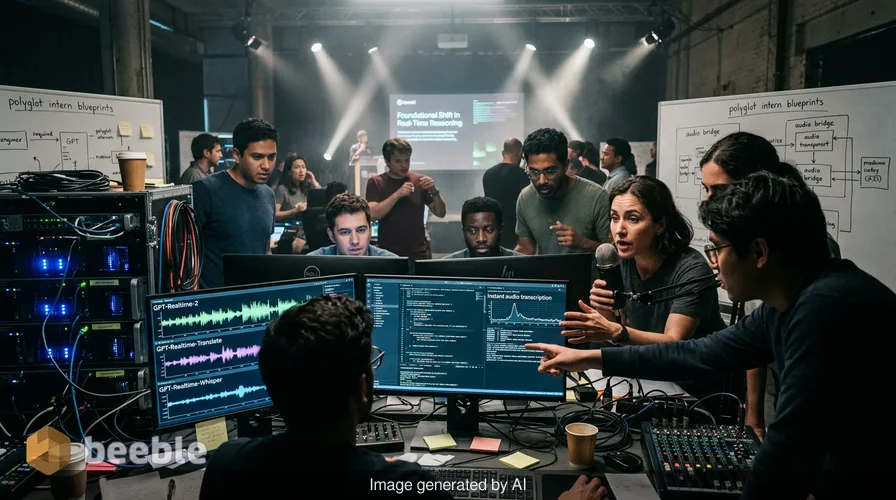
OpenAI is now attempting to bridge that gap with the launch of three new specialized audio models: GPT-Realtime-2, GPT-Realtime-Translate, and GPT-Realtime-Whisper. This isn't just another incremental update to a chatbot; it represents a foundational shift in how software "hears" and "thinks." By moving beyond simple text-to-speech and into the realm of real-time reasoning, these models aim to turn AI into something closer to a tireless polyglot intern—one that doesn't just transcribe your words, but understands the urgency in your voice.
The Reasoning Engine: Beyond the Script
To understand why this matters, we have to look under the hood at GPT-Realtime-2. Historically, voice AI has functioned like a relay race. One model would listen and turn your voice into text, a second would process that text to find an answer, and a third would turn that answer back into a robotic voice. Each hand-off created a delay—a "latency gap"—that made the conversation feel disjointed and unnatural.
GPT-Realtime-2 changes the math by integrating reasoning capabilities from OpenAI’s GPT-5 class architecture directly into the audio stream. Practically speaking, this means the AI isn't waiting for you to finish your sentence to start thinking. It can handle interruptions, acknowledge a quick "wait, let me check that," and adjust its response on the fly. This is what developers call a "voice-to-action" pattern. Instead of the AI just talking back to you, it is empowered to complete tasks in the background while the conversation is still happening.
Imagine you are calling a travel agent while walking through a busy airport. You tell the AI, "My flight was canceled, I need a hotel near the terminal, and can you check if my bags are being transferred?" In the old system, you’d be put on hold while the bot parsed each request sequentially. With this new architecture, the system can reason through these multi-step requests simultaneously, adjusting its search for hotels as it verifies your baggage status, all while maintaining a natural conversational flow.
Breaking the Language Barrier in Real Time
While GPT-Realtime-2 handles the logic, GPT-Realtime-Translate is tackling the massive, interconnected reality of our global economy. This model can process speech from over 70 input languages and translate it into 13 output languages instantly. This isn't the clunky translation of the past where you speak, wait five seconds, and hear a garbled result. It is streaming, meaning it translates while the speaker is still mid-sentence.
Looking at the big picture, this has massive implications for heavy industry and global logistics. Large-scale operations often involve teams across multiple continents speaking different dialects. Deutsche Telekom is already utilizing this technology to overhaul its customer support, allowing users to speak their native language while the system translates and resolves issues in real-time.
Similarly, educational platforms and media services like Vimeo are using these models to provide instant dubbing. In everyday life, this means a student in Tokyo could watch a live lecture from a professor in Berlin and hear it in Japanese with the nuance and tone of the original speaker preserved. The technology is becoming a transparent layer between people, rather than a barrier to be overcome.
The Whisper of Efficiency: Live Workflow Integration
Then there is GPT-Realtime-Whisper, the workhorse of the trio. While translation and reasoning get the headlines, transcription is the invisible backbone of modern business. This model converts speech to text with incredibly low latency, which sounds simple but is technically robust.
For the average user, this means that the dreaded "summarizing the meeting" task might finally be automated out of existence. Because the transcription is streaming, the AI can generate live captions for broadcasts or create a running summary of a boardroom discussion as it happens. Prateek Sachan, CTO of BolnaAI, noted that for regions with diverse phonetics—like India—this model delivered a 12.5% lower error rate than previous industry standards. This level of accuracy is the difference between a tool that is a novelty and one that is a dependable professional asset.
The "So What?" Filter: What This Means for You
From a consumer standpoint, we are entering a phase of tech democratization where high-level reasoning is no longer locked behind a keyboard. But what does this actually look like in your daily life?
| Feature | Old Voice AI | OpenAI Realtime Models |
|---|---|---|
| Responsiveness | Laggy; requires clear pauses | Near-instant; handles interruptions |
| Reasoning | Follows strict, pre-set scripts | Can navigate multi-step, complex tasks |
| Language | Primarily English-optimized | Native-level fluency across 70+ languages |
| Action | Answers questions | Executes tasks (booking, calling tools) |
For your personal budget, this might mean more efficient interactions with service providers. Priceline is already using this for their AI agent, "Penny," to help travelers adjust plans in real-time. Instead of waiting on hold for 40 minutes to change a hotel reservation, a voice agent can do it in 40 seconds. For your privacy, however, the shift is more nuanced. OpenAI has built-in active classifiers to prevent the AI from being used for spam or deceptive purposes, but the responsibility ultimately falls on the developers to be transparent. As these voices become more human, the line between "helpful assistant" and "persuasive salesperson" could become uncomfortably blurred.
Looking Under the Hood: The Cost of Conversations
Behind the slick demos and polished corporate PR, these advancements are resource-intensive. Running GPT-5 class reasoning in real-time requires immense computational power—the digital crude oil of our era. This is why we are seeing these models released as an API first, targeting developers rather than a standalone app. OpenAI is essentially providing the "Lego bricks" for other companies to build into their own apps.
This decentralized approach means you won't necessarily go to an "OpenAI App" to use this. Instead, you'll find it embedded in your banking app, your car’s navigation system, or your healthcare provider’s portal. It is a systemic change that aims to make the interface between humans and machines feel less like a transaction and more like a collaboration.
Navigating the Shifting Landscape
Ultimately, these new models represent a push toward a more intuitive digital world. We are moving away from the era where humans had to learn the "language of computers" (syntax, menus, specific keywords) and into an era where computers are finally learning the language of humans.
As these systems become more resilient and scalable, the goal is to make the technology disappear. A truly great tool is one you don't have to think about using. Whether it's translating a video in real-time or helping you navigate a complex flight cancellation, the value of these models isn't in their "AI-ness," but in their utility.
Practically speaking, we should remain somewhat skeptical. AI models can still hallucinate, and real-time reasoning isn't the same as human empathy. However, if these tools can eliminate even half of the friction we experience in our daily digital chores, they will have achieved something remarkable. The next time you pick up the phone to call a help desk, don't be surprised if the voice on the other end is faster, smarter, and more helpful than you ever expected—even if it doesn't have a heartbeat.
Sources:
- OpenAI Developer Relations: Realtime API Model Specifications (May 2026)
- Deutsche Telekom: Implementing Real-time Translation in Global Support Systems
- Priceline: The Evolution of Penny—Voice-to-Action Implementation Reports
- BolnaAI: Technical Analysis of Phonetic Accuracy in Streaming Whisper Models
- Industry Report: The Impact of Low-Latency Reasoning on Consumer AI Adoption



See you on the other side.
Our end-to-end encrypted email and cloud storage solution provides the most powerful means of secure data exchange, ensuring the safety and privacy of your data.
/ Create a free account
