


Will the Laptop Become a Relic of the Past?

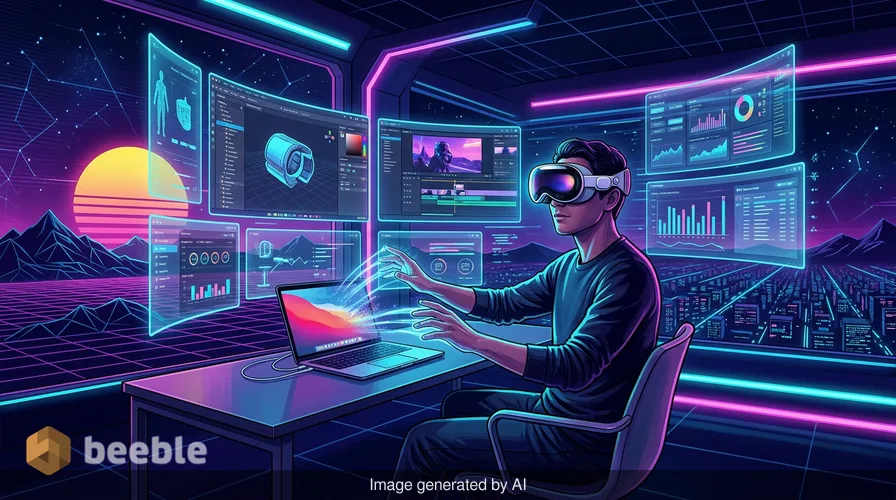
Have you ever felt a physical sense of constraint when staring at your laptop screen for eight hours a day? For decades, we have accepted the rigid boundaries of a glass rectangle as the primary interface for our professional lives. We shuffle windows, toggle between tabs, and squint at dense spreadsheets, all while confined to a physical frame that fits in a backpack. But what if the computer wasn't something you looked at, but rather something you stepped into?
Looking at the big picture, this was the central premise when Apple launched the Vision Pro. While early reviewers were quick to compare it to the iPhone—viewing it as a mobile device you wear on your face—one of the sharpest minds in tech analysis, Ben Thompson, proposed a different trajectory. He argued that the Vision Pro isn't the next evolution of the phone; it is the future of the Mac. Two years into this experiment, that distinction has become the foundational truth of spatial computing.
The Destination vs. the Companion
To understand why this shift matters, we have to look at how we use our devices. Historically, the iPhone is a companion. It is the device that lives in your pocket, handles the volatile bursts of daily communication, and fills the gaps in your schedule. It is built for brevity. Conversely, the Mac is a destination. You sit down at a Mac with intention. You have a project to finish, a video to edit, or a complex system to build. The Mac is where deep work happens.
Practically speaking, the Vision Pro aligns perfectly with the Mac’s philosophy. It is not something you wear while walking the dog or buying groceries. It is a robust workstation that replaces the physical constraints of a desk with an infinite digital canvas. Behind the jargon of 'spatial computing' lies a simple reality: the Vision Pro is designed to be the ultimate environment for focused, high-value output. It transforms your surroundings into a streamlined office, where your tools are no longer fighting for space on a 14-inch display.
Under the Hood of Spatial Productivity
How does this work for the person who just wants to get their emails done? In everyday life, the most disruptive feature of this technology isn't the 3D movies or the immersive games; it’s the management of space. When you put on the headset, you aren't limited by physical hardware. You can place a massive browser window on your left, a Slack channel on your right, and a document front and center.
Think of spatial computing as an invisible scaffolding for your daily thoughts. On a traditional monitor, your brain spends a non-trivial amount of energy managing the logistics of where things are. You minimize and maximize, losing your train of thought in the process. In a spatial environment, you simply turn your head. This intuitive way of interacting with data feels less like operating a machine and more like arranging physical objects on a table. For the average user, the result is a systemic reduction in the mental friction required to stay organized.
The Tangible Evolution of Hardware
When we look back at the first generation of the Vision Pro, it’s easy to focus on the weight and the eye-watering price tag. However, zooming out to our current 2026 perspective, we can see those were merely the growing pains of a new medium. The tech industry moves in a cyclical fashion, where hardware starts as a clunky, expensive prototype before becoming a scalable consumer product.
| Feature | Traditional Mac Setup | Vision Pro (Spatial Computing) |
|---|---|---|
| Display Limit | Fixed by physical monitors | Infinite virtual canvas |
| Ergonomics | Restricted by desk/chair height | Flexible; work in any posture |
| Portability | Requires flat surface and space | Fully mobile, high-performance office |
| Multitasking | Window-switching (Alt-Tab) | Spatial persistence (Turning your head) |
| Interaction | Mouse, Keyboard, Trackpad | Eyes, Hands, Voice (and peripherals) |
What this means is that we are moving away from the 'desktop' metaphor that has dominated computing since the 1980s. For the average user, the desk itself is becoming optional. We are seeing a resilient shift toward a setup where the power of a professional-grade computer is uncoupled from the physical weight of a laptop.
The Real-World Productivity Tax
There is a hidden cost to our current digital habits. Every time you switch focus on a small screen, you pay a small cognitive tax. Over the course of a day, these seconds add up to a significant drain on your energy. Historically, the solution was to buy more monitors. We’ve all seen the heavy industry of office cubicles filled with dual or triple-screen setups.
Curiously, the Vision Pro solves this problem by making the hardware invisible. To put it another way, it replaces thousands of dollars of physical monitors, stands, and cables with a single, interconnected software layer. On the market side, this has led to a major reshuffle in how companies think about office equipment. Why buy a fleet of 27-inch displays when your employees can have an infinite workspace that travels with them? This is why Thompson’s analysis was so prescient: the Vision Pro isn't competing with the Meta Quest; it’s competing with the entire concept of the home office.
Challenges to a Borderless Future
Of course, no transformation is without its friction. While the Vision Pro is unprecedented in its technical execution, it still faces the challenge of social acceptance. There is something opaque about a person wearing a headset in a shared space. Even with the introduction of external displays that show the user's eyes, the 'goggle' barrier remains a hurdle for mainstream adoption.
Furthermore, the digital crude oil—the microchips and sensors—required to make this experience seamless is still expensive. While the ecosystem is becoming more decentralized as third-party developers build for visionOS, the entry point for the average consumer remains high. We are currently in the 'prosumer' phase, where the device is a tool for those whose time is valuable enough to justify the investment in a superior workflow.
The Bottom Line for Your Digital Life
Ultimately, the transition to spatial computing is not about a flashy new gadget; it is about the democratization of professional space. It allows someone living in a cramped studio apartment to have a 100-foot-wide workspace that would have previously required a corner office in a skyscraper.
From a consumer standpoint, the advice is to stop viewing the Vision Pro as a high-tech television. Instead, observe your own digital habits. How many times a day do you feel cramped by your screen? How much time do you spend managing windows rather than doing work?
As we move further into 2026, the question isn't whether the laptop will survive—it likely will, for a long time—but whether it will remain the gold standard for getting things done. The future of the Mac isn't another laptop with a slightly faster chip; it’s a world where the screen finally disappears, leaving only you and your ideas. Shift your perspective from the hardware you hold to the space around you, because that is where the next decade of work is going to happen.
Sources:
- Stratechery by Ben Thompson: The Vision Pro and the Future of the Mac
- Apple Newsroom: visionOS and the Era of Spatial Computing
- Market Intelligence Reports: Global AR/VR Hardware Trends 2024-2026
- IEEE Spectrum: The Physics of Eye-Tracking and Spatial Interfaces



See you on the other side.
Our end-to-end encrypted email and cloud storage solution provides the most powerful means of secure data exchange, ensuring the safety and privacy of your data.
/ Create a free account
