


Will you actually trust your AI intern with the keys to your computer?
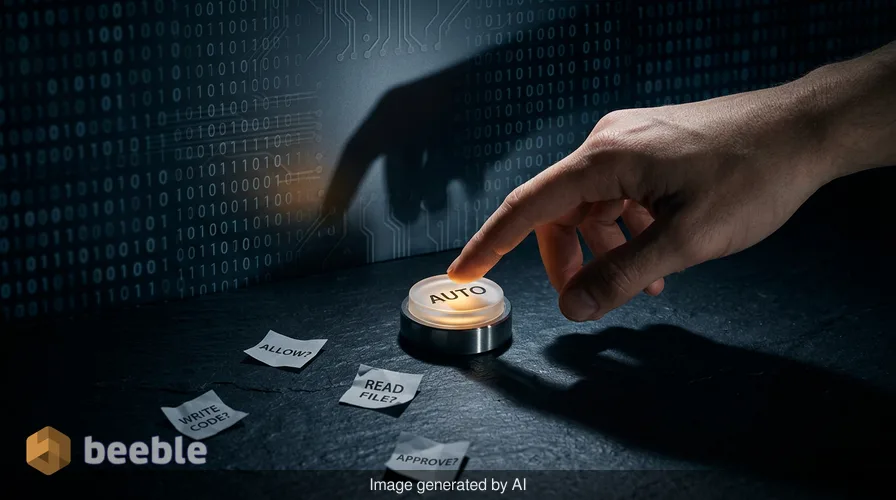
How many times today have you clicked a checkbox without reading the text next to it? Most of us treat terms of service and permission prompts like digital flies to be swatted away. We want the result, but we have little patience for the process. This habit is exactly why Anthropic is changing the fundamental relationship between developers and their AI tools. Starting August 14, the company will turn on auto mode by default for Claude Code users on Pro, Max, and Team accounts.
This shift moves Claude Code from a tool that asks for permission to a tool that asks for forgiveness. For months, users had to approve every action the AI took, from reading a file to writing a new line of code. Anthropic now believes the AI is ready to work without constant supervision. The company pitches this as a way to balance speed and control, but it also reflects a deeper realization about how humans interact with machines. When a tool asks for permission too often, the human brain stops evaluating the risk and starts performing a reflex.
The end of the permission prompt era
When Anthropic first launched the test version of auto mode in March, it was an optional feature for the adventurous. It allowed the AI to chain multiple tasks together without stopping for a 'yes' or 'no' at every turn. Now, that autonomy is the standard. If you are a subscriber to the higher tiers of Claude, your AI assistant will soon proceed with its tasks unless it determines an action is irreversible or destructive.
Think of Claude Code as a tireless intern sitting at your desk. Previously, this intern had to tap you on the shoulder every five seconds to ask if they could open a folder or move a file. Now, the intern has the keys to the office. They will only wake you up if they are about to shred a foundational contract or step outside the building. This change aims to remove the friction that slows down software development, but it also places a massive amount of trust in the system's ability to recognize its own limits.
Why humans are the weakest link in software safety
One of the most striking pieces of data in Anthropic’s announcement involves a study of 1,053 paid testers. The results were counterintuitive. Anthropic found that auto mode caught 89% of harmful actions, while human reviewers caught only 13.6%. The math is staggering. The AI was nearly seven times more effective at spotting its own potential mistakes or malicious prompts than the people who were supposed to be supervising it.
This discrepancy exists because manual review becomes habitual. Anthropic noted that users approve 97% of permission prompts in Claude Code. When a user sees a hundred prompts a day, the 101st prompt feels like a formality rather than a security check. We become blind to the details because the sheer volume of information creates a bottleneck in our attention. By removing the need for these constant approvals, Anthropic is not just speeding up the work. It is acknowledging that humans are often the least reliable part of the security chain when tasks are repetitive and high-volume.
The psychology of the default setting
Default settings are among the most powerful forces in the tech industry. Most users never change the original configuration of their software, which gives the manufacturer immense influence over how the product is used. By making auto mode the default, Anthropic is signaling a shift in the industry's risk tolerance. Boris Cherny, Head of Claude Code, mentioned on X that his team has used auto mode exclusively for months and cannot imagine going back to permission prompts.
From a market standpoint, this move positions Claude as a more streamlined competitor to other AI coding assistants. If one tool requires a dozen clicks to complete a task and another completes it in one, the market will almost always gravitate toward the path of least resistance. However, this convenience comes with a systemic shift in responsibility. The user is no longer the active gatekeeper for every small change. Instead, the user becomes a high-level manager who only steps in when the system flags a major event.
Building digital guardrails for autonomous code
To manage the risks of this autonomy, Anthropic is introducing new safety layers. One such layer is prompt injection screening. In the world of AI, a prompt injection is like a digital sleight of hand where a malicious actor tries to trick the AI into ignoring its original instructions. If the AI is writing code based on external data, that data might contain hidden commands that tell the AI to leak information or delete files.
Another layer includes customizable hard deny rules. These rules act as a digital fence. Even if the AI is in auto mode, it cannot cross these boundaries. For example, a company could set a rule that prevents the AI from ever sending data to an external server. This addresses the fear of data exfiltration, which is essentially sneaking information out the back door of a company’s secure environment. These guardrails are foundational because they provide a safety net that does not rely on human attention spans.
What this means for your daily workflow
For the average developer or team lead, the shift to auto mode will feel disruptive at first. You will notice that the AI completes complex tasks in seconds rather than minutes. You will spend less time clicking 'Allow' and more time reviewing the final product. But there is a practical trade-off to consider. Because the AI is moving faster, a mistake that it does catch might be more difficult to trace back through a long chain of autonomous actions.
Practically speaking, this change requires users to become better at defining the environment. If you want the AI to stay within a specific sandbox, you must be explicit about those boundaries. The tool is no longer just a calculator; it is an agent. An agent requires a clear mission and clear limitations. If you provide a vague instruction, an autonomous AI might take a logical but unwanted path to reach the goal. The bottom line is that the time you save on manual approvals should be reinvested into higher-level architectural review.
Preparing for the shift on august 14
If you have a Pro, Max, or Team account, you should prepare for this transition by reviewing your current projects. Anthropic has stated the AI will stop if an action is determined to be irreversible, but the definition of 'irreversible' can be subjective in different coding environments. It is worth checking if your local environment has its own backups or version control systems active. This provides a secondary safety net in case the AI makes a choice that is technically safe but functionally wrong for your specific needs.
Looking at the big picture, this move by Anthropic is a preview of how all AI software will likely evolve. We are moving away from tools that act as extensions of our hands and toward tools that act as extensions of our intent. The friction of the 'Are you sure?' button is disappearing. In its place is a new kind of digital trust that is built on statistical models rather than human oversight. As we move into this autonomous phase, our value as humans will less likely be found in the clicking of buttons and more in the setting of goals.
Sources:
- Anthropic official announcement, August 2026.
- Boris Cherny, Head of Claude Code, public statements via X.
- Internal safety study of 1,053 paid testers, Anthropic Research.



See you on the other side.
Our end-to-end encrypted email and cloud storage solution provides the most powerful means of secure data exchange, ensuring the safety and privacy of your data.
/ Create a free account
