


Will you ever want to talk to a human receptionist again?

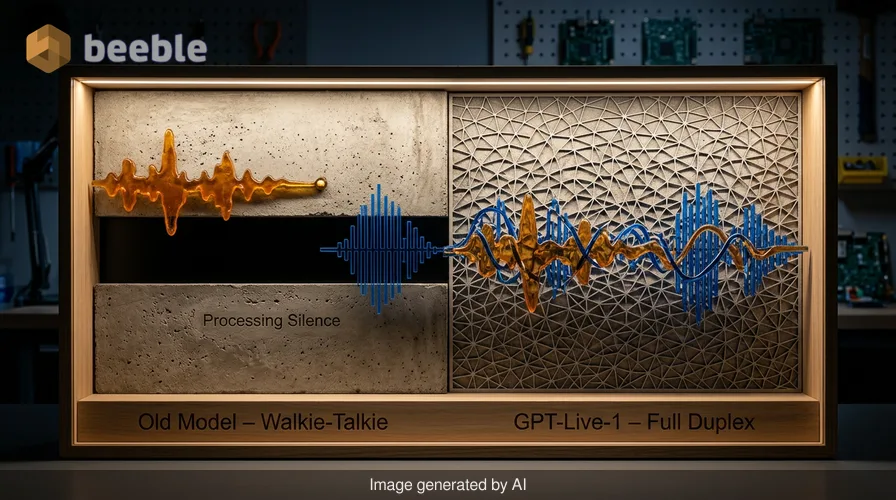
When was the last time you had a phone conversation where neither party accidentally talked over the other? It is a common human experience to pause, wait for a signal, and then speak. For years, talking to an AI assistant felt like using a walkie-talkie. You said your piece, waited for the machine to process the audio, and then listened to a pre-recorded or synthesized response. If you interrupted, the system usually crashed or ignored you. OpenAI aims to change this dynamic with the launch of GPT-Live, a new family of voice models that listen and speak at the same time.
This technology is what engineers call full duplex communication. In simple terms, it means the AI does not wait for you to finish your sentence before it starts thinking. It processes your words as you say them. On Wednesday, the startup released GPT-Live-1 and a smaller, faster version called GPT-Live-1 mini. These models are now available to users globally. For the average person, this is the end of the awkward three-second silence that has defined voice tech for a decade.
How simultaneous listening changes the vibe
Under the hood, GPT-Live moves away from the traditional three-step process of voice assistants. Usually, a device records your voice, turns it into text, sends that text to a brain to think, and then turns the new text back into speech. This chain creates a massive lag. Even a half-second delay makes a conversation feel unnatural. GPT-Live is a native audio model. It does not translate your voice into text first. It hears the sound, the tone, and the emotion directly.
Because the model is always listening, it can handle interruptions. If you ask a virtual assistant for the weather and it starts a long-winded explanation of barometric pressure, you can simply say, stop, just tell me if it is raining. The AI reacts instantly. It stops talking and adjusts its response based on your new input. This makes the AI feel less like a search engine and more like a tireless intern sitting across the desk from you.
Practically speaking, this is a shift in how we interact with hardware. We are moving toward a world where the screen is secondary. If the voice interface is fast enough, you do not need to look at your phone to set a timer, draft an email, or check your bank balance. The speed of GPT-Live-1 is roughly 232 milliseconds. This is the same speed as human response time in a normal conversation.
The tale of two models
OpenAI is rolling out two distinct versions of this technology. GPT-Live-1 is the powerhouse designed for complex reasoning and deep knowledge. GPT-Live-1 mini is the streamlined version built for speed and efficiency. Looking at the big picture, the mini model is actually the more disruptive tool for everyday life. It is cheaper for developers to use and fits more easily into mobile apps that do not have a constant, high-speed internet connection.
| Feature | GPT-Live-1 | GPT-Live-1 mini |
|---|---|---|
| Response Latency | ~230 ms | ~180 ms |
| Best Use Case | Tutoring, Complex Planning | Quick Tasks, Customer Service |
| Availability | Plus/Team Users | All Users |
| Context Window | 128k Tokens | 128k Tokens |
| Audio Quality | High Fidelity | Optimized for Speech |
The mini version is the digital crude oil for the next generation of apps. It allows a small developer to build a language-learning app where the AI tutor can correct your pronunciation in the middle of a word. It allows a local pizza shop to have an AI phone assistant that can handle three customers at once without sounding like a robot from 1995. This scalability is what makes the technology tangible for people who do not care about the technical specs of neural networks.
Why the IPO bound startup is moving now
On the market side, this release is a tactical move. OpenAI is preparing for an initial public offering. To attract investors, the company needs to show that it has more than just a clever chatbot. It needs to prove that it can own the interface of the future. By releasing GPT-Live, OpenAI is planting a flag in the ground before rivals like Google or Apple can fully integrate similar real-time audio into their operating systems.
Historically, the companies that control the interface win the decade. Microsoft won the 1990s with the desktop. Apple won the 2000s with the touch screen. OpenAI wants to win the 2020s with the voice. If they can make GPT-Live the default way people interact with their devices, they create a systemic lock-in. Once you get used to an assistant that actually listens and understands your tone, going back to a standard voice command system feels like using a typewriter in a world of laptops.
Curiously, this release also addresses a major problem for the AI industry: data fatigue. Most of the high-quality text on the internet has already been used to train these models. However, the world of live, conversational audio is a vast, untapped resource. By putting these models in the hands of millions of people, OpenAI gets to see how humans actually talk. This helps them refine the models to be more resilient against slang, accents, and the messy way people actually communicate in real life.
The death of the automated phone menu
From a consumer standpoint, the most immediate impact will be in customer service. We are all familiar with the slow leak in a tire that is the modern call center. You wait on hold, you talk to a machine that doesn't understand you, and then you get transferred to a human who asks you the same questions. GPT-Live-1 mini is the end of that cycle.
Companies can now deploy voice agents that sound human and have the authority to solve problems. If you call a let-down airline to rebook a flight, the AI can check the database, offer options, and confirm the change while you are still explaining the situation. It does not need to put you on hold to check a schedule. It is interconnected with the airline's entire system.
This shift will be volatile for the labor market. Millions of people work in call centers globally. If an AI can do the job better, faster, and for a fraction of the cost, those roles will change or disappear. However, for the user, it means a more transparent and less frustrating experience. You get your answer in thirty seconds instead of thirty minutes. This is a foundational change in how businesses treat your time.
Privacy in an always listening world
Zooming out, we have to look at the trade-off. For GPT-Live to work, it has to be ready to hear you at any moment. This raises questions about how much of our lives we want to share with a cloud-based brain. OpenAI says the audio is processed securely and users have control over their data. Yet, the reality is that the more intuitive these assistants become, the more we will naturally share with them.
Essentially, we are trading a bit of our privacy for a massive gain in convenience. This is a cyclical trend in tech. We did it with GPS for maps and with our credit card info for one-click shopping. The difference here is the intimacy of voice. Your voice contains data about your health, your stress levels, and your surroundings. As these models become a standard part of our smartphones, we must observe our digital habits more closely.
What this means is that your phone is no longer a tool you pick up to perform a task. It is becoming a silent participant in your day. It waits for a cue and is ready to assist without the friction of a keyboard. This is a streamlined vision of the future that OpenAI is betting on for its public debut.
What this means for your daily routine
For the average user, the arrival of GPT-Live-1 is not just another update in the app store. It is a prompt to rethink how you use your time. Practically, you should try using the voice mode for tasks that usually require a lot of typing. Ask it to summarize a long document while you are driving. Use it to practice a difficult conversation you need to have at work. Have it act as a translator when you are traveling in a country where you do not speak the language.
Ultimately, the technology is only as useful as the problems it solves. GPT-Live-1 makes the AI a better listener, but you still have to be the one to give it direction. As we move away from screens and toward these conversational agents, our ability to give clear instructions becomes a vital skill. The invisible backbone of our modern life is shifting from what we can type to how well we can speak.
Instead of fearing the change, observe how these tools can remove the small, annoying frictions from your day. The next time you are stuck in a digital loop with a legacy customer service bot, remember that the technology to replace it is already here. The way we talk to machines has changed forever, and the machines are finally ready to listen.
Sources
OpenAI Official Product Launch Blog, July 2026.
Technical Specification Sheet for GPT-Live-1 Family Models.
Market Analysis Report on AI Voice Interface Adoption Rates.
Quarterly Financial Outlook for OpenAI Pre-IPO Disclosures.



See you on the other side.
Our end-to-end encrypted email and cloud storage solution provides the most powerful means of secure data exchange, ensuring the safety and privacy of your data.
/ Create a free account
