


Will You Let ChatGPT Manage Your Text Messages?

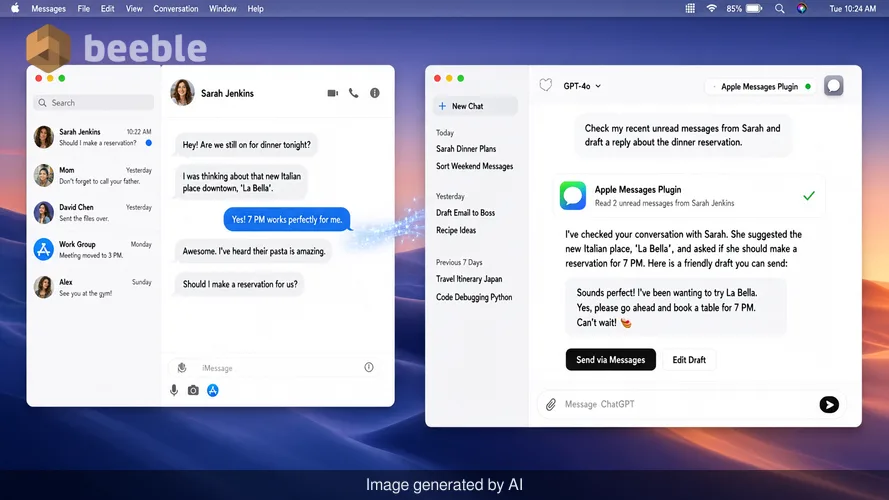
Have you ever stared at a wall of blue bubbles and wished someone else would deal with the social labor of replying? OpenAI just released a plug-in that lets ChatGPT read, sort, and send Apple Messages for you. It is a bridge between the static text on your iPhone and the processing power of a large language model. This tool allows users to connect their private inbox with the chatbot to automate the daily grind of digital communication. For the average user, the appeal is convenience. Practically speaking, the plug-in acts as a tireless intern who never sleeps and remembers every detail of your digital life.
How the plug-in manages your inbox
Under the hood, this tool connects the chatbot directly to your iMessage database. You can now ask the bot to find that one specific address your sister sent six months ago without scrolling through thousands of memes and unrelated updates. The plug-in handles three primary tasks: analysis, drafting, and execution.
When you ask ChatGPT to analyze your messages, it looks for patterns and specific data points. A brief commercial for the tool shows a user asking for follow-up suggestions based on the previous day of conversations. The AI identifies who is waiting for a reply and what the context of the last message was. It then offers a list of potential responses that match the tone of your previous interactions.
For those who use their phones for business, the plug-in works with Codex and ChatGPT Work. This means developers can use the tool to share code snippets or troubleshoot issues directly within a text thread. The integration with professional accounts suggests that OpenAI is moving toward a systemic approach where AI handles both personal logistics and high-level work tasks in the same interface.
The trade-off between speed and privacy
Privacy remains a central concern whenever a third-party tool gains access to personal data. OpenAI told Bloomberg that the plug-in runs locally on the user machine. According to the company, the tool does not create a full index of every message in the cloud. This is a technical distinction that aims to reassure users that their entire life story is not sitting on a remote server for AI training.
However, the specifics of this local processing are still opaque. If the AI must understand the context of a conversation to suggest a reply, it has to process that data somewhere. For the average user, the question is whether they trust the firewall between their local device and the OpenAI infrastructure. TechCrunch is currently seeking more details on how long local data persists and whether any metadata leaves the device.
Historically, Apple has guarded its messaging ecosystem with extreme care. This plug-in indicates a shifting dynamic where even the most protective hardware companies must open their doors to AI integration to remain relevant. It is a disruptive move that changes the message inbox from a simple storage locker into an active workspace.
Putting the AI intern to work
Practically speaking, the utility of this plug-in depends on how much control you are willing to surrender. The tool can delete messages for you or search for information buried deep in your history. If you are looking for a flight confirmation number from three weeks ago, you can ask the chatbot instead of using the often-unreliable native search function in the Messages app.
The drafting feature is where the tool becomes most tangible. ChatGPT can write a polite decline to a dinner invitation or a professional follow-up to a client. It uses the history of your conversation to ensure the language sounds like you. This reduces the cognitive load of switching between tasks throughout the day.
| Feature | Manual Messaging | ChatGPT Plug-in |
|---|---|---|
| Search Speed | Slow, keyword-dependent | Fast, context-aware |
| Drafting | Requires manual typing | Generates drafts based on history |
| Organization | Contact-based | Intent-based and searchable |
| Privacy | Local and encrypted | Local processing with AI access |
| Sending | User-initiated only | Manual or persistent approval |
The danger of persistent approval
OpenAI is clear about one specific risk: the persistent approval setting. This feature allows ChatGPT to send messages on your behalf without asking for permission every time. The company discourages users from turning this on. They warn that doing so removes the final chance to review a message before the AI sends it as you.
In everyday life, this could lead to awkward or professional disasters. AI is prone to hallucinations, which are instances where the bot invents facts or misinterprets a prompt. If the bot sends an incorrect meeting time or a poorly phrased joke to a boss, the user is still the one who faces the consequences. The bottom line is that while the AI is a fast drafter, it is a poor judge of social nuance.
Zooming out, this warning reflects a broader trend in AI development. Companies are eager to provide autonomous agents that do work for us, but they are also careful to keep the human in the loop for liability reasons. For the consumer, this means the tool is an assistant, not a replacement for your own eyes and ears.
From consumer tool to industrial efficiency
Looking at the big picture, the integration of AI into messaging is not just about convenience for individuals. It has implications for how small businesses and heavy industry manage communication. When a site manager at a construction firm can ask a chatbot to summarize all supply chain updates received via text, the efficiency gains are scalable.
This decentralized way of managing information means that critical data no longer lives in a vacuum. A message about a delayed shipment of steel or a change in a shift schedule becomes an actionable data point for the AI. It can cross-reference that text with a calendar or a project management tool. The interconnected nature of these systems makes the information more resilient and less likely to be forgotten.
Conversely, this creates a situation where the boundary between work and life becomes even more blurred. If your AI intern is constantly monitoring your texts to find work-related data, the pressure to be always-on increases. The tool makes communication easier but it also makes it harder to truly disconnect from the flow of information.
What this means for your digital habits
The arrival of the Apple Messages plug-in is a foundational step toward a world where we no longer manage our own notifications. As a result, users must decide where they draw the line for AI intervention. If you are someone who struggles with an overflowing inbox, this tool offers a user-friendly way to regain control. It turns a chaotic list of chats into a searchable, editable database.
Ultimately, you should observe how much you rely on the bot for your social interactions. While the AI can handle the logistics of a conversation, it cannot replicate the genuine connection of a personal message. Use the tool to find data and draft templates, but keep the final click for yourself. The most practical approach is to treat the plug-in as a specialized search engine for your life rather than a spokesperson for your personality.
As we move further into this era of AI agents, your personal data becomes the fuel for your digital productivity. Appreciate the invisible mechanics that allow a chatbot to sort through thousands of texts in seconds, but remain curious about how that data is handled under the hood. The convenience of a perfectly drafted text is only valuable if you still own the voice behind the message.
Sources:
- OpenAI Official Product Announcement
- Bloomberg Technology Report on AI Local Processing
- Apple Developer Documentation for Messages Integration
- TechCrunch Analysis of OpenAI Plug-in Architecture



See you on the other side.
Our end-to-end encrypted email and cloud storage solution provides the most powerful means of secure data exchange, ensuring the safety and privacy of your data.
/ Create a free account
