


Will your next AI assistant run on the three old computers in your guest room?

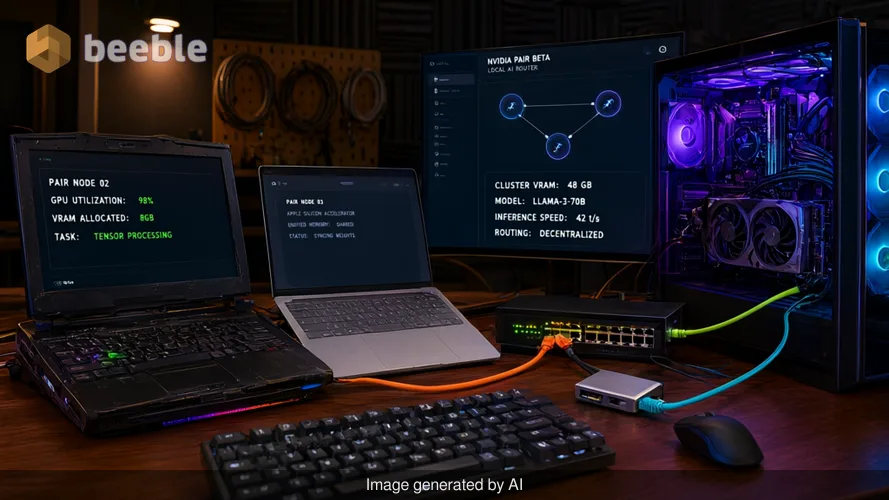
Do you have an old gaming laptop gathering dust in a drawer while your current PC struggles to run the latest local AI models? Most users treat hardware as a disposable ladder where each new rung makes the previous one obsolete. Nvidia now wants you to treat those old machines as part of a single, unified team. The company recently released the beta version of its Personal AI Router, known as PAIR. This software connects multiple computers on a local network to share the heavy lifting of artificial intelligence tasks.
Technically, this is a move toward decentralized compute for the average person. For years, running a powerful Large Language Model at home required a single, expensive graphics card with massive amounts of video memory. If the model was too big for your card, it simply did not run. PAIR changes this math by letting a user distribute that workload across several different devices. It acts as a traffic controller for data. It sends pieces of an AI request to your desktop, your old laptop, and even certain Mac devices simultaneously. This approach turns a collection of individual tools into a makeshift private cloud.
How the digital traffic controller manages your hardware
Under the hood, PAIR functions differently than traditional server clusters. In a professional data center, engineers often link GPUs together to create one giant virtual pool of memory. Nvidia specifies that PAIR does not do this. It does not turn your three separate computers into one giant virtual GPU. Instead, it operates on the principle of parallel processing. When you ask an AI to summarize a long document or generate code, PAIR breaks that task into smaller chunks. It routes those chunks to the available processors on your network, gathers the results, and presents them in a single interface.
Practically speaking, this means you do not need identical hardware to see a benefit. The software supports Windows, macOS, and Linux. You can link a high-end desktop containing an RTX 50-series card with an older RTX 30-series laptop and a Mac Mini. The system recognizes the specific strengths of each device. It gives the heavy lifting to the faster card while the older machine handles smaller sub-tasks. This setup turns AI into a tireless intern that uses every tool in the office to get the job done faster.
Looking at the big picture, this software solves the VRAM bottleneck. VRAM, or Video Random Access Memory, is the digital workspace where AI models live while they work. If a model needs 24 gigabytes of space and your card only has 12, the model fails. By routing tasks across multiple machines, PAIR allows users to run more complex models that would normally crash a single home computer. The total capacity of your network becomes the new limit for what you can achieve locally.
Moving from the cloud to the living room
Privacy is the foundational reason for this shift. Most people currently use AI through web browsers, which means their data travels to a corporate server. Companies use that data to train future models or track user behavior. PAIR keeps everything behind your home router. The data never leaves your local network. For a small business owner or a writer working on a sensitive manuscript, this creates a secure bubble. You get the speed of modern AI without the risk of a data breach or a change in a provider's terms of service.
From a consumer standpoint, this also changes the value proposition of old hardware. The resale market for three-year-old laptops is often disappointing. However, the value of that laptop as a dedicated AI node is quite high. Instead of selling an old device for a fraction of its original cost, you can plug it into a power outlet in a closet and let it contribute to your home AI cluster. This extends the useful life of electronics and slows down the cycle of constant upgrades.
The hidden costs of local AI clusters
There is a practical trade-off to this decentralized approach. While the software is free, electricity is not. Running three computers at full tilt to process a single AI request consumes significantly more power than using one optimized machine. The heat generation is another factor. A cluster of three PCs will turn a small home office into a sauna during a long session of data analysis. Users must weigh the cost of their electric bill against the monthly subscription fees of cloud AI services.
Latency is the other hurdle. Because the data must travel over your home Wi-Fi or Ethernet cables, there is a slight delay. This delay is usually measured in milliseconds, but it adds up. A single, powerful GPU will always be faster than a cluster of three slower ones connected over a network. PAIR is a solution for capacity, not necessarily for raw, instantaneous speed. It is about being able to run the model at all, rather than running it the fastest.
Why enterprises are watching a home user tool
Nvidia states that PAIR is for home use, but the implications for the office are transparent. Most modern businesses have dozens of idle desktops sitting in cubicles overnight. These machines often have decent internal graphics chips or modern processors that sit unused for sixteen hours a day. An enterprise could theoretically use PAIR to link these idle machines into a temporary supercomputer for internal research.
Historically, companies had to buy dedicated server racks for this kind of work. Those racks cost tens of thousands of dollars and require specialized cooling. Using existing desktop capacity is a disruptive way to lower the barrier to entry for corporate AI. Nvidia also mentioned that PAIR works with DGX Spark desktop supercomputers. This suggests the software is a bridge between enthusiast home setups and professional industrial environments. It allows a company to test AI workflows on cheap, existing hardware before they commit to a multi-million dollar data center investment.
The bottom line for your digital habits
For the average user, the release of PAIR is a signal that the era of the lone PC is ending. We are moving toward a modular lifestyle where our devices work together rather than in isolation. If you have an old PC in the attic, it is time to check its specifications. You might already own half of a supercomputer without realizing it.
Ultimately, this software forces a shift in how we view compute power. We should stop looking at hardware as a single unit and start viewing it as a liquid resource. Just as you might share a data plan across several family phones, you will soon share the thinking power of your computers across your entire house. The digital crude oil of the next decade is processing power, and Nvidia just gave everyone a way to build their own refinery.
Practically speaking, you should start by auditing your network. A wired Ethernet connection will always outperform Wi-Fi for this type of task. If you plan to build a local cluster, consider investing in a basic network switch. This ensures the data moves between your machines with as little friction as possible. Observe how your current computer handles AI tasks today. If you notice frequent slowdowns or out-of-memory errors, adding a second, older machine to the mix via PAIR might be the most cost-effective upgrade you can make.
Sources: Nvidia Technical Documentation, RTX AI User Guide, DGX Spark Product Specifications.



See you on the other side.
Our end-to-end encrypted email and cloud storage solution provides the most powerful means of secure data exchange, ensuring the safety and privacy of your data.
/ Create a free account
