
Will your next Amazon delivery be the work of a machine or a human?

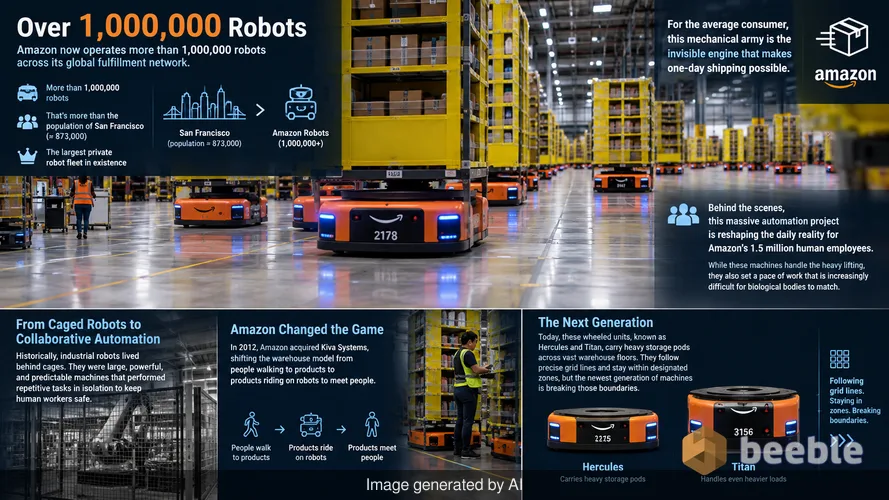
Amazon now operates more than 1,000,000 robots across its global fulfillment network. This count exceeds the total population of San Francisco and represents the largest private robot fleet in existence. For the average consumer, this mechanical army is the invisible engine that makes one-day shipping possible. Under the hood, however, this massive automation project is reshaping the daily reality for the company’s 1.5 million human employees. While these machines handle the heavy lifting, they also set a pace of work that is increasingly difficult for biological bodies to match.
Historically, industrial robots lived behind cages. They were large, powerful, and predictable machines that performed repetitive tasks in isolation to keep human workers safe. Amazon changed this dynamic when it acquired Kiva Systems in 2012. That move shifted the warehouse model from people walking to products to products riding on robots to meet people. Today, these wheeled units, known as Hercules and Titan, carry heavy storage pods across vast warehouse floors. They follow precise grid lines and stay within designated zones, but the newest generation of machines is breaking those boundaries.
The arrival of the collaborative robot
Proteus is the latest addition to the Amazon fleet and marks a change in warehouse philosophy. Unlike its predecessors, Proteus has sensors that allow it to navigate around humans and obstacles without being confined to a fenced area. Brian Greenwood, a professor of business at George Mason University, notes that this proximity creates a new set of challenges. When a robot is physically close to a worker, it essentially dictates the speed of the task. The machine does not get tired, it does not need a coffee break, and it maintains a consistent velocity from the start of the shift to the end.
Looking at the big picture, this interaction is a high-speed duet where the human is often struggling to keep time. The logistics network is like a circulatory system for the modern economy, and Amazon is trying to increase the blood flow by removing every possible friction point. For a human worker, a friction point might be a moment to stretch or a brief pause to adjust a box. For an AI-driven robot, those moments are inefficiencies that the system is designed to eliminate.
Why the human hand still matters
Despite the million-robot milestone, humans remain the most versatile tools in the warehouse. A robotic arm is excellent at picking up a standardized plastic tote, but it struggles with a loose bag of dog food or a fragile glass ornament. Amazon expects to double its fleet of robotic arms this year, yet Scott Dresser, vice president of Amazon Robotics, admits the current count is only in the single-digit thousands. Humans possess a level of dexterity and visual recognition that current AI models cannot yet replicate at scale.
This is why the human workforce continues to grow alongside the robots. Amazon needs people to handle the complex, non-standard items that make up a large portion of Prime orders. The company also requires humans to troubleshoot the robots when they create traffic jams. Amazon uses a suite of AI models called DeepFleet to manage robot congestion, but mechanical failures and software glitches still require a human touch to resolve. Essentially, the humans are moving away from manual labor and toward a role that resembles a specialized technician or a traffic controller.
The physical cost of mechanical speed
The warehousing sector has an injury rate that is often double the national average for other industries. Amazon executives argue that robots improve safety by taking over the dull, dirty, and dangerous tasks. A robot arm that sorts packages at height reduces the need for a person to climb ladders or reach above their shoulders thousands of times per day. By removing these high-risk movements, the company aims to reduce physical fatigue and long-term strain.
Conversely, labor groups point to the psychological and physical pressure of working alongside machines. When a robotic system like Sequoia identifies and stores items 75 percent faster than previous methods, the human at the end of that system must work 75 percent faster to keep the line moving. This relentless rhythm can lead to repetitive stress injuries even if the individual tasks are less heavy. The injury data in the warehouse sector reflects a system that is optimized for throughput rather than biological limits.
How automation hits your doorstep
For the average user, this robotic expansion has a tangible impact on the wallet. Automation is the primary reason Amazon can keep Prime membership costs relatively stable while increasing delivery speeds. It costs significantly less to move a package via a robot-assisted system than a purely manual one. These savings allow the company to expand its reach into rural areas and offer same-day service for millions of items. Practically speaking, if Amazon stopped using robots tomorrow, the cost of shipping would likely triple, and delivery times would slip back to the three-to-five-day window common a decade ago.
On the market side, Amazon is not just a retailer anymore; it is becoming a robotics manufacturer. With new factories in Texas and Indiana, the company is building the capacity to sell this technology to other industries. We are seeing a transition where the warehouse itself is becoming a single, massive computer. The human workers are components within that computer, providing the flexibility that silicon and steel still lack.
Navigating the new warehouse reality
The bottom line is that the relationship between humans and machines is no longer a choice between one or the other. It is an interconnected system where both are required to function. While the robots handle the volume, humans provide the nuance. However, the balance of power in this relationship is shifting. As AI models become better at predicting human movement, the workspace will become even more crowded.
| Robot Type | Primary Function | Human Interaction Level |
|---|---|---|
| Hercules / Titan | Moving storage pods | Low (Fenced areas) |
| Proteus | General transport | High (Moves around people) |
| Sequoia | Inventory identification | Medium (Feeds workstations) |
| Robotic Arms | Sorting and packing | High (Direct collaboration) |
What this means for the future of work is a move toward high-tech supervision. If you are entering the logistics workforce, the most valuable skill will not be physical strength, but the ability to manage and maintain automated systems. The digital crude oil of the 21st century is data, and these robots generate petabytes of it every day. Workers who can interpret that data to improve efficiency will find themselves in high demand.
Ultimately, you should observe your next Amazon delivery with a new perspective. That package did not just arrive because a van driver dropped it off. It was the result of a million machines and a million people working in a synchronized, often stressful, dance. As a consumer, you are the final step in an industrial process that is currently testing the limits of how fast humans can move when a robot is leading the way.
Sources: Amazon 2025 Annual Report, US Occupational Safety and Health Administration (OSHA) Warehouse Safety Data, Amazon Robotics official production announcements.



See you on the other side.
Our end-to-end encrypted email and cloud storage solution provides the most powerful means of secure data exchange, ensuring the safety and privacy of your data.
/ Create a free account