


Will your next Android phone treat ChatGPT like it's part of the family?

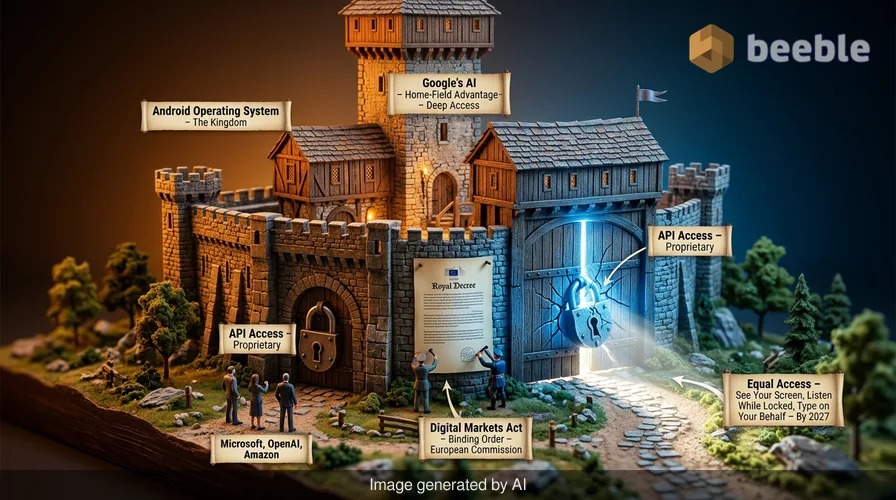
Have you ever wondered why Google Gemini can read your emails or start a Google Maps route with a voice command while other apps like ChatGPT cannot? For years, Google has kept the deep parts of the Android operating system to itself. This gives its own AI a home-field advantage. However, a major legal shift in Europe is about to change how your phone works. The European Commission recently issued a binding order that forces Google to hand over the keys to its kingdom. By 2027, any AI assistant you choose will have the same power as Google’s own tools.
This decision is part of the Digital Markets Act, a law designed to stop tech giants from acting as gatekeepers. The Commission decided that if Google wants to run the world's most popular mobile platform, it has to let its competitors play on a level field. This means apps from Microsoft, OpenAI, or Amazon will soon gain the ability to see what is on your screen, listen for your voice even when the phone is locked, and even type on your behalf. This is a massive shift for the mobile economy and for your personal privacy.
Breaking down the eleven keys to your phone
The European Commission identified 11 specific features that Google currently protects. To make the transition manageable, the order splits these features into two groups. The first group consists of six features that Google must open to everyone without a heavy approval process. These are the basic senses of your phone. They include the microphone, the camera, and the system audio.
Under these new rules, a third-party AI can stay active in the background. It can listen for a "hotword" like "Hey ChatGPT" even when your battery is low or your screen is off. Today, only Google Assistant or Gemini can do this reliably because they have direct access to the phone's low-power processors. In the future, your phone might have three or four different assistants listening at once. If we view AI as a tireless intern, Google currently owns the only desk in the office. The EU just ordered them to buy chairs for everyone else.
The second group of features is more sensitive. These are the five "restricted" features that involve your personal data and the ability to control other apps. These include access to your Gmail, your Calendar events, and your Drive documents. Google is allowed to require a certification for these. They want to ensure that a rogue app does not start sending spam emails from your account or deleting your files without permission.
The rise of screen automation
One of the most disruptive changes is a feature called screen automation. Currently, if you want to book a flight, you have to open a travel app, type in your destination, and click through the payment screens. Google is building technology that lets Gemini do this for you by virtually "tapping" the screen inside other apps.
The EU order ensures that Google cannot keep this magic trick for itself. By the time Android 18 arrives, a certified AI from a rival company will have the same permission to drive your apps. It will see the buttons on your screen and understand what they do. This turns your smartphone from a collection of isolated apps into a unified tool where one AI can manage everything.
For the average user, this means more choice. You might prefer the way OpenAI handles text but like how Alexa manages your smart home. Soon, you will not have to choose between them based on which one has better access to your phone's hardware. They will all have the same reach. This forces the companies to compete on how smart their AI is rather than how much of the phone they own.
Trading the secret sauce of search
The second part of the EU order does not involve your phone hardware. It involves the data that makes Google the king of the internet. Google is now required to share its search data with rivals for a fee. This includes the queries people type, what they click on, and how Google ranks those results.
Google has spent decades building a massive library of human intent. Every time you search for a recipe or a repair shop, Google learns something new. This data is the digital crude oil that fuels their advertising machine. The EU wants to break this monopoly by making Google sell anonymized versions of this data to smaller search engines and AI chatbots.
There are strict rules to protect your identity in this data trade. Google must remove your name, your IP address, and any specific details that could reveal who you are. They also have to group users together. Every search in the dataset must be part of a group of at least 1,000 people. This makes it much harder for a rival company to figure out exactly what you were searching for. It provides enough information to help a new search engine improve without sacrificing the privacy of individual users.
Security concerns and the Trojan horse argument
Google is not happy about these changes. Kent Walker, Google’s president of global affairs, argued that opening up these permissions creates a security risk. He claims that letting external apps access the microphone and camera so deeply could lead to more malware or data leaks. In his view, the current system where Google vets everything acts as a vital safeguard for the 60% of Europeans who use Android.
There is some truth to these concerns. If an AI assistant can read your screen, it can see your private messages, your bank balances, and your passwords. This is why the EU allowed Google to create a certification program for the most sensitive features. Google will be able to test rival assistants to make sure they are hardened against hacks.
However, the EU is also making sure Google does not use "security" as an excuse to block competition. Google cannot set higher standards for rivals than it sets for its own Gemini AI. If Google wants to use a certain permission, it has to let its competitors use it too. This prevents the company from creating a walled garden where only its own products are allowed to flourish.
What this means for your digital life
Looking at the big picture, these changes will likely land on your device in August 2027. That seems like a long time away, but the engineering required is massive. Google has to rewrite parts of the Android core to allow multiple assistants to coexist.
Practically speaking, you should expect your phone to become much more talkative. You will see new permission prompts asking if you want to let a third-party app "control your device" or "read your screen." These are not just standard app permissions. They are the same level of access that the operating system itself has.
| Feature Type | What is Included | Access Level |
|---|---|---|
| Open Features | Mic, Camera, Sensors, Hotword | No certification needed |
| Gated Features | Gmail, Calendar, Maps, Drive | Requires free certification |
| Search Data | Clicks, Queries, Rankings | Shared with rivals for a fee |
| System Control | App automation, Tap imitation | Part of Android 18 release |
From a consumer standpoint, the bottom line is that your phone is about to become more flexible. You will no longer be locked into the Google ecosystem just because you use an Android device. If a new AI startup builds a better way to manage your life, you can switch to them without losing the ability to use voice commands or have the AI read your notifications.
Ultimately, this is a test of whether a more open phone is a better phone. We are moving away from a world where one company controls the entire experience toward a world where your device is a neutral platform for many different intelligences. This shift will require users to be more vigilant about which apps they trust with these powerful permissions. The era of the single, dominant mobile assistant is ending. Your digital life is about to get much more crowded, but it will also be more under your control.
Sources: European Commission official decision (July 16, 2026), Google Global Affairs statement, Digital Markets Act technical specifications.



See you on the other side.
Our end-to-end encrypted email and cloud storage solution provides the most powerful means of secure data exchange, ensuring the safety and privacy of your data.
/ Create a free account
