


Would you hand your credit card to a chatbot?

Have you ever spent three hours comparing wireless headphones only to end up more confused than when you started? The process of modern digital shopping is a paradox. We have more choices than ever, but the friction of reading reviews, comparing prices, and navigating checkout screens has turned a simple errand into a part-time job. OpenAI and Visa now have an answer to this fatigue.
Through a new partnership announced this week in San Francisco, ChatGPT is no longer just a conversationalist. It is now an agent with a wallet. By embedding Visa’s global payment network directly into the chatbot, OpenAI has given its AI the ability to find, select, and purchase physical goods on behalf of users. Practically speaking, this turns the AI into a tireless intern who is happy to handle the boring logistics of your consumer life.
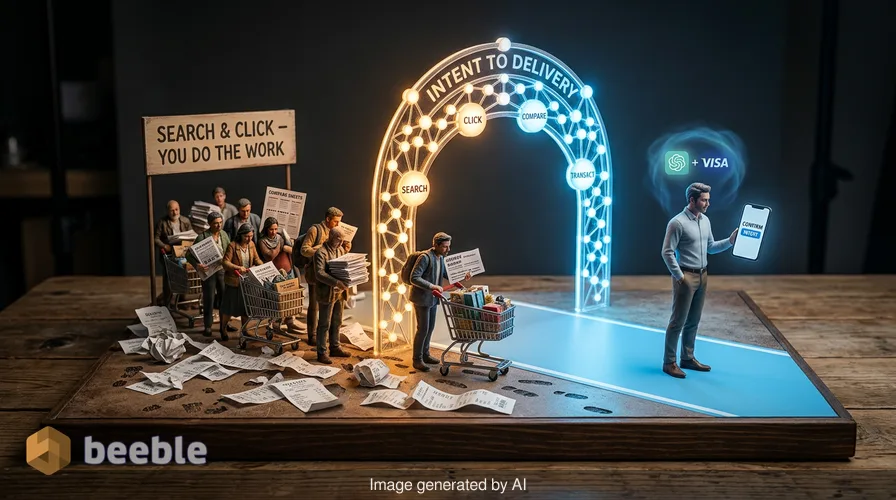
This move is a foundational shift in how we interact with the internet. For years, we have lived in the era of search and click. You ask a question, a search engine gives you links, and you do the work. The goal of this tie-up is to move us into the era of delegation. You provide the intent, and the AI handles the execution. However, giving a piece of software the keys to your bank account requires a significant leap in trust that many users may not be ready to make just yet.
How the digital intern handles your money
Under the hood, the system is less about magic and more about interconnected financial rails. When you link a Visa card to your ChatGPT account, you are not just giving the AI your card number. You are granting it access to a specialized version of the Visa network designed for autonomous agents.
Jack Forestell, the chief product and strategy officer at Visa, demonstrated this on Wednesday by asking the bot to find and buy wireless headphones under $150. The AI did not just provide a list of links. It scoured various retailers, identified a pair that fit the budget and user preferences, and initiated the checkout process.
In this scenario, OpenAI provides the logic. The AI understands the nuances of your request, such as a preference for noise cancellation or a specific color. Visa handles the heavy lifting of the transaction. This includes authorizing the payment and monitoring for fraud. Because this uses the standard Visa network, the AI can theoretically shop at any merchant that accepts Visa. This is a massive expansion compared to previous tech experiments that only worked with specific, pre-approved retailers.
The guardrails between your wallet and the web
Naturally, the idea of a chatbot spending money on its own raises systemic concerns about security. If the AI hallucinates or misunderstands a prompt, it could accidentally order a dozen televisions instead of one. To prevent these scenarios, the system has several layers of friction.
Users do not just set the AI loose. You must establish spending limits, such as a maximum of $200 per transaction or a monthly cap on total spending. Most transactions still require a final human approval step. Before the purchase is finalized, the AI sends a notification to your phone. You see the item, the price, and the merchant. You then tap a button to confirm.
Visa is also applying its standard dispute rules to these purchases. If a merchant sends the wrong item or the AI makes a purchase you did not intend to authorize, the same fraud protection you have on your physical card applies here. Essentially, Visa is treating the AI agent as a digital extension of the cardholder. This makes the transition easier for banks and merchants who are already used to the existing rules of the road.
Learning from the mistakes of the past
This is not the first time OpenAI has tried to enter the world of e-commerce. Late last year, the company launched a feature called Instant Checkout. It was a clunky attempt to let ChatGPT shop the web, and it failed for two simple reasons.
| Feature | Instant Checkout (2025) | Visa Integration (2026) |
|---|---|---|
| Merchant Network | Limited to enrolled partners | Any merchant accepting Visa |
| Transaction Fees | 4% fee for merchants | Standard Visa interchange rates |
| Ease of Use | High friction, frequent errors | Streamlined, native integration |
| Consumer Trust | Experimental and opaque | Backed by Visa's fraud rules |
Looking at the big picture, the 4% fee was the primary dealbreaker for most businesses. Retail margins are thin, and adding a massive surcharge just for the privilege of an AI-driven sale was a hard sell for most store owners. By using the existing Visa network, OpenAI is bypassing the need to negotiate with every individual store. The merchant sees this as just another Visa transaction. This scalability is what makes the current partnership much more disruptive than the previous attempt.
Why Mastercard is taking a different path
While OpenAI and Visa are focused on the person buying headphones or groceries, Mastercard is looking at the corporate side of the equation. Visa’s biggest rival is also developing AI shopping features, but it has targeted businesses instead of everyday consumers.
Mastercard’s AI agents focus on procurement. For example, a marketing manager might tell an AI to spend $5,000 on digital advertising across three different platforms. The AI would then find the best rates and execute the buy. This is a safer bet for Mastercard in the short term. Businesses are already used to automated systems handling large sums of money. Consumers, conversely, are much more protective of their personal bank accounts and daily spending habits.
The hurdle of human psychology
Technologically, the system is ready. Psychologically, we are in a more volatile place. Jack Forestell admitted that it will take time for people to trust an AI to handle their shopping autonomously. Most of us are comfortable with a chatbot suggesting a recipe or writing an email. We are much less comfortable with it making financial decisions without us watching over its shoulder.
This is a classic case of the "black box" problem in technology. When you can see the logic of a machine, you trust it. When a chatbot makes a purchase in the background, the process is opaque. Users will likely start small. They might let the AI buy a repeat order of laundry detergent or a book they have been meaning to read. Only after months of flawless execution will the average person let the AI buy higher-ticket items like electronics or furniture.
From a consumer standpoint, the bottom line is that the barrier between thinking about a purchase and owning the product is getting thinner. The internet has always been a place where we go to find things. Now, it is becoming a place where things are found for us. This is convenient, but it also removes the moments of pause that often prevent us from overspending. When the checkout process is invisible, your budget can become a lot more fragile.
What this means for your daily habits
As this technology rolls out over the coming months, your relationship with your digital wallet is going to change. For the average user, the most immediate impact will be the reduction of the search-and-compare grind. Instead of juggling ten browser tabs, you will have a single conversation.
However, you should remain a robust skeptic of any system that offers too much convenience for free. While the fees are not yet public, data is the real currency here. OpenAI will learn more about your spending habits, brand preferences, and price sensitivity than any credit card company ever could. This data is incredibly valuable for training future versions of the AI to be even more persuasive.
Practically speaking, you should treat this new feature like a new credit card. Start with low limits. Test it on merchants you already know and trust. Most importantly, do not disable the notification approval step. The goal of an AI agent is to save you time, but that time is only valuable if you aren't spending it later on the phone with a customer service representative to fix an automated mistake.
Ultimately, this partnership is a sign that the AI revolution is moving into the tangible world of physical goods. The digital crude oil of our era—data—is finally being used to power the engines of everyday commerce. It is a transition that is as exciting as it is uncertain. Watch your notifications closely, because the next person to spend your money might not be a person at all.
Sources:
Visa Global Product Strategy Briefing (June 2026)
OpenAI Commerce Division Development Update
Federal Trade Commission Guidelines on AI-Driven Financial Transactions
Market Analysis of Autonomous Agent Payment Protocols



See you on the other side.
Our end-to-end encrypted email and cloud storage solution provides the most powerful means of secure data exchange, ensuring the safety and privacy of your data.
/ Create a free account
