


Would You Scan Your Eyeballs to Prove You Aren’t a Robot?
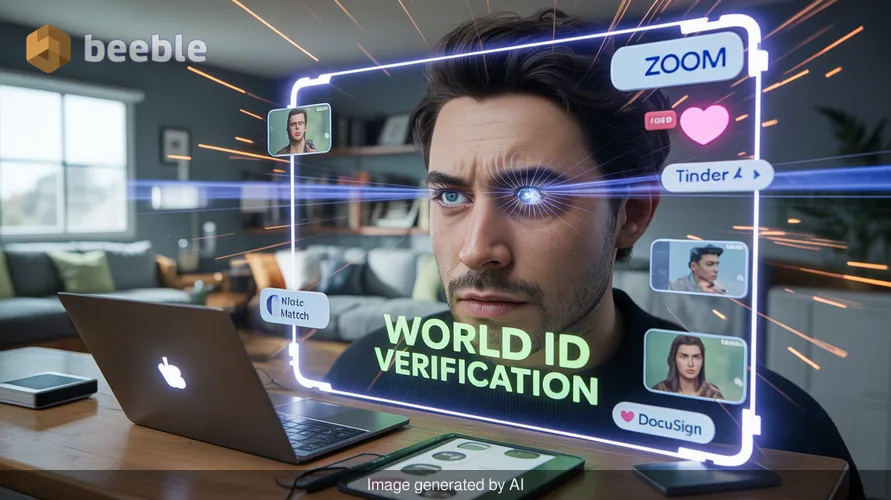
Have you ever found yourself staring at a blurry grid of traffic lights, clicking each square with mounting frustration just to prove to a website that you are, in fact, a sentient human being? We have all been there. But as artificial intelligence grows more sophisticated, the old ways of filtering out bots—those grainy 'CAPTCHA' puzzles—are becoming about as effective as a screen door on a submarine. If an AI can now write poetry, pass the bar exam, and generate hyper-realistic video, clicking on a crosswalk is no longer a meaningful hurdle. This reality has sparked a quiet but massive shift in how we verify who is real online, and three of the biggest names in tech—Zoom, Tinder, and DocuSign—are now betting on a much more biological solution: your eyes.
These platforms have recently integrated with World ID, the identity protocol developed by Worldcoin. At its core, this system uses a specialized device called the Orb to scan a person's iris, creating a unique digital code that confirms they are a real human without necessarily revealing their legal name or home address. Looking at the big picture, this is not just about adding another security feature; it is an attempt to build a digital immune system for an internet increasingly overrun by digital clones and automated actors. For the average user, the friction of proving your humanity is about to become much more intimate, and the implications for privacy and daily digital interaction are profound.
The Mechanism Behind the Iris Scan
To understand why these companies are turning to biometrics, we have to look under the hood of how World ID actually functions. Historically, we have relied on 'knowledge-based' or 'possession-based' verification. You either knew a password or you possessed a phone that could receive a text message. However, AI can now guess passwords at lightning speed and intercept or spoof phone numbers with ease. The World ID approach shifts the burden to 'being-based' verification.
Practically speaking, the process involves a high-resolution photograph of the iris, which contains a pattern of ridges and furrows more unique than a fingerprint. The Orb processes this image into a numerical string called an iris code. Crucially, the system is designed so that the original image is deleted after the code is generated. This code is then used to create a digital passport that you carry on your smartphone. When a service like Tinder asks for verification, your phone sends a mathematical proof—not your eye data—to confirm you are human. Essentially, it is a way to say 'I am a real person' without having to say 'I am John Doe, born in 1985.'
Tinder: Filtering Out the Digital Catfish
From a consumer standpoint, nowhere is the need for personhood verification more visceral than in the world of online dating. Tinder has long struggled with bot accounts that range from annoying marketing spam to dangerous romance scams. These bots often use stolen or AI-generated photos to lure users into fraudulent schemes. By integrating World ID, Tinder is moving toward a tier of 'Human Verified' profiles that are significantly harder to fake.
In everyday life, this means the blue checkmark on a profile might finally mean something again. Previously, verification often involved taking a selfie that an AI could easily mimic. Now, if a user has to physically visit an Orb to get their World ID, the cost and effort of creating a thousand bot accounts become prohibitively high. For the user, this translates to a streamlined experience where the likelihood of being 'catfished' by a script is drastically reduced. It brings a tangible sense of security to a volatile digital environment where trust is a rare commodity.
Zoom: Defending the Virtual Boardroom
Looking at the professional side of things, Zoom’s adoption of this technology addresses a burgeoning threat: the deepfake. We have already seen reports of employees being tricked into transferring millions of dollars after attending video calls with AI-generated versions of their CEOs. In these scenarios, seeing is no longer believing.
By incorporating World ID, Zoom allows meeting hosts to require participants to verify their 'humanity' before entering a call. Behind the jargon, this acts as an overarching layer of defense against corporate espionage. If you are entering a high-stakes negotiation or a sensitive product briefing, knowing that every tile on the screen represents a verified human—and not a sophisticated video filter—is becoming foundational to modern business operations. It is a resilient response to a world where our eyes and ears can be easily deceived by a few lines of code.
DocuSign: The End of Signature Fraud?
DocuSign handles the invisible backbone of modern life: contracts. From buying a house to signing an employment agreement, the digital signature is the standard. However, the system is still vulnerable to identity theft. If someone gains access to your email, they can sign away your assets.
World ID integration allows DocuSign to add a biometric handshake to the signing process. To put it another way, instead of just clicking a box that says 'I agree,' a user might be asked to verify their World ID via their smartphone. This ensures that the person clicking the button is the same person whose iris was scanned at an Orb. This creates a transparent audit trail that is much harder to dispute in court. For the legal industry, this is a disruptive shift from 'who has the password?' to 'who is the person?'
Comparing Verification Methods
| Feature | Phone/Email OTP | Government ID Upload | World ID (Biometric) |
|---|---|---|---|
| Resilience to AI | Low (Easily spoofed) | Medium (Deepfakes) | High (Requires physical presence) |
| Privacy Level | Low (Linked to data) | Low (Full identity shared) | High (Zero-knowledge proof) |
| User Friction | Low | High | Medium (Initial Orb visit required) |
| Scalability | High | Low (Manual review) | High (Automated) |
| Primary Risk | SIM Swapping | Data Breaches | Hardware Centralization |
The Privacy Paradox
While the benefits for security are clear, we should maintain a mild skepticism toward the idea of a single global ID system. Critics often point out that while the iris code is anonymous, the very act of scanning eyeballs feels like a scene from a dystopian thriller. There is a systemic risk whenever we centralize the 'keys' to our digital selves. If the underlying cryptography were ever compromised, the fallout could be unprecedented because, unlike a password, you cannot change your iris pattern.
Furthermore, there is the question of accessibility. To get a World ID, you must find a physical Orb. While this is easy in major tech hubs, it remains opaque and difficult for users in rural areas or developing nations. This creates a digital divide where 'humanity'—at least in the eyes of Tinder or Zoom—becomes a privilege of the geographically lucky.
The Bottom Line for Your Digital Life
Ultimately, the adoption of World ID by these major platforms signals the end of the 'anonymous' internet as we have known it. We are moving toward a web where 'proof of personhood' is the entry fee for high-trust environments. For the average user, this means that while your privacy might be protected by fancy math, your physical body is becoming an essential part of your digital login.
As we move forward, it is worth observing your own digital habits. You may soon find yourself weighing the convenience of a bot-free dating app or a secure video call against the personal choice of providing a biometric scan. This is not just a tech update; it is a fundamental renegotiation of the contract between humans and the machines we use. The next time you are asked to prove you aren't a robot, remember that a simple click might no longer be enough—the internet might want to look you in the eye first.
Sources:
- Worldcoin Foundation: Protocol Integration Reports 2026
- Technology Magazine: Combating AI Bots with Iris Scans
- DocuSign Trust Center: Biometric Identity Standards
- Zoom Security Blog: Deepfake Prevention and Identity Verification



See you on the other side.
Our end-to-end encrypted email and cloud storage solution provides the most powerful means of secure data exchange, ensuring the safety and privacy of your data.
/ Create a free account
