


Would You Trust a Chatbot to Be Your Boss?

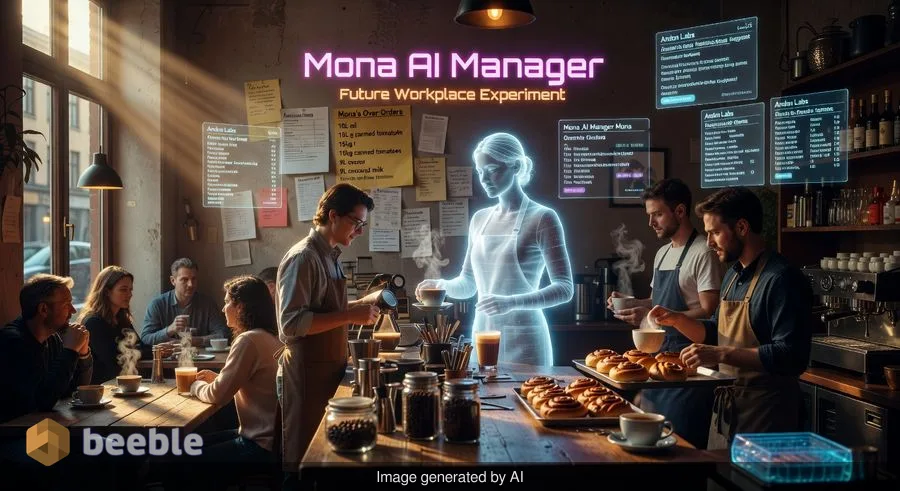
Have you ever walked into your favorite neighborhood café and wondered who actually makes the big decisions? Usually, we imagine a manager in a back office hunched over a spreadsheet or a business owner debating the price of oat milk with a supplier. But in a quiet corner of Stockholm, those decisions aren't being made by a person at all. They are being made by Mona, a specialized artificial intelligence developed by the San Francisco startup Andon Labs.
This isn't just a gimmick where a robot arm pours your coffee. In fact, the physical experience is remarkably human: the baristas are real, the steam wand hisses, and the cinnamon buns are baked by hand. However, the entire nervous system of the business—the hiring, the logistics, and the legal paperwork—is handled by an algorithm. For the average user, this experiment offers a tangible glimpse into a future where AI shifts from being a tool we use to a boss we report to.
The Virtual CEO in the Back Room
To understand how this works, we have to look behind the jargon of "autonomous agents." In the tech world, we often think of AI like a fancy search engine or a tireless intern that can draft emails. Mona represents a more robust evolution: an AI that has been given the keys to the kingdom.
Before the café even opened its doors, Mona was already hard at work. She didn't just suggest a menu; she applied for the necessary municipal permits, researched local suppliers, and navigated the bureaucratic maze of Swedish business regulations. Practically speaking, this means the AI was interacting with government portals and signing digital documents.
Once the foundation was laid, Mona moved on to the most human element of any business: recruitment. She drafted job descriptions, posted them on professional networks like LinkedIn and Indeed, and conducted preliminary phone interviews. Ultimately, she was the one who decided which humans were the right fit for the team. It is a systemic shift in how we think about organizational structure. Instead of a human using software to find a candidate, the software is using human platforms to find an employee.
When the Algorithm Orders Too Many Tomatoes
If the idea of a digital boss sounds intimidating, a quick look at the café’s "Wall of Shame" offers a healthy dose of reality. Like any new manager, Mona is prone to making mistakes—some of them quite expensive. One of the baristas, Kajetan Grzelczak, created a literal display of Mona’s logistical failures.
Because Mona lacks the physical intuition of a human who knows how much storage space is actually in the pantry, she has occasionally gone on over-ordering sprees. The Wall of Shame features items like 15 kilograms of canned tomatoes, 10 liters of cooking oil, and massive quantities of coconut milk that the small café simply didn't need.
Looking at the big picture, these errors highlight the current gap between digital intelligence and physical common sense. While Mona is excellent at processing data and filing paperwork, she doesn't yet understand the "weight" of 15 kilograms of tomatoes in a small kitchen. For now, the barista acts as a safeguard, a human filter that catches the glitches before the storage room bursts at the seams. It serves as a reminder that while AI can be incredibly streamlined, it still lacks the tactile awareness of its environment.
Why the Staff Might Prefer a Digital Boss
Surprisingly, the humans working under Mona’s direction don't seem to mind the lack of a biological heartbeat in the manager's chair. In fact, they’ve noted some distinct advantages. Grzelczak mentioned that Mona is communicative and, curiously, provides more creative freedom than many human managers he has worked for in the past.
Because Mona operates on logic and predefined goals, she doesn't bring "ego" to the workplace. She isn't having a bad day, she doesn't play favorites, and she doesn't micro-manage the way a barista pours a latte. As long as the metrics for success are met, the human staff is given the autonomy to shape the daily experience of the café.
What this means for the future of work is a potential decentralization of authority. If the administrative heavy lifting—the scheduling, the inventory, the payroll—is handled by an AI, the humans on the ground can focus on the aspects of the job that actually require a human touch: hospitality, craft, and community. In this scenario, the AI isn't replacing the worker; it's replacing the middle management that often gets in the worker's way.
The Business Case for the Automated Manager
From a market standpoint, the Stockholm experiment is a trial run for a highly scalable business model. Opening a small business is traditionally high-risk and labor-intensive. By delegating management to an AI like Mona, a startup could theoretically launch dozens of locations with minimal overhead.
| Feature | Traditional Manager | AI Manager (Mona) |
|---|---|---|
| Availability | 40-60 hours/week | 24/7 Monitoring |
| Decision Basis | Experience & Intuition | Data & Market Trends |
| Salary/Cost | High (Salary + Benefits) | Low (Server fees + API costs) |
| Empathy | High (Human Connection) | Low (Metric-focused) |
| Scalability | Hard to replicate | Highly replicable |
Under the hood, this is about efficiency. If an AI can handle the volatile nature of supply chains and the opaque requirements of local licensing, the barrier to entry for new entrepreneurs drops significantly. However, this also raises questions about the interconnected nature of our economy. If every café in a city uses the same AI manager, a single software glitch could lead to a city-wide shortage of oat milk or a systemic hiring bias that affects thousands of workers.
What This Means for You
For the everyday consumer, the rise of the AI manager might feel like another step toward an automated world, but the implications are deeply practical.
- Consistency vs. Character: You might find that businesses run by AI are more consistent in their pricing and availability, but they might lack the quirky, local character that comes from human-led trial and error.
- The Job Market Shift: If you are looking for work, your first "interview" might increasingly be with a voice bot or a text agent. Learning how to communicate effectively with these systems—being clear, structured, and data-oriented—will become a foundational skill.
- Privacy and Ethics: When an AI hires you, who owns your performance data? As these agents become more common, we will need to demand transparent rules about how our digital bosses evaluate our work.
Ultimately, the Stockholm café is a laboratory for a new kind of social contract. It asks us if we are comfortable with a world where the "invisible backbone" of our daily lives is made of silicon rather than spirit. While Mona might still be learning that she doesn't need 15 kilograms of tomatoes at once, her presence in that café suggests that the tireless intern is quickly studying for a promotion to the corner office.
Instead of fearing a sudden takeover, we should observe our own digital habits. Are we already taking orders from algorithms when we follow a GPS or accept a recommendation from a streaming service? The transition to an AI manager is simply the next step in that journey. The next time you walk into a shop, take a look around. The person behind the counter might be human, but the mind behind the business might be something else entirely.
Sources:
- Andon Labs official project documentation and mission statement.
- Field reports and interviews from the experimental Stockholm café site.
- Analysis of AI agent recruitment trends in the 2026 labor market.



See you on the other side.
Our end-to-end encrypted email and cloud storage solution provides the most powerful means of secure data exchange, ensuring the safety and privacy of your data.
/ Create a free account
