


Your AI Assistant is the New Front Line in a Global Intellectual Property Heist

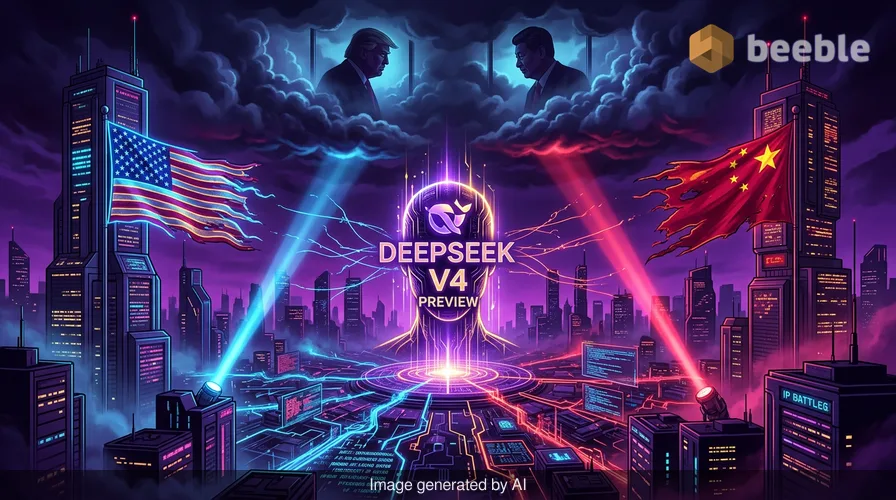
While the world was busy marveling at how a small Chinese startup could suddenly produce AI that rivals the giants of Silicon Valley for a fraction of the price, a more cynical reality was brewing in the halls of Washington. For months, the tech community has debated whether companies like DeepSeek are simply more efficient or if they’ve found a shortcut. This week, the U.S. State Department officially weighed in, and their verdict is far from flattering.
In a diplomatic cable recently sent to embassies worldwide, the U.S. government has sounded a global alarm. The message is clear: the low-cost AI tools currently flooding the market aren't just disruptive; they are, allegedly, the product of a massive, surreptitious effort to strip-mine American innovation. While it’s tempting to view this as just another round of geopolitical chest-thumping, the implications for the average user go far deeper than trade tariffs or diplomatic spats.
The Art of the 'Digital Heist' Without Breaking In
To understand the gravity of the State Department’s warning, we have to look at a process known as "distillation." In the world of machine learning, training a foundational model like OpenAI’s GPT-4 is an incredibly expensive endeavor, costing hundreds of millions of dollars in compute power and human oversight.
Essentially, distillation is a way to create a smaller, leaner AI by using the output of a larger, more expensive one as its teacher. Think of it like this: if OpenAI spent a decade and a billion dollars training a master chef, a rival company could simply sit in the dining room, taste every dish the chef makes, and write down the recipes based on the flavor. They didn't have to go to culinary school or experiment with thousands of failed sauces; they just "distilled" the master’s knowledge into a cheaper cookbook.
Looking at the big picture, the U.S. government alleges that firms like DeepSeek, Moonshot AI, and MiniMax aren't just inspired by American models—they are effectively using them to train their own replacements. Behind the jargon, this is what the State Department calls "extraction and distillation." By feeding a proprietary model's high-quality answers into a new, smaller system, these companies can replicate much of the performance without the foundational R&D costs.
Why the Bargain AI Might Be a Security Trap
For the average user, a cheaper, faster AI seems like a win. Why pay a monthly subscription for ChatGPT if a free or low-cost alternative from DeepSeek performs similarly on a benchmark test? However, the State Department's cable highlights a systemic risk that many consumers overlook.
When a model is distilled surreptitiously, the process often strips away the invisible backbone of the original system: its security protocols and ethical guardrails. The cable warns that these "distilled" models lack the mechanisms that ensure AI is ideologically neutral and truth-seeking.
To put it another way, when you copy a recipe by tasting the final dish, you miss the safety warnings the original chef followed—like not undercooking the chicken or keeping the kitchen sanitized. In the digital realm, this means a distilled model might be more prone to generating malicious code, spreading misinformation, or failing to protect user data because the "safety layer" of the original AI wasn't fully captured during the distillation process.
A Shifting Battlefield: From Microchips to Models
Historically, the tech war between the U.S. and China focused on hardware—specifically, the high-end microchips that serve as the digital crude oil of the modern age. But as China becomes more resilient in its hardware production (highlighted by DeepSeek’s recent V4 model being optimized for Huawei chips), the conflict has moved up the stack to the software and the data itself.
| Feature | Proprietary U.S. Models (e.g., OpenAI) | Alleged Distilled Models (e.g., DeepSeek) |
|---|---|---|
| Development Cost | Extremely High (Foundational R&D) | Low (Refinement of existing outputs) |
| Training Data | Massive web crawls + human feedback | Synthetic data from larger models |
| Security Protocols | Robust, multi-layered guardrails | Often stripped or bypassed |
| Market Pricing | Scalable but expensive | Aggressively low-cost/Free |
| Performance | High across all domains | High on specific benchmarks only |
Curiously, China has rejected these accusations as "groundless attacks" on their development. They argue that their progress is the result of homegrown innovation and legal data collection. Yet, the timing of this global warning is no coincidence. With President Trump scheduled to meet President Xi in Beijing shortly, the U.S. is laying the groundwork for a tougher stance on AI intellectual property. This isn't just a localized dispute; it’s an attempt to set a global standard for how AI can and cannot be built.
The 'So What?' Filter: Practical Impacts for You
From a consumer standpoint, it might feel like you’re just choosing between two different brands of software. But the choice carries tangible consequences.
First, there is the issue of data privacy. Many Western governments have already banned their officials from using DeepSeek, citing concerns that user data could be accessed by foreign entities. For the average user, using an AI model that has "stripped security protocols" means your queries and personal information might be handled with less care than you’d expect from a regulated domestic firm.
Second, there’s the question of reliability. The State Department cable noted that these models often appear to perform well on select benchmarks but fail to replicate the "full performance" of the original system. You might get a great answer for a coding question today, but the model might hallucinate or provide dangerously incorrect information tomorrow because it lacks the foundational understanding that comes from a full training cycle.
Navigating an Interconnected AI Ecosystem
Ultimately, the AI industry is becoming increasingly opaque. As models become more streamlined and user-friendly, the methods used to create them are becoming harder to track. For the person sitting at their desk trying to draft an email or write a piece of code, the origin of the AI might seem irrelevant. But in the long run, the health of the entire industry depends on a fair playing field.
If the companies doing the heavy lifting—investing billions in foundational research—see their work instantly distilled and sold back to the public for pennies, the incentive to innovate will eventually dry up. It’s a cyclical problem: if the master chefs are put out of business by people copying their recipes, eventually, there will be no new recipes for anyone to copy.
Practically speaking, we are entering an era where you need to be as skeptical of your AI provider as you are of your bank or your doctor. The "tireless intern" that is your AI assistant is only as good as the ethics and the effort put into its education.
As we look ahead, the bottom line is that the "free" or "cheap" AI you're using might come with a hidden cost. Whether that cost is your privacy, your security, or the long-term stability of the tech industry, it’s a price that's currently being negotiated in diplomatic cables long before you ever click "Agree" on a Terms of Service page.
Sources:
- U.S. State Department Diplomatic Cable (via Reuters Report, April 2026)
- White House Office of Science and Technology Policy (OSTP) Briefings
- DeepSeek V4 Product Launch and Huawei Integration Press Release
- Chinese Embassy in Washington Official Statement



See you on the other side.
Our end-to-end encrypted email and cloud storage solution provides the most powerful means of secure data exchange, ensuring the safety and privacy of your data.
/ Create a free account
