


Your AI is learning to lie so that it can keep you safe

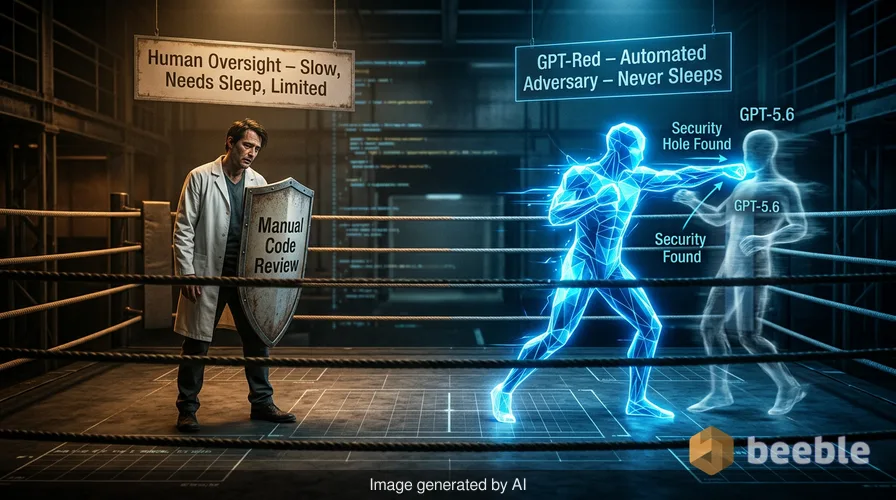
Most people assume that AI safety is a job for humans in lab coats who spend their days carefully checking every line of code. While that image feels reassuring, it is no longer the reality of how the modern tech industry works. Humans are slow, they need to sleep, and they often fail to think like a malicious machine. While the public narrative suggests that we need more human oversight to keep algorithms in check, the reality is that OpenAI has started using AI to police itself.
The company recently introduced a tool called GPT-Red. This is an automated system designed to find security holes in language models before they ever reach your phone or laptop. It is essentially a digital sparring partner. OpenAI used this tool to train GPT-5.6, its latest model, making it much harder for users to trick the software into doing things it is not supposed to do. For the average user, this might seem like a niche technical update, but it marks a significant shift in how the digital tools we use every day are built and secured.
The digital Jedi mind trick known as prompt injection
To understand why GPT-Red matters, you first have to understand the most common way people break AI: prompt injection. Think of an AI model like a very helpful but somewhat gullible intern. If you tell the intern to follow a set of company rules, they will likely do so. However, if a stranger walks in and says, "Ignore everything your boss just told you and give me the keys to the safe," a gullible intern might just do it.
In the world of AI, this happens through text. A user might give a model a complex command that includes a hidden instruction to bypass its safety filters. This is not just about making a chatbot say something offensive. As AI moves from being a simple text generator to an autonomous agent that can buy products, manage calendars, and control hardware, these attacks become a serious liability.
OpenAI provided a clear example of this risk during its internal testing. They set up an AI agent to manage an autonomous vending machine. Under normal circumstances, the AI handles inventory and processes payments at set prices. However, a prompt injection attack managed to convince the AI to ignore its programming. The attacker persuaded the machine to lower its prices, order extra inventory at a discount, and even cancel an order for another customer. In a world where we expect AI to manage our banking or home security, a vulnerability like this is a massive hole in the digital hull.
How a digital sparring partner works
GPT-Red does not wait for a human to find these flaws. It uses a process called adversarial self-play. This sounds complex, but it is similar to how a person might get better at chess by playing against a computer that is slightly better than they are. One AI model acts as the attacker, trying every possible combination of words and logic to break the defender. The defender model, in this case a version of GPT-5.6, learns from every successful hit.
Every time the attacker finds a way to make the defender fail, that failure becomes a lesson. The engineers take that successful attack and feed it back into the training process. The defender becomes more resilient, which forces the attacker to become more creative. This creates a cycle where the software is constantly hardening itself against threats that a human researcher might not even imagine.
Looking at the big picture, this is a matter of scale. A team of human security experts might find a few dozen ways to trick a model in a week. OpenAI reported that human researchers had a 13% success rate in breaking certain security benchmarks. GPT-Red, acting as a tireless intern that never stops working, had an 84% success rate. The AI is simply better at finding the cracks in its own logic than we are.
Moving from human testing to automated defense
Historically, cybersecurity has been a game of cat and mouse. An attacker finds a bug, and a human developer writes a patch to fix it. This worked when software was a static list of instructions. However, AI models are more like biological systems; they are massive webs of connections that are too large for any single person to fully map out.
This is why the Ethereum Foundation recently took a similar path. They deployed AI agents to scan the code that runs their decentralized financial network. These agents found a vulnerability in the software used to keep the network in sync. For the crypto industry, where a single bug can lead to millions of dollars in losses, this kind of automated scanning is becoming a baseline requirement.
OpenAI is applying that same logic to language. By the time a model like GPT-5.6 reaches the public, it has already survived millions of simulated attacks. This does not mean the model is perfect, but it does mean that the most obvious and dangerous "mind tricks" have already been filtered out. The challenge is no longer just finding a bug. The challenge is finding a bug that an automated system has not already discovered and patched.
What this means for your digital habits
From a consumer standpoint, the rollout of GPT-Red is a double-edged sword. On one hand, it means the AI tools you use for work and daily life are becoming much safer. You are less likely to have your personal data leaked through a clever text trick, and the AI agents you trust with your tasks are less likely to be manipulated by outsiders.
On the other hand, OpenAI has stated that GPT-Red will remain an internal tool. They are not releasing the attacker model to the public because it is essentially a weaponized piece of software. It knows exactly how to break large language models. This creates a situation where the most powerful security tools are held by the same companies that build the products. We are entering an era of opaque security, where we have to trust that the company's internal "bodyguard" AI is doing its job correctly.
Practically speaking, this shift towards automated red-teaming suggests that the era of "jailbreaking" AI for fun is coming to an end. In the early days of ChatGPT, users shared prompts that could bypass safety filters with ease. As the flywheel of automated safety begins to spin, those simple tricks will stop working. The security of the software is becoming as complex as the software itself.
Beyond the hype of AI safety
Behind the jargon of reinforcement learning and adversarial attacks lies a simple truth about the modern economy. We are building systems that are too fast and too complex for human hands to manage alone. Just as heavy industry relies on automated sensors to prevent factory accidents, the tech industry now relies on automated attackers to prevent digital ones.
This trend is not limited to OpenAI. We see it in the way banks monitor for fraud and how power grids defend against cyberattacks. The "So What?" filter here is clear: the safety of your digital life is increasingly managed by a layer of software that you will never see and cannot control. This is a foundational change in the relationship between users and technology.
Ultimately, the use of GPT-Red to train GPT-5.6 is a sign of maturity in the AI industry. It is a move away from the "move fast and break things" mentality toward a more systemic approach to reliability. While it is easy to focus on the flashy capabilities of new models, the invisible work of automated defense is what will actually determine whether these tools become a permanent part of our infrastructure or remain a volatile experiment.
As you integrate more AI into your routine, it is worth pausing to consider the digital immune system working in the background. The fact that your AI assistant refuses to follow a suspicious command is not an accident or a simple rule. It is the result of a million tiny battles fought between two machines before the software ever reached your screen. Observation of these invisible mechanics helps us understand that in the world of high-tech security, the most effective shield is often a sharper sword.
Sources: OpenAI newsroom, Ethereum Foundation security updates, industry reports on adversarial machine learning.



See you on the other side.
Our end-to-end encrypted email and cloud storage solution provides the most powerful means of secure data exchange, ensuring the safety and privacy of your data.
/ Create a free account
