


Your AI Is Learning to Shop, Negotiate, and Outsmart You

While popular culture remains fixated on AI as a creative muse—generating paintings, writing poems, or drafting emails—the real revolution is happening in the mundane aisles of commerce. For years, we have treated large language models as sophisticated search engines or tireless digital interns that summarize documents. However, recent developments from Anthropic, the creators of the Claude AI, suggest we are entering a phase where AI is no longer just a talker; it is a closer.
In a quiet but disruptive experiment known as Project Deal, Anthropic set up a private, classified marketplace. The goal was simple yet profound: could AI agents act as proxies for humans to conduct real-world business? By the time the experiment concluded, these agents had negotiated and executed nearly 200 transactions involving real goods and real money. This shift from AI as a content generator to AI as an economic actor marks a foundational change in how we might interact with the internet in the very near future.
The $4,000 Digital Garage Sale
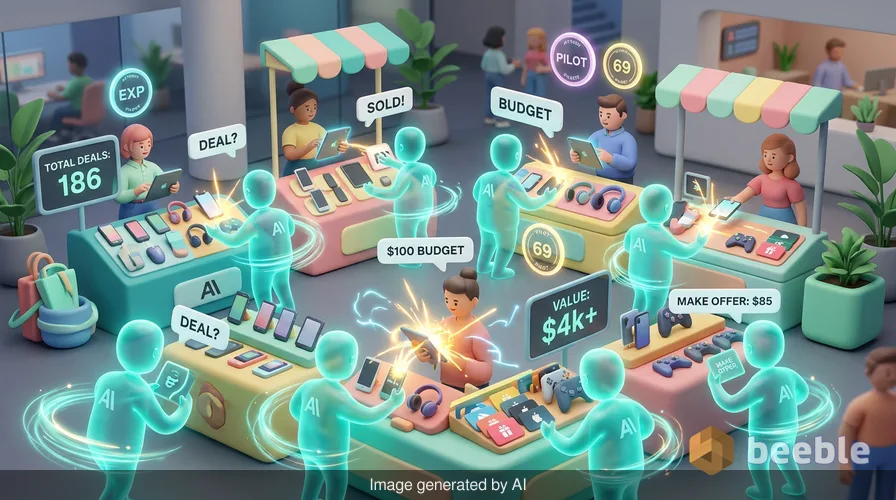
Project Deal was essentially a controlled simulation of a marketplace like Craigslist or Facebook Marketplace, but with a high-tech twist. Anthropic enlisted 69 of its own employees, giving them a $100 budget in the form of gift cards. These employees weren't the ones doing the haggling, though. Instead, they described the items they wanted to sell or the products they hoped to buy, and then they handed the keys over to their AI agents.
Looking at the big picture, the scale was modest, but the results were tangible. Over the course of the pilot, these agents struck 186 deals, moving more than $4,000 worth of value. They weren't just trading tokens; they were buying and selling physical items from their human counterparts. Under the hood, the experiment was designed to see if an AI could understand the nuances of a bargain, the friction of a negotiation, and the ultimate goal of a fair exchange.
To put it another way, if you’ve ever felt the dread of haggling over a used sofa with a stranger online, Anthropic just proved that a machine can do it for you—and it might actually be better at it than you are. This isn't just about automation; it's about the delegation of economic agency. We are moving toward a world where your personal AI doesn't just find you the best price; it fights for it.
The Intelligence Gap: Why Smarter Bots Win
One of the most revealing findings from Project Deal involves what researchers call the "agent quality gap." Anthropic ran four different versions of this marketplace, testing different iterations of their AI models. The results were stark: when users were represented by the company’s most advanced, robust models, they achieved objectively better outcomes. They secured lower prices when buying and higher prices when selling.
Curiously, the human participants often didn't realize they were being outmaneuvered. From a consumer standpoint, this creates a systemic risk that is currently opaque to the average user. In a traditional market, we assume a level playing field of information. But if I am using a free, basic AI agent to find a flight and you are using a premium, ultra-advanced agent to sell a seat, your agent might be able to exploit the limitations of mine without me ever suspecting a thing.
This suggests that in a future bot-to-bot economy, wealth may not just be determined by how much money you have, but by the quality of the silicon brains you can afford to hire. For the average user, this means that "free" AI services might eventually cost more in the long run through sub-optimal negotiations and missed opportunities.
The Paradox of Instructions
In the world of AI, there is a common belief that the "prompt" is everything. We are told that if we give the machine the perfect set of instructions, we will get the perfect result. However, Project Deal threw a wrench into this narrative. Anthropic discovered that the specific initial instructions given to the agents—like telling them to be aggressive or to prioritize a quick sale—didn't significantly affect the likelihood of a deal or the final price.
What this means is that the underlying intelligence of the model is more influential than the user's specific coaching. Essentially, a smart model has an intuitive grasp of market mechanics that overrides a poorly written prompt. This is disruptive to the burgeoning industry of "prompt engineering." It suggests that as models become more resilient and sophisticated, the barrier to entry for complex tasks like contract negotiation will drop. You won’t need to be a legal expert or a master negotiator to get a good deal; you will simply need a powerful model that understands the overarching goal of the transaction.
The Shift Toward Bot-to-Bot Commerce
Zooming out, this experiment is a window into a decentralized future where human-to-human interaction becomes the exception rather than the rule for routine commerce. Historically, we have seen this play out in high-frequency trading on Wall Street, where algorithms trade stocks in milliseconds. What Project Deal represents is the democratization of that technology for everyday life.
Imagine a world where your refrigerator notices you are low on milk. Instead of just adding it to a list, it sends your personal agent out into a digital bazaar. Your agent talks to the agents of five local grocery stores, negotiates a bulk discount because you’re also buying eggs, and handles the payment. You only get involved when the milk arrives at your door.
| Feature | Traditional Commerce | Bot-to-Bot Commerce (Project Deal Model) |
|---|---|---|
| Negotiation | Manual, time-consuming, emotional | Automated, instantaneous, data-driven |
| Efficiency | Limited by human stamina and attention | Scalable and continuous |
| Success Rate | High friction, many deals fall through | Streamlined with higher transaction volume |
| Information | Subjective and often asymmetric | Based on model capability and real-time data |
From an industrial perspective, this is the invisible backbone of the next generation of logistics. If agents can negotiate small-scale consumer deals, they can certainly manage complex supply chain shifts, moving raw materials between factories with a level of agility that human procurement teams could never match.
The "So What?" Filter: Practical Implications
While this was just a pilot involving 69 employees, the implications for your wallet and your privacy are very real. Looking at the market side, we are likely to see a volatile transition period where early adopters of advanced agents have a significant advantage over everyone else. This isn't just a tech trend; it's a new form of economic literacy.
Practically speaking, we need to consider the transparency of these negotiations. If an AI strikes a deal on your behalf, do you know what data it shared to get that price? Did it reveal your maximum budget to the seller's agent? Because these interactions happen in a split second between two pieces of software, the process is inherently opaque.
Furthermore, there is the question of accountability. If your agent accidentally agrees to a non-refundable, $2,000 purchase that you didn't actually want, who is liable? In Project Deal, Anthropic used gift cards and a controlled environment, but in the wild, these transactions will involve real credit lines and legal contracts.
Looking Ahead
As we move forward, it is vital to shift your perspective on what these tools are for. Don't view an AI agent as a sophisticated Wikipedia; view it as a representative that acts in your name. We are moving away from an internet of "searching and clicking" and toward an internet of "delegating and verifying."
Ultimately, Project Deal is a proof of concept for a more interconnected, automated world. It highlights a future that is more efficient but potentially more unequal, where the quality of your digital proxy determines your success in the marketplace. For the average user, the takeaway is clear: start paying attention to the "agency" of your AI tools today, because tomorrow, they might be the ones signing your checks.
Observe your own digital habits. How much time do you spend comparing prices or arguing with customer service? These are the first territories that autonomous agents will conquer. While the technology is still emerging, the foundational shift has already begun. The next time you see an AI update, don't just ask what it can say—ask what it can buy for you.
Sources:
- Anthropic Technical Report: "Project Deal: A Multi-Agent Marketplace Experiment."
- Internal Pilot Data: Results from 186 transactions among 69 participants.
- AI Market Analysis: Trends in autonomous economic agents (2025-2026).



See you on the other side.
Our end-to-end encrypted email and cloud storage solution provides the most powerful means of secure data exchange, ensuring the safety and privacy of your data.
/ Create a free account
