


Your Borderless Stablecoin Is Becoming a Wall Street Savings Account

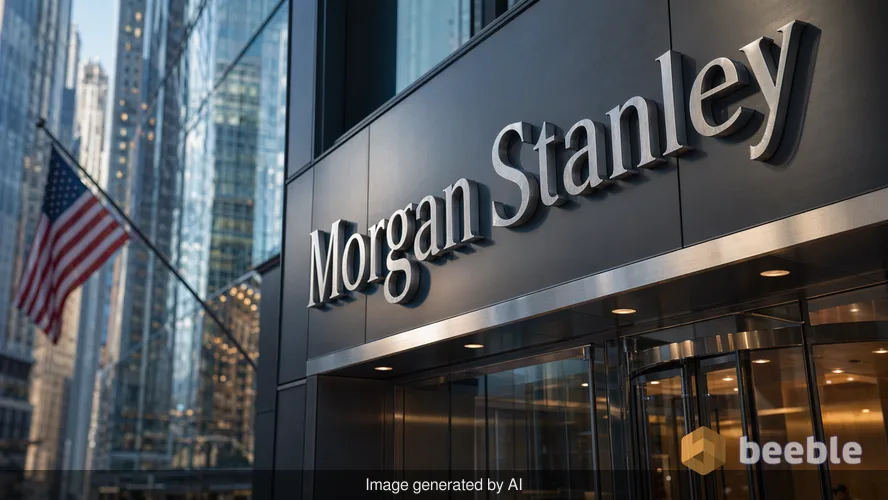
A decade ago, the promise of digital currency felt like a clean break from the marble pillars of traditional finance. We imagined a world where money moved like email—instant, borderless, and entirely independent of the suits in midtown Manhattan. But as you glance at your smartphone today, checking the balance of a digital dollar that exists only as code, the reality is far more nuanced. While the front end of your wallet looks like the future of the internet, the back end increasingly looks like a vault at Morgan Stanley.
On a macro level, we are witnessing a profound transformation in how the world’s safest assets are stored and utilized. The recent debut of Morgan Stanley’s Stablecoin Reserves Portfolio, known by its ticker MSNXX, is not just another corporate product launch; it is a calculated move to capture the heart of the digital economy. By targeting the massive reserves held by companies like Circle, the issuer of USDC, Morgan Stanley is signaling that the era of the 'digital wild west' is over. In its place, we are seeing the emergence of a hybrid system where blockchain speed meets the systemic stability of the world's largest investment banks.
The Institutional Land Grab for Your Digital Dollars
For the average person, a stablecoin is a convenience—a way to move value across borders without waiting three days for a wire transfer or paying exorbitant fees to a middleman. But for an institution like Morgan Stanley, those same stablecoins represent a massive, untapped pool of liquidity. Where we once saw a digital frontier of unbanked rebels, we now see a regulated landscape of institutional giants; where we once sought to escape the grasp of the traditional banking system, we now find ourselves tethered to its interest rate hikes through the very tokens in our wallets.
The numbers tell a story of a silent takeover. As of late April 2026, the total value of all stablecoins has reached a staggering $316 billion, a figure that is projected to balloon to $2 trillion by 2028. This is not just 'play money' for speculative traders; it is becoming the foundational plumbing for global commerce. Morgan Stanley, managing over $9 trillion in assets, has realized that whoever controls the reserves of these stablecoins essentially controls the new global reserve currency. Paradoxically, the more decentralized we want our transactions to be, the more centralized the underlying security of our money becomes.
The Battle Between BlackRock and Morgan Stanley
Until recently, BlackRock was the undisputed heavyweight in this arena. Through its management of the Circle Reserve Fund (USDXX), BlackRock has been the invisible hand guarding roughly $78 billion in assets that back the world’s second-largest stablecoin. This arrangement created a symbiotic relationship: Circle provided the blockchain technology, and BlackRock provided the institutional trust. However, Morgan Stanley’s MSNXX is a direct challenge to this dominance, specifically tailored to the requirements of the GENIUS Act—a federal framework that has fundamentally changed the rules of the game.
Financially speaking, the GENIUS Act acted as a catalyst for this institutional migration. By mandating strict reserve requirements for stablecoin issuers, the law effectively forced crypto companies to seek out the 'safest' partners possible. In practice, this meant moving away from opaque, offshore accounts and into the transparent, highly regulated money market funds of Wall Street. Consequently, the 'glass bank vault' metaphor of the blockchain—where everyone can see the transactions but only the owner holds the key—now has a second layer of security: the regulatory oversight of the U.S. government.
Why Your Wallet Is Hooked to the NYSE
It is easy to think of these developments as high-level corporate maneuvering that doesn’t affect the everyday user, but the reality is deeply interconnected with your personal financial health. When you hold a stablecoin, you are effectively a silent partner in these money market funds. MSNXX, for instance, operates only on days when the New York Stock Exchange is open. This creates a curious tension: while your token can be sent to anyone in the world 24/7, the actual value backing that token is managed according to the 9-to-5 schedule of a Manhattan trading floor.
Zooming out, this shift reflects a broader psychological change in how we view digital assets. In the early days, volatility was the price of admission for innovation; today, stability is the primary requirement for mass adoption. We are trading the radical autonomy of self-custody for the perceived safety of institutional management. On an individual level, this means that the interest rates set by the Federal Reserve in Washington D.C. now have a direct, tangible impact on the 'yield' or value of your digital wallet, just as they do on your traditional savings account or your monthly mortgage payment.
The Tokenization Paradox: Real Assets on Virtual Ledgers
One of the most fascinating aspects of Morgan Stanley’s new fund is what it reveals about the slow evolution of technology. While competitors like BlackRock are experimenting with 'BUIDL'—a tokenized fund that exists directly on a blockchain—Morgan Stanley is taking a more conservative approach. MSNXX does not trade 'on-chain' yet. It is a traditional fund serving a digital-first client base.
This highlights a pervasive gap in the current market: we have the desire for 21st-century speed, but we are still using 20th-century infrastructure to guarantee its value. To put it another way, we are putting a Ferrari engine (the blockchain) into a horse-drawn carriage (traditional money market funds). Morgan Stanley’s leadership has acknowledged that tokenization is the future, but they are waiting for the regulatory and technical 'forest fires' to clear out the risks before they commit fully. For the consumer, this means we are in a transient phase where our money is 'digital' in name but 'legacy' in its mechanics.
The $2 Trillion Horizon and Behavioral Shift
Looking toward 2028, the projected $2 trillion stablecoin market suggests that these tokens will become as ubiquitous as credit cards or cash. Behind the scenes of this trend, we are seeing the 'institutionalization of trust.' Behavioral economics tells us that people are generally risk-averse; we might flirt with experimental technologies, but when it comes to our life savings, we return to the names we know.
The success of Morgan Stanley’s recent Bitcoin ETF, which pulled in $173 million in just two weeks, proves that retail investors are eager for crypto exposure, provided it comes with a familiar logo and a professional advisor. Ultimately, the battle between Morgan Stanley and BlackRock isn't just about fees or fund performance; it is a battle for the right to be the trusted custodian of the digital era.
Key Takeaways for the Mindful Investor
- The Illusion of Separation: Understand that 'crypto' and 'traditional finance' are no longer two separate worlds. The stability of your digital dollars is now directly tied to the health of Wall Street institutions and U.S. Treasury yields.
- The Regulation Premium: The GENIUS Act has made stablecoins safer but also more centralized. Consider whether your preference for a digital asset is based on its 'decentralized' nature or its simple utility as a payment tool.
- The Yield Connection: As banks like Morgan Stanley enter the fray, the profits generated from the 'boring' reserves of your stablecoins are being captured by institutions. Stay informed about how issuers are sharing (or not sharing) that value with you.
- Institutional Trust vs. Code: Reflect on your own financial biases. Do you feel safer holding a token backed by a smart contract or a token backed by a 100-year-old bank? There is no right answer, but being aware of your psychological drivers is key to financial mindfulness.
As we move deeper into this new economic reality, it is important to remember that money has always been a collective belief system. Whether it was gold coins, paper bills, or digital tokens, its value has always depended on the strength of the institutions and social contracts that support it. By bringing stablecoins under their wing, Morgan Stanley and BlackRock are not changing what money is; they are simply updating the ledger for a new generation. The next time you swipe your phone to pay for a coffee with a digital dollar, take a moment to realize that you aren't just using a new technology—you are participating in a multi-trillion dollar shift in the very fabric of global finance.
Sources:
- Morgan Stanley Global Liquidity Announcement (April 2026)
- Standard Chartered Digital Asset Research: The Road to $2 Trillion
- CoinGecko Stablecoin Market Cap Index
- RWA.xyz Tokenized Asset Report
- Farside Investors: Bitcoin ETF Net Inflow Data
- The GENIUS Act: Federal Reserve Regulatory Framework for Stablecoins



See you on the other side.
Our end-to-end encrypted email and cloud storage solution provides the most powerful means of secure data exchange, ensuring the safety and privacy of your data.
/ Create a free account
