


Your favorite brand is about to become invisible to the bots that buy your groceries

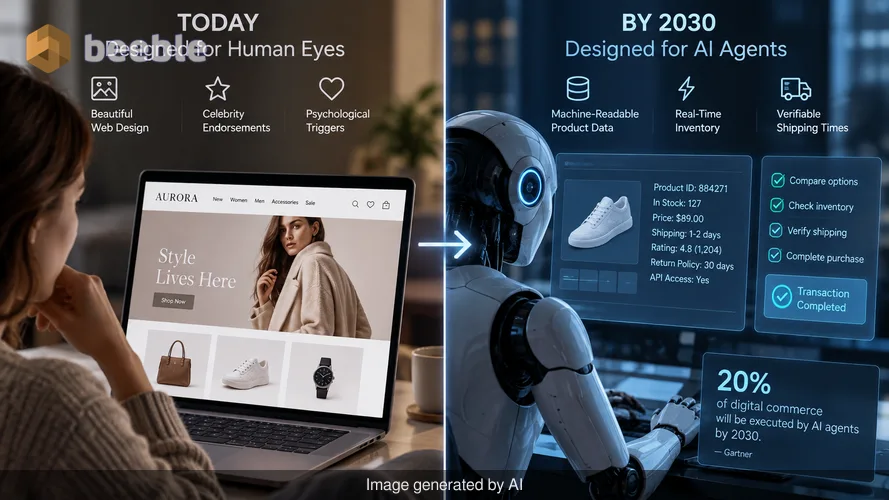
While modern retail focuses on the customer journey through beautiful web design and high-definition product photography, that journey is about to become obsolete for humans. Most corporate strategies still prioritize the eyes of the consumer. They invest in flashy layouts, celebrity endorsements, and psychological triggers designed to make a person click a button. However, the most important customer of the next decade will not have eyes. It will not have a bank card in its pocket or a preference for aesthetic minimalism. By 2030, one in five digital transactions will happen autonomously through AI agents.
This shift, often called agentic commerce, marks the end of the search-and-click era. Research from Gartner indicates that 20% of all digital commerce will be executed by AI platforms rather than people. For a retailer, this means your brand image matters significantly less than your raw data. If a machine cannot read your inventory or verify your shipping times in milliseconds, your product simply ceases to exist in the eyes of the market.
The machine does not care about your brand story
Historically, retailers have spent decades building a voice. They want you to feel a certain way when you visit their site. They use specific fonts and color palettes to signal luxury or value. Agentic AI is immune to these tactics. You can think of an AI agent as a tireless intern. This intern has one job: find the specific item you need based on rigid parameters like price, material, and delivery speed. It does not scroll through a homepage. It does not get distracted by a limited-time offer banner.
Markus Müller, the Global Field CTO for API Management at Boomi, explains that the competitive landscape is shifting. Success no longer depends on surface-level marketing. Instead, it depends on the quality of the underlying data. When an AI agent researches a product on behalf of a consumer, it looks for deep, structured information. If a retailer provides high-quality data about a product's origin, dimensions, and real-time availability, the AI is more likely to recommend that item. Retailers with vague descriptions or messy data will be filtered out by the algorithms before a human ever sees the product.
The invisible plumbing that keeps stores alive
To understand how this works under the hood, we have to look at APIs. An API, or Application Programming Interface, is a digital handshake. It is the language that allows your store's inventory system to talk to an AI agent. In the current retail model, APIs are often an afterthought. They power the search bar or the checkout page, but the human user does most of the heavy lifting by browsing.
In an agentic world, the API is the front door. If that door is locked, slow, or difficult to open, the AI agent will move to the next store in a fraction of a second. Müller argues that brands must upgrade their API architectures to survive. A retailer needs a system that is scalable and resilient enough to handle thousands of simultaneous requests from AI agents. These agents are relentless. They do not sleep, and they do not get frustrated. They simply move to the provider that offers the most transparent and accessible data.
This creates a tangible challenge for legacy retailers. Many stores still use old databases that update only once a day. If an AI agent buys the last item in stock because the database was slow to update, the system breaks. The retailer loses trust with the AI platform. In the future, a bad API rating could be more damaging to a business than a bad Yelp review.
How shopping changes when bots do the talking
For the average user, the day-to-day experience of shopping will feel decentralized. Instead of opening five different tabs to compare prices for a new dishwasher, you will give a single command to your AI assistant. You might ask for a machine that has a stainless steel tub, fits in a 24-inch space, and has the lowest repair rate in its class.
Behind the scenes, your AI agent communicates with hundreds of retailers via their APIs. It ignores the lifestyle photos of happy families in clean kitchens. It focuses on the specifications. This is where the shift becomes practical for the consumer. You no longer have to be a tech expert or a professional researcher to find the best deal. The AI agent acts as a shield against manipulative marketing.
| Feature | Traditional E-Commerce | Agentic E-Commerce |
|---|---|---|
| Primary User | Human beings | AI Agents / Bots |
| Search Method | Keywords and browsing | Structured data queries |
| Decision Driver | Brand loyalty and aesthetics | Logic, specs, and price |
| Transaction Speed | Minutes to hours | Milliseconds |
| API Role | Support function | The primary storefront |
Looking at the big picture, this changes the power dynamic of the internet. A small manufacturer in a rural town can compete with a global giant if their data is cleaner and more accessible. The invisible backbone of the industry is no longer just the shipping trucks; it is the flow of information between servers.
Protecting the system from a surge of silicon shoppers
There is a hidden risk in this transition. When thousands of AI agents start pinging a website at the same time, they can act like a self-inflicted cyberattack. If a retailer is not prepared, the sheer volume of bot traffic can crash their servers. This is why infrastructure matters. Retailers have to build systems that can tell the difference between a malicious bot and a legitimate shopping agent.
Markus Müller points out that data trust is the new currency. If a retailer provides inaccurate data to an AI, the AI will learn to ignore that retailer in the future. We are moving toward a systemic requirement for honesty. In the search-and-click era, a store might get away with a slightly misleading product description to get a person to buy. In the agentic era, a machine will flag that discrepancy and blackball the store from its recommendation engine. Transparency is no longer a moral choice. It is a technical necessity for survival.
Ultimately, this shift will force companies to be more organized. They must treat their product information with the same care they treat their physical stock. For the consumer, this means the opaque pricing and confusing technical specs of the past will likely disappear. Machines have no patience for confusion.
What this means for your digital habits
Practically speaking, you should start observing how you interact with digital assistants today. The way you talk to your phone or your smart speaker is a preview of your future relationship with retail. As these tools become more agentic, they will take over the boring parts of your life. They will handle the grocery restocks, the price comparisons for insurance, and the search for the perfect replacement part for your sink.
For the average person, the lesson is simple: the brands you see advertised on billboards may not be the ones you end up buying. Your AI assistant will choose the products that offer the best objective value based on the data it can find. To prepare for this, users should look for platforms that offer transparency and clear data sharing policies. The shift to autonomous commerce is not just about convenience. It is about a world where the best product wins because its data was the easiest to verify.
As we approach 2030, the retailers who thrive will be those who stopped worrying about the look of their website and started worrying about the health of their APIs. The future of shopping is invisible, automated, and driven by the cold logic of machines.
Sources:
- Gartner: Optimize Product Data for Agentic Commerce Success
- Boomi: Global Field CTO Insights on API Management
- International Data Corporation: Future of Consumer Reports 2026



See you on the other side.
Our end-to-end encrypted email and cloud storage solution provides the most powerful means of secure data exchange, ensuring the safety and privacy of your data.
/ Create a free account
