


Your Immutable Bitcoin Security Might Be More Fragile Than You Think

In the early days of personal computing, a secure password was a simple string of letters; today, a digital asset requires a complex sequence of cryptographic proofs. The speed of innovation creates a constant paradox for wealth preservation; the more secure a system is today, the more vulnerable it is to the technology of tomorrow. For years, Bitcoin holders viewed the network as an unassailable fortress of math. This perception is now under scrutiny as the world's largest financial institutions move to patch a hole that does not even exist yet.
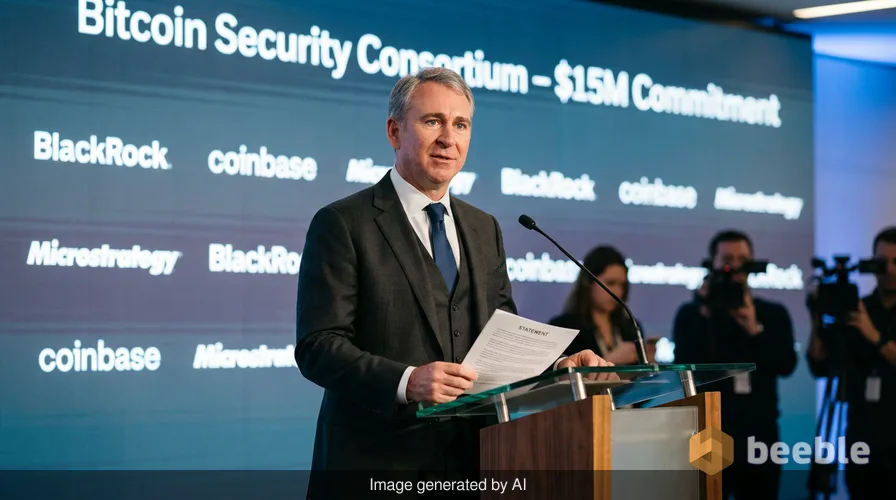
On July 23, a group of financial heavyweights including BlackRock, Coinbase, and MicroStrategy announced the Bitcoin Security Consortium. This group is committing $15 million to a specific, long-term mission. They want to prepare the network for the arrival of quantum computers. While this technology is still in its infancy, its theoretical ability to break current encryption standards is a systemic risk for the $460 billion in Bitcoin currently sitting in vulnerable addresses.
The high price of digital permanence
Bitcoin functions like a glass bank vault. In this system, every passerby can see exactly how much money sits in every account, but only the holder of the private key can open the door. This transparency is a core feature of the blockchain. However, the way these keys are presented to the network creates a lingering technical debt. For a significant portion of the Bitcoin supply, the public key is already visible to the world.
In standard modern transactions, your public key remains hidden until you decide to spend your coins. But in older types of transactions, or when a user reuses an address, that public key is etched permanently into the ledger. A conventional computer cannot use that public key to guess your private key; the math is simply too hard. A quantum computer is different. Using Shor’s algorithm, a sufficiently powerful quantum machine could work backward from a public key to derive the private key. This is no longer a fringe theory. Researchers at Google Quantum AI have already shortened the timeline for when these machines might become viable.
A coalition of the concerned
It is rare to see the world's largest asset managers fund open-source research for a problem that might be a decade away. On a macro level, this move signals that Bitcoin is no longer just a speculative retail asset. It is a line item on institutional balance sheets. When BlackRock manages a Bitcoin ETF, or when MicroStrategy holds billions in its corporate treasury, the long-term survival of the network becomes a fiduciary duty.
The consortium includes nine founding members. This list features Anchorage Digital, ARK Invest, Block, Blockstream, Fidelity Digital Assets, and Galaxy. These companies represent the entire lifecycle of a digital dollar, from custody and exchanges to mining and infrastructure. Their $15 million investment is a drop in the bucket compared to their total assets, but the signal it sends is profound. They are pre-emptively buying time. If the network wait until a quantum computer exists to start building a defense, it is already too late.
The vulnerability of the visible key
Data from a Dune Analytics dashboard reveals the scale of the exposure. Over 7 million BTC currently sit in outputs with exposed public keys. At recent market prices, this represents a $460.8 billion risk. This number is not static. During the most recent month, another 77,275 BTC moved into this exposed category.
| Address Type | Quantum Vulnerability | Approximate BTC |
|---|---|---|
| Pay-to-Public-Key (P2PK) | High (Public key is visible) | 2 million+ |
| Reused Addresses | High (Public key revealed on first spend) | 5 million+ |
| Modern SegWit (P2WPKH) | Low (Public key hidden until spend) | 12 million+ |
| Quantum-Resistant | None (Does not exist on Bitcoin yet) | 0 |
Financially speaking, this creates a "quantum discount factor." Some analysts, like Capriole Investments founder Charles Edwards, suggest this risk already weighs on the price of Bitcoin. If the market believes a third of the supply could be stolen in twenty years, that belief reflects in today’s valuation. The institutions are not just funding math; they are defending the net asset value of their products.
The governance of a decentralized defense
One of the most complex aspects of this mission is the lack of a central authority. In a traditional bank, the CEO orders a security upgrade and the IT department implements it overnight. Bitcoin has no CEO. The consortium cannot force a change on the network. To manage this, the group appointed Mike Schmidt of the nonprofit Brink to coordinate the work.
Schmidt’s role is a delicate balancing act. The consortium members do not pool their money. Instead, each company chooses which independent researchers to fund. This structure prevents any single corporation from steering the technical direction of the protocol. It is a safeguard for decentralization. Even with $15 million, BlackRock cannot buy a change to the Bitcoin code. They can only fund the people who write the proposals that the community must eventually vote on with their software choices.
Managing the transition to a quantum-resistant world
Practicality often clashes with security. The leading proposal for this transition is BIP-361. This draft outlines a phased migration. The first step involves preventing users from sending more money to vulnerable address types. The second step is more controversial. It involves tightening the rules on how legacy coins are spent.
This creates a behavioral dilemma. If you own Bitcoin in an old wallet and you do not move it to a new, quantum-resistant wallet, should the network eventually lock you out to prevent a thief from taking it? On an individual level, this feels like an overreach. From a systemic standpoint, it is a forest fire prevention measure. A mass theft of 7 million BTC would collapse the market for everyone, regardless of how secure their individual wallet is.
The psychological burden of technical debt
In everyday terms, this is similar to the transition from magnetic stripe credit cards to chip-and-pin technology. The old cards worked, but they were fundamentally flawed. The transition took years and required every merchant and consumer to change their habits. Bitcoin faces a similar hurdle, but with much higher stakes. There is no customer service line to call if you fail to migrate your coins before the first quantum attack occurs.
Behind the scenes of this trend, we see a shift in the philosophy of digital wealth. We are moving away from the idea of "buy and forget." True digital sovereignty requires a level of active maintenance that most retail investors are not prepared for. The consortium is funding the tools to make this transition easier, but the responsibility still rests with the user.
Reclaiming control over the economic future
Ultimately, the quantum threat is a reminder that no financial system is ever truly finished. Whether it is the shifting interest rates of a central bank or the cryptographic updates of a blockchain, money is a living protocol. The entry of BlackRock and Coinbase into this research space confirms that the world's most powerful financial actors now view Bitcoin's technical health as a matter of global economic stability.
As a consumer, it is easy to feel small in the face of $460 billion risks and quantum algorithms. However, the lesson here is one of mindfulness. Security is not a state of being; it is a process of constant adaptation. By watching how these institutions prepare for a theoretical future, we can learn to be more proactive with our own financial habits. Whether you hold Bitcoin or a standard savings account, the greatest risk is often the assumption that the rules of today will remain the rules of tomorrow.
Sources:
Bitcoin Security Consortium announcement (July 2024).
Dune Analytics: Bitcoin Quantum Exposure Dashboard.
BIP-361: Phased Quantum Migration Proposal (Jameson Lopp et al.).
Google Quantum AI: Resource estimates for Shor’s algorithm on ECC.
Capriole Investments Market Report (Charles Edwards).



See you on the other side.
Our end-to-end encrypted email and cloud storage solution provides the most powerful means of secure data exchange, ensuring the safety and privacy of your data.
/ Create a free account
