


Your Next Electric Car Might Not Have a Battery Pack at All

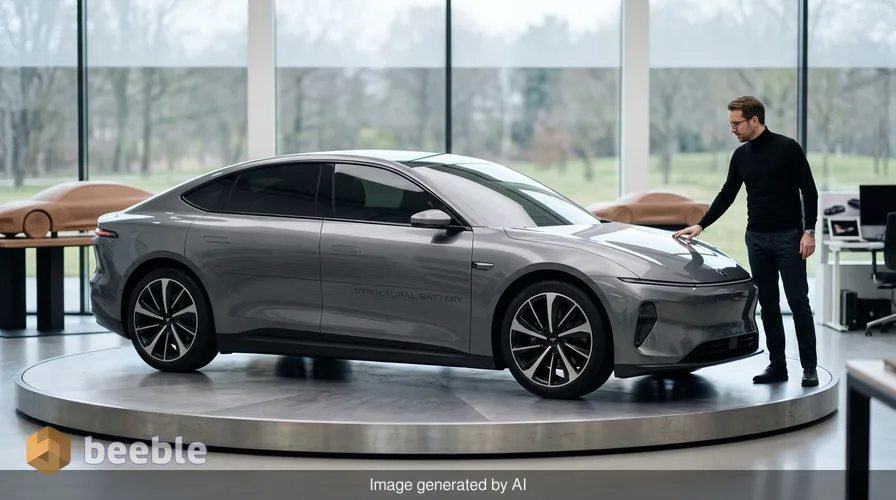
To understand the future of transportation, you have to look past the leather seats and the high-definition touchscreens and peer directly into the weave of the car's frame. For decades, the automotive industry has been locked in a weight-gain cycle. We wanted more safety features, so we added steel. We wanted more range, so we added larger, heavier battery packs. This created a systemic problem: we were spending a massive portion of a vehicle's energy just to move the weight of the fuel source itself. Essentially, the battery has become the passenger that never pays rent, taking up space and adding thousands of pounds to the chassis.
However, a foundational shift is currently occurring in research labs that promises to break this cycle. Scientists at Chalmers University of Technology have refined a structural battery that does not sit inside the car; it is the car. By using carbon fiber as both a structural component and an active energy storage medium, this technology is poised to increase electric vehicle (EV) range by as much as 70%. In everyday life, this means a car that currently struggles to hit 250 miles on a charge could suddenly clear 420 miles without changing its physical footprint.
The Backpack Problem of Modern EVs
Under the hood of a standard electric vehicle today, you will find a massive metal box filled with lithium-ion cells. This box—the battery pack—is dead weight in terms of physics. It provides no structural rigidity to the car; in fact, the car’s frame must be reinforced specifically to carry it. Looking at the big picture, this is a remarkably inefficient way to build a machine. It is the equivalent of a hiker carrying a 50-pound backpack full of snacks, but having to use 40 pounds of those snacks' energy just to keep the backpack off the ground.
To put it another way, heavy industry has long viewed energy storage and structural integrity as two separate departments. One team builds the bones of the car, and the other team fits the gas tank or battery inside those bones. The structural battery breakthrough merges these departments. It treats the car's hood, roof, and doors as the electrodes of a massive, distributed battery. This eliminates the need for the heavy "backpack" entirely, slashing the overall weight of the vehicle and allowing it to travel much further on the same amount of electricity.
Behind the Jargon: How Carbon Fiber Stores Power
The secret sauce in this development is carbon fiber. Most of us know carbon fiber as a high-end, expensive material used in racing cars and aerospace because it is incredibly strong and light. But behind the jargon, carbon fiber possesses a curious property: it can conduct electrons and store lithium ions just like the graphite used in traditional battery anodes.
In this new architecture, the carbon fiber serves a dual purpose. It acts as the reinforced skeleton of the car, providing the stiffness needed for crash safety, while simultaneously acting as the negative electrode. The researchers have paired this with a specialized electrolyte and a positive electrode, creating a "battery sandwich" that is as thin as a piece of sheet metal. For the average user, this sounds like science fiction, but the results are tangible. By turning the roof or the floor pan into a power source, manufacturers can remove the bulky battery pack and use that weight savings to either increase range or make cars significantly more affordable by requiring fewer total raw materials.
Comparing the Old Guard to the New Architecture
To visualize the impact, it helps to look at the specifications. While current lithium-ion technology is highly optimized, it has hit a ceiling of diminishing returns. The more energy you want, the more weight you must add, which eventually starts to hurt efficiency.
| Feature | Traditional EV Battery Pack | Structural Carbon Fiber Battery |
|---|---|---|
| Function | Energy storage only | Energy storage + Structural support |
| Weight Impact | Adds 1,000–2,000 lbs | Replaces existing weight of the frame |
| Range Potential | Incremental gains (2-5% yearly) | Disrupted gains (up to 70% jump) |
| Space Utilization | Takes up floor/trunk space | Integrated into the car's body |
| Material Complexity | High (Cobalt, Nickel, Copper) | Shifting toward Carbon and refined Polymers |
Practically speaking, the shift to structural batteries is not just about going further on one charge. It is about a more streamlined approach to manufacturing. If a car is lighter, it needs smaller motors, smaller brakes, and less complex suspension systems. This creates a cyclical effect where the entire vehicle becomes more efficient, cheaper to produce, and more responsive to drive.
The "So What?" Filter: Challenges and Reality Checks
While the 70% range boost is a headline-grabbing figure, we must apply a bit of pragmatic skepticism toward the timeline for mass adoption. Historically, transitioning a material from a Swedish research lab to a global assembly line is an arduous process. There are several systemic hurdles the industry must clear before your local dealership is stocked with carbon-fiber-powered sedans.
First, there is the issue of repairability. If your car's door is also part of its battery, a minor fender bender becomes a much more complex—and expensive—electrical repair. Conversely, the safety of these materials in a high-impact crash must be rigorously proven. Carbon fiber is famous for shattering rather than bending. Ensuring that a structural battery doesn't release its energy all at once during a collision is a primary concern for engineers.
Furthermore, the supply chain for high-grade carbon fiber is currently more volatile than that of traditional steel or aluminum. For this technology to be scalable, the cost of manufacturing these specialized fibers needs to drop. Currently, they are more at home in a $200,000 supercar than a $30,000 family hatchback. What this means is that we will likely see this technology emerge first in high-end performance vehicles or perhaps in aviation, where weight is the ultimate enemy of profit.
The Bottom Line for Consumers
Zooming out, the breakthrough at Chalmers University represents the beginning of the end for the "battery pack" as we know it. We are moving toward a future where energy storage is decentralized and invisible. Just as we moved from giant desktop computers to thin smartphones, the guts of our cars are being miniaturized and integrated into the very skin of the vehicle.
From a consumer standpoint, you should keep an eye on how automakers discuss "mass reduction" in the coming years. For a long time, the metric of a good EV was kilowatt-hours (kWh). In the near future, the metric that will matter most is the energy-to-weight ratio. As these structural components become more robust and cost-effective, the anxiety over range—the fear of being stranded with a dead battery—will likely become a relic of the early electric era.
Ultimately, this isn't just a win for EV owners; it's a win for resource efficiency. By using materials that do two jobs at once, we reduce the total amount of mining and processing required to build a car. It is a more resilient way to approach heavy industry, moving us away from the "add more stuff" philosophy and toward a "make the stuff smarter" approach.
As you look at your current vehicle, or perhaps the one you plan to buy next, try to see it not as a collection of separate parts—engine, frame, tank—but as an interconnected system. The invisible backbone of modern life is becoming more efficient every day, and soon, the very roof over your head as you drive to work may be the very thing that gets you there.
Sources:
- Chalmers University of Technology Research Archives (2024-2026)
- International Energy Agency (IEA) Global EV Outlook
- Advanced Materials & Manufacturing Industry Reports



See you on the other side.
Our end-to-end encrypted email and cloud storage solution provides the most powerful means of secure data exchange, ensuring the safety and privacy of your data.
/ Create a free account
