


Your 'Secure' Exchange Wallet Might Be Bitcoin's Weakest Quantum Link

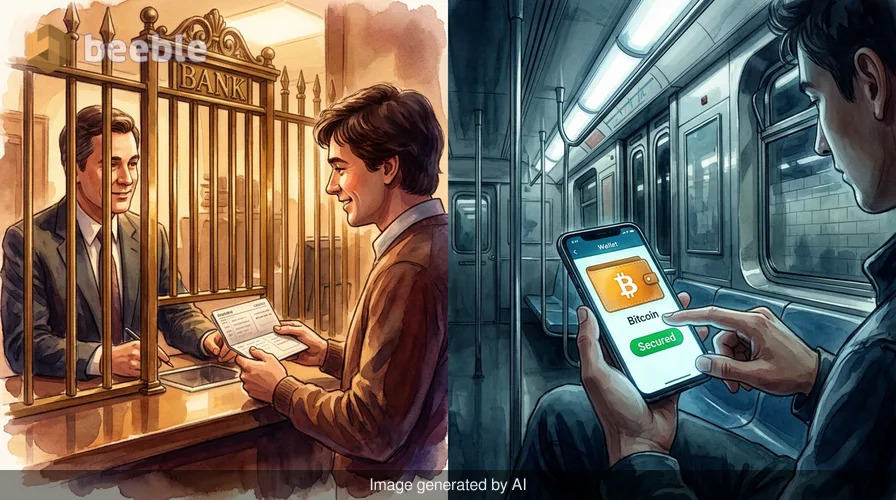
The blue light of a smartphone screen illuminates a thumb hovering over the 'Refresh' button at 2:15 AM. On the screen, a clean, user-friendly interface displays a Bitcoin balance that represents three years of disciplined saving, a digital nest egg tucked away within the fortress of a major global exchange. There is a profound sense of security in that number. It feels tangible, anchored by the multi-billion-dollar valuation of the platform and the reassuring presence of two-factor authentication. For the average retail investor, this digital vault feels more resilient than a local bank branch, mostly because it is built on the supposedly unhackable bedrock of the blockchain.
Behind the scenes of this trend, however, a nuanced architectural flaw is beginning to surface, one that has little to do with traditional hackers and everything to do with the future of physics. As we sit in mid-2026, the conversation around Bitcoin has shifted from simple price volatility to the systemic integrity of the network itself. While most users feel protected by the sheer scale of the institutions they use, recent data suggests that the very convenience of these exchanges might be creating a concentrated vulnerability to the burgeoning era of quantum computing.
The Glass Bank Vault and the Quantum Skeleton Key
To understand why your exchange balance might be at risk, we have to look at how Bitcoin actually lives on the ledger. Think of the blockchain as a glass bank vault where everyone can see the money inside, but only the owner has the key. In the early days of Bitcoin, many users utilized a format called Pay-to-Public-Key (P2PK). In this setup, your public key—the digital address required for others to send you money—was visible to the entire world. Later, the network moved toward a more sophisticated system called Pay-to-Public-Key-Hash (P2PKH), which essentially adds a protective layer, masking your public key until the moment you decide to spend your funds.
In practice, this mask acts as a vital shield. A quantum computer, utilizing something known as Shor’s algorithm, could theoretically derive a private key (the thing that lets you spend money) from a public key in a matter of minutes. However, it cannot easily derive a public key from a hash. Consequently, as long as your public key remains hidden behind that hash, your Bitcoin is effectively quantum-resistant. The trouble starts when the public key is revealed, which happens the moment you authorize a transaction or if you are using an older, legacy address where the key was never hidden to begin with.
The Glassnode Warning: A Concentrated Vulnerability
Zooming out to the macro level, new data from Glassnode reveals a startling reality: a massive portion of the Bitcoin supply is currently sitting in a state of exposure. Specifically, the data highlights that nearly 4 million BTC—roughly a quarter of the circulating supply—is held in addresses where the public key is already known to the network. Curiously, a significant percentage of this vulnerable Bitcoin isn't just sitting in forgotten, decade-old wallets from the Satoshi era; it is concentrated within the massive cold storage systems of major cryptocurrency exchanges.
Financially speaking, exchanges prioritize liquidity and operational efficiency above almost all else. To manage billions of dollars in customer withdrawals every day, these platforms often reuse addresses or utilize complex multi-signature scripts that inadvertently reveal public keys to the ledger. While this makes the internal plumbing of the exchange run smoothly, it creates a systemic honeypot. If a cryptographically relevant quantum computer were to go online today, it wouldn't need to hunt down individual retail users; it would simply need to target the handful of massive wallets owned by the world’s largest exchanges.
Paradoxically, Convenience is the Catalyst
On an individual level, we gravitate toward exchanges because they remove the friction of self-custody. Managing your own private keys is a mundane yet terrifying task; lose a piece of paper, and your life savings vanish into the digital ether. By trusting an exchange, we trade that personal responsibility for institutional insurance and a familiar login screen. Through this economic lens, we are treating Bitcoin like fiat currency, relying on a central authority to protect us from the complexities of the underlying technology.
Historically, this has worked well. But quantum computing represents a paradigm shift. Unlike a standard database hack, a quantum attack on an exchange's wallet doesn't require a password or a leaked staff email. It attacks the mathematical laws that the entire system is built upon. As a result, the very centralization that makes crypto feel safe for the masses is exactly what makes it fragile in the face of next-generation computation. The interconnected nature of the market means that if one major exchange were compromised via a quantum exploit, the resulting market correction would likely clear out the dead wood of the entire industry, regardless of whether your personal coins were technically secure.
The Shifting Sands of Digital Trust
Ultimately, this is a story about the evolution of trust. We are currently living through a transient period where the old rules of finance—the belief in the invincibility of big institutions—are colliding with the transparent and uncompromising reality of the blockchain. In contrast to a traditional bank, where a central bank can simply print more money to cover a systemic failure, the Bitcoin network is a rigid, mathematical structure. If the math is broken, the belief system that gives the asset value begins to dissolve.
Fortunately, the situation is not as dire as the headlines might suggest. The Bitcoin developer community is already working on post-quantum cryptographic (PQC) signatures. However, implementing these changes requires a network-wide consensus, a process that is notoriously slow and politically fragmented. More importantly, it requires users to move their funds from old, vulnerable addresses to new, quantum-secure ones. For an exchange holding hundreds of thousands of individual accounts, this migration is a logistical nightmare that many are procrastinating on until the threat becomes more tangible.
Beyond the Hype: A Lesson in Financial Resilience
From a consumer standpoint, the Glassnode data serves as a sobering reminder that there is no such thing as a truly passive investment. Even in the digital age, our assets require a form of maintenance. Just as you wouldn't leave a classic car in a garage for thirty years without checking the seals, you cannot leave digital assets in a legacy wallet and assume the world around it won't change. The inflationary pressure of technological advancement is just as real as the inflation that eats away at the purchasing power of the dollar in your pocket.
Practically speaking, the quantum threat is symptomatic of a larger trend: the gradual erosion of the "set it and forget it" mentality. Whether it’s shifting interest rates affecting your mortgage or a quantum algorithm threatening your digital wallet, the modern financial landscape demands a higher level of mindfulness. We are moving away from an era of blind trust in institutions and toward an era of verified, individual sovereignty.
Food for Thought: Reclaiming Your Digital Future
As you look at your portfolio today, it is worth asking whether your sense of security is based on the actual strength of the technology or merely the comforting branding of the platform you use. Are you holding your assets in a way that respects the mechanics of the blockchain, or are you treating it like a speculative mood ring that you hope stays green?
Consider these reflections for your own financial journey:
- The Custody Question: When was the last time you checked what kind of address your Bitcoin is stored in? If you are on an exchange, have you looked into their specific roadmap for quantum resistance?
- The Illusion of Permanence: Markets and technologies are in a constant state of flux. How resilient is your long-term savings plan to a sudden shift in the underlying security of the internet?
- The Value of Sovereignty: Moving funds to a non-custodial, P2PKH or SegWit wallet doesn't just potentially improve security; it forces you to understand the tools you are using. Is the convenience of an exchange worth the systemic risk of the honeypot?
In the end, Bitcoin remains a revolutionary tool for financial freedom, but that freedom comes with the price of vigilance. The glass bank vault is still standing, but as the world builds more powerful telescopes, the secrets we thought were hidden might soon be in plain sight.
Sources:
- Glassnode: On-chain Analysis of Bitcoin Address Vulnerabilities (Q2 2026)
- National Institute of Standards and Technology (NIST): Post-Quantum Cryptography Standardization Report
- Bitcoin Core Research: Proposed BIPs for Quantum-Resistant Signatures
- Global Macro Index: Impact of Quantum Computing on Digital Asset Liquidity
- Journal of Behavioral Economics: Institutional Trust vs. Technological Risk in Retail Investing



See you on the other side.
Our end-to-end encrypted email and cloud storage solution provides the most powerful means of secure data exchange, ensuring the safety and privacy of your data.
/ Create a free account
