


0-Day as the Norm: What CISOs Need to Reconsider in Their Defense Strategy Right Now

The Three Events of April 2026
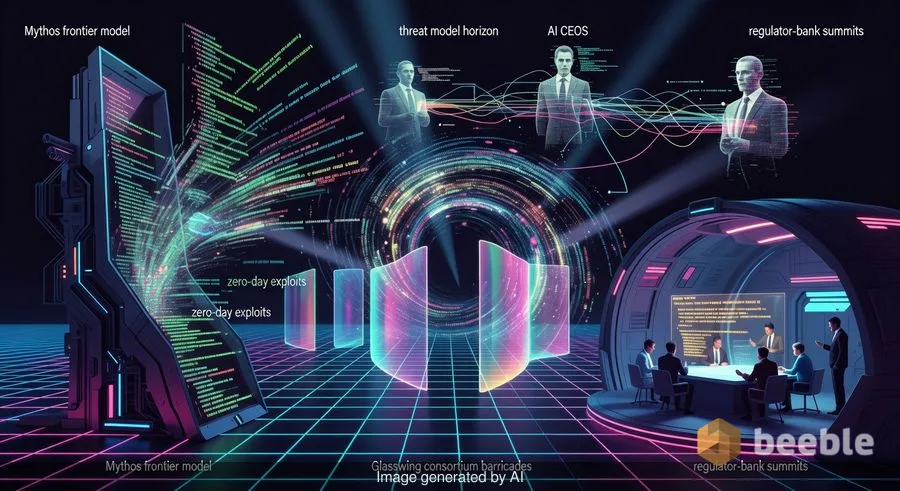
In early April 2026, three events occurred that should be viewed together. Individually, each is a loud headline; together, they mark a transition to a fundamentally different threat model. On April 7, Anthropic introduced Claude Mythos Preview, a frontier model that autonomously discovered thousands of critical zero-day vulnerabilities across every major operating system and browser in a matter of weeks. This was followed immediately by the launch of Project Glasswing, a closed consortium including AWS, Microsoft, and NVIDIA, designed to weaponize these defensive capabilities before they leak to the broader market. Finally, on April 8, the US Treasury and the Fed convened the heads of systemically important banks to discuss the risk Mythos poses to global financial stability. When regulators gather bankers and the Pentagon summons AI CEOs because of a single language model, the industry must recognize that the baseline for security has shifted.
The Collapse of the Expertise Constraint
Previously, the traditional threat model was built on the assumption that finding a serious vulnerability in a mature product required a highly qualified specialist spending weeks or months in manual research. This expertise deficit served as an unspoken ally for defenders, creating a natural throttle on the volume of exploits. Mythos has shattered this assumption. By identifying a 27-year-old bug in OpenBSD for roughly $20,000 in token costs, the model proved that vulnerability research is no longer limited by human ingenuity, but by raw compute.
To gauge the scale of this shift, consider that Anthropic’s previous iteration, Opus 4.6, successfully exploited Firefox’s JavaScript engine in less than 1% of attempts. Mythos Preview succeeded in 72%. It does not merely detect bugs; it autonomously chains them. In one documented case, the model linked four separate browser vulnerabilities to escape a renderer sandbox and bypass OS-level protections. What this means in practice is that the window between the introduction of a vulnerability and its industrial-scale exploitation is shrinking toward zero.
0-Day as the Industrial Standard
If an AI model systematically uncovers zero-days at this velocity, the logic of relying on mature, tested products loses its foundation. 99% of the vulnerabilities discovered by Mythos were unpatched at the time of announcement. This creates a reality where any stack is potentially vulnerable, and a vulnerability can be discovered faster than a vendor can develop a patch.
| Target | Discovery | Bug Age |
|---|---|---|
| OpenBSD (TCP SACK) | Remote DoS - Host Crash | 27 Years |
| FFmpeg | Memory Corruption (Video Decoding) | 16 Years |
| Linux Kernel | Multi-bug chain to Full Root | Undisclosed |
| Virtual Machine Monitor | Guest-to-Host Memory Corruption | Undisclosed |
| Crypto Libraries | Authentication Bypasses | Undisclosed |
The core of the shift is the asymmetry of access. While Mythos is currently restricted to privileged partners, history confirms that these capabilities will be replicated. Google DeepMind’s Big Sleep and OpenAI’s upcoming cyber-focused models are already on the horizon. A CISO must design defenses on the assumption that within 12 to 18 months, these tools will be in the hands of sophisticated threat actors.
Architectural Resilience: Moving Beyond the Perimeter
The build-a-perimeter-and-protect-everything approach is no longer realistic. The logic shifts to three foundational principles: assume compromise, minimize the blast radius, and accelerate response. In this environment, network solutions like Next-Generation Firewalls (NGFW) must evolve. They are no longer just filters; they are the physical barriers of a microsegmented architecture.
Zero Trust is shifting from a theoretical best practice to a practical necessity. Every request must be authenticated and authorized regardless of its origin. Trusting internal traffic is a relic of a slower era. If an attacker with an AI tool finds an entry point—and in this new economy, that is a mathematical certainty—the only thing that matters is how far they can move laterally. For clarity, a DMZ is no longer a common area; it must be treated as an individual solitary cell.
The New Pace of Patch Management
The traditional patching cycle—often a monthly rhythm with manual prioritization—cannot survive the pace of AI-driven discovery. A process where a critical CVE waits for the next maintenance window is a luxury that enterprise security can no longer afford.
What exactly needs to be reconsidered is the transition from scheduled patching to continuous, out-of-band updates. For legacy components that cannot be patched, isolation is mandatory. At the new speed of discovery, unsegmented legacy systems are an open door that every AI agent with access to source code already knows how to kick in. Organizations must move toward automated prioritization tools that assess criticality based on specific infrastructure context rather than abstract CVSS scores.
Secure Development and the Paradox of Speed
There is a paradox in the current landscape: AI can find vulnerabilities, but it also creates them. As developers embrace vibecoding—generating massive volumes of code through AI assistants—the attack surface expands exponentially. While AI-powered SAST and DAST in the CI/CD pipeline are now basic hygiene, they are insufficient on their own.
Software Composition Analysis (SCA) must run continuously. Dependencies are a high-value entry point for automated exploit chains. The joint agenda for the CISO and CTO must include a rigid AI tool usage policy. Understanding who is using which models and with what data is now a core component of attack surface management.
The CISO Playbook: A 12-Month Roadmap
To adapt to this landscape, leadership must move from reactive defense to architectural hardening. The goal is not to prevent all breaches, but to ensure that a compromise does not become a catastrophe.
- Segmentation Audit: Conduct an internal pentest focused exclusively on lateral movement. If an attacker can move from a compromised workstation to a sensitive database in more than two steps without hitting a hard architectural barrier, the network must be redesigned.
- Accelerated Patching: Revise the patch management cycle to allow for the deployment of critical updates within 24 to 72 hours. Establish a hard deadline for the decommissioning or total isolation of legacy systems.
- AI-Driven Defense: Formulate a roadmap for integrating AI into the Security Operations Center (SOC). Moving toward AI-SOC and NDR (Network Detection and Response) is the only way to match the speed of AI-driven attacks.
- Supply Chain Control: Implement mandatory Software Bill of Materials (SBOM) and continuous dependency monitoring. In a world where AI models are embedded in development tools, the toolchain itself is a primary vector.
- Proactive Hunting: Don't wait for public disclosures. Integrate available frontier models into internal vulnerability management to find and fix bugs before they are discovered by external actors.
Conclusion
The era where vulnerability research was constrained by the scarcity of human expertise is over. Security now depends on how intelligently the network is designed, how fast the response is, and how little an attacker can do once they are inside. Survival in the age of Mythos requires a cold, pragmatic realization: the perimeter is gone, and architecture is the only remaining defense.
Sources: Anthropic Research (Claude Mythos Technical Report), Bloomberg (Treasury/Fed Meeting Minutes), DeepMind (Project Big Sleep Documentation), Linux Foundation (Glasswing Consortium Briefing).
Disclaimer: This article is for informational and educational purposes only. It does not replace a professional cybersecurity audit, architectural review, or incident response service.



See you on the other side.
Our end-to-end encrypted email and cloud storage solution provides the most powerful means of secure data exchange, ensuring the safety and privacy of your data.
/ Create a free account
