


Alibaba’s Qwen3.5 Debut: A New Benchmark for Agentic AI and Cost Efficiency

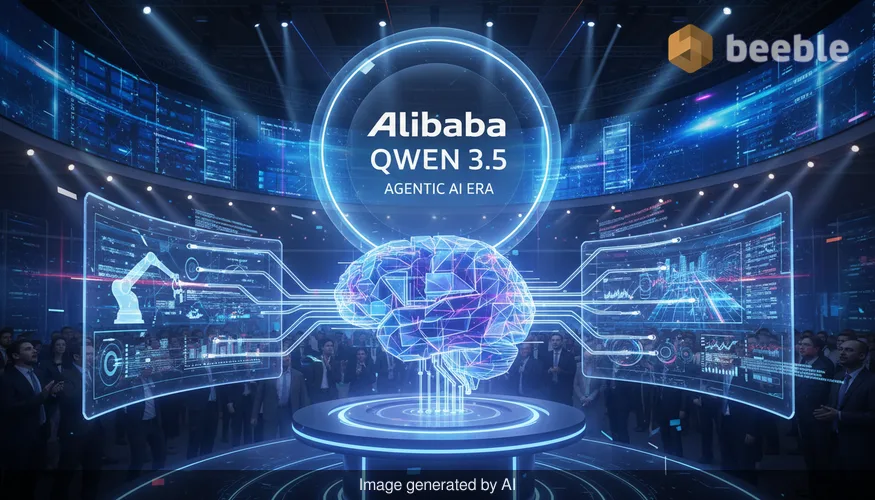
On Monday, February 16, 2026, Alibaba Cloud shifted the landscape of the global AI race by unveiling Qwen3.5. This latest iteration of their proprietary large language model (LLM) is not just another incremental update; it represents a fundamental pivot toward the "agentic AI era." While previous models focused on generating text and code, Qwen3.5 is engineered to act—planning, executing, and refining complex workflows with a level of autonomy that Alibaba claims surpasses its primary U.S. competitors.
The announcement comes at a time when the industry is moving away from simple chatbots toward "agents"—AI systems capable of using tools, navigating software interfaces, and completing multi-step projects without constant human intervention. By optimizing for both reasoning depth and operational cost, Alibaba is positioning Qwen3.5 as the backbone for the next generation of automated enterprise solutions.
Defining the Agentic Shift
To understand why Qwen3.5 matters, we must first define the "agentic" shift. Traditional AI models are reactive; they provide an answer based on a prompt. Agentic AI, however, is proactive. If you ask an agent to "organize a business trip," it doesn't just list flights; it checks your calendar, compares prices across platforms, books the ticket via an API, and adds the itinerary to your schedule.
Alibaba has focused heavily on "tool-use" and "long-horizon planning" in this release. Qwen3.5 features a refined architecture that allows it to maintain a coherent logical chain over thousands of steps. This is a significant leap from the "hallucination" issues that plagued earlier models when tasked with long-form execution. By treating the model as a controller for external software, Alibaba is moving the AI from the screen into the actual workflow of the user.
Benchmarks and Performance: Challenging the Status Quo
Alibaba’s internal data suggests that Qwen3.5-Max (the flagship variant) has overtaken several leading Western models in key reasoning benchmarks. Specifically, in the HumanEval coding test and the GSM8K mathematical reasoning suite, Qwen3.5 showed a 15% improvement over its predecessor, Qwen2.5, and edged out current iterations of rival models in zero-shot logical reasoning.
| Metric | Qwen3.5-Max | Leading US Rival (Est.) | Qwen2.5 (Previous) |
|---|---|---|---|
| MMLU (General Knowledge) | 89.4% | 88.2% | 85.1% |
| HumanEval (Coding) | 91.2% | 89.5% | 82.4% |
| GSM8K (Math) | 94.1% | 93.0% | 88.9% |
| Context Window | 1M Tokens | 128k - 1M Tokens | 128k Tokens |
| Cost (per 1M tokens) | $0.15 | $0.50 - $2.00 | $0.25 |
Beyond raw scores, the most striking aspect of the release is the cost efficiency. Alibaba has managed to reduce the inference cost of Qwen3.5 by nearly 40% compared to previous high-tier models. In the high-volume world of enterprise AI, where companies process billions of tokens daily, this price drop is a powerful incentive for migration.
The Architecture of Autonomy
How did Alibaba achieve these gains? The secret lies in a hybrid training approach that combines traditional supervised fine-tuning with a new "Reasoning-Reinforcement Learning" (RRL) loop. This process rewards the model not just for the correct final answer, but for the efficiency and accuracy of the steps it took to get there.
Think of it like training a chef. A traditional model is rewarded for the final dish. Qwen3.5 was rewarded for how it organized the kitchen, how it handled the knife, and how it adjusted the heat when things went wrong. This "process-based" learning makes the model significantly more reliable when it encounters unexpected errors in a real-world environment, such as a broken API link or a change in data format.
Practical Applications for Developers and Enterprises
For businesses, the arrival of Qwen3.5 opens doors that were previously closed due to cost or reliability concerns. Here are three immediate use cases:
- Autonomous DevOps: Qwen3.5 can be integrated into CI/CD pipelines to not only identify bugs but to write the fix, test it in a sandbox, and submit a pull request for human review.
- Complex Supply Chain Management: The model can ingest thousands of pages of logistics data, identify bottlenecks, and autonomously contact suppliers via email to request status updates or negotiate minor terms.
- Personalized Research Agents: Researchers can task the model with monitoring hundreds of academic journals, synthesizing findings, and updating a central database in real-time, maintaining context over months of data.
Implementation Checklist: Moving to Qwen3.5
If your organization is considering integrating Qwen3.5 into its stack, consider the following steps to ensure a smooth transition:
- Audit Your Current API Usage: Compare your current token costs with Alibaba’s new pricing. The savings may justify the migration effort alone.
- Evaluate Tool-Calling Requirements: Qwen3.5 excels at using external functions. Ensure your internal APIs are well-documented (OpenAPI/Swagger) so the model can ingest them easily.
- Test the Context Window: With a 1-million-token window, you can now feed entire codebases or legal archives into the prompt. Start with a small-scale pilot to see how the model handles your specific data density.
- Set Guardrails: Because agentic AI can take actions, it is vital to implement human-in-the-loop (HITL) checkpoints for sensitive tasks like financial transfers or public-facing communications.
The Road Ahead
The launch of Qwen3.5 signals a maturing AI market where the focus is shifting from "magic" to "utility." Alibaba’s aggressive pricing and focus on agentic capabilities put immense pressure on other global players to lower their barriers to entry. As we move further into 2026, the success of an AI model will no longer be measured by how well it writes a poem, but by how much of a company’s operational burden it can reliably carry.
Sources
- Alibaba Cloud Official Newsroom (Hypothetical 2026 Release)
- Qwen Technical Whitepaper v3.5
- ModelStudio Developer Documentation
- Global AI Benchmark Consortium (GABC) 2026 Report



See you on the other side.
Our end-to-end encrypted email and cloud storage solution provides the most powerful means of secure data exchange, ensuring the safety and privacy of your data.
/ Create a free account
