


Beyond the Chatbot: How Dassault Systèmes’ AI Companions are Rewiring Industrial Engineering

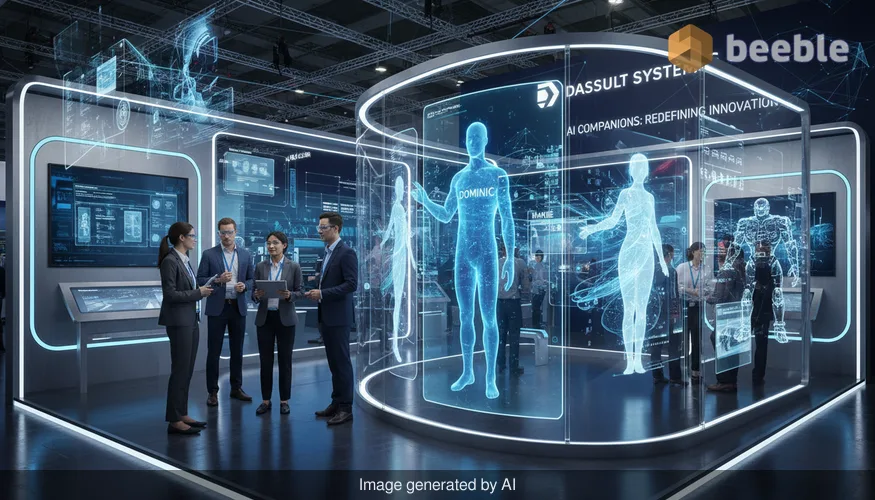
The industrial world is moving past the era of static software. For decades, engineers and designers have relied on Computer-Aided Design (CAD) and Product Lifecycle Management (PLM) tools as digital drafting boards. However, the rise of generative AI is transforming these tools from passive instruments into active collaborators. At the forefront of this shift is Dassault Systèmes, the French software titan that has spent forty years perfecting the 'virtual twin.'
With the introduction of specialized AI companions like Aura, Leo, and Marie, the company is not just adding a search bar to its interface; it is embedding domain-specific intelligence directly into the engineering workflow. These are not general-purpose chatbots like those used for writing emails; they are precision instruments designed to navigate the complexities of thermodynamics, material science, and manufacturing logistics.
The Virtual Twin Meets Generative Intelligence
To understand why these AI companions matter, one must first understand the concept of the Virtual Twin. Unlike a simple 3D model, a virtual twin is a mathematically accurate, physics-based representation of a real-world object or system—be it a jet engine, a skyscraper, or a human heart.
By integrating generative AI into this environment, Dassault Systèmes allows engineers to move from 'drawing' a solution to 'describing' a problem. Instead of manually adjusting the geometry of a bracket to reduce weight, an engineer can ask the AI to optimize the part for 3D printing using a specific titanium alloy. The AI doesn't just suggest a shape; it validates that shape against the laws of physics within the virtual twin environment.
Meet the Specialists: Marie, Leo, and Aura
Dassault Systèmes has moved away from the 'one-size-fits-all' AI approach, opting instead for specialized personas trained on distinct datasets. This ensures that the advice given is technically sound and contextually relevant.
- Marie: Positioned as the scientific expert, Marie is designed to answer complex queries regarding chemistry, biology, and material science. For a researcher developing a new polymer, Marie can provide insights into molecular stability or regulatory compliance, drawing from vast libraries of scientific literature.
- Leo: This companion is the bridge to the engineering world. Leo is built to handle the 'how-to' of industrial design. Whether it is a question about mechanical stress distribution or a query regarding the best assembly sequence for a complex fuselage, Leo provides actionable engineering data.
- Dominic: While Marie and Leo focus on the 'what' and 'how,' Dominic serves as the situational guide. Recently showcased at the Mobile World Congress, Dominic acts as a high-level navigator, helping users manage the logistics of large-scale events or navigate the sprawling ecosystem of the 3DEXPERIENCE platform.
Florence Verzelen, Executive Vice President of EMEA at Dassault Systèmes, describes these tools as 'superpowers.' The goal is to eliminate the 'drudge work' of data retrieval and basic calculation, allowing human experts to focus on high-level creative problem-solving.
From Generative Design to Generative Engineering
There is a crucial distinction between the generative design of the last decade and the AI-driven engineering of today. Traditional generative design used algorithms to iterate through thousands of geometric permutations based on set constraints. It was powerful but often produced 'black box' results that were difficult to modify.
Modern AI companions provide a layer of natural language interaction. This allows for a 'human-in-the-loop' experience where the engineer can argue with the AI, ask for justifications, and refine the parameters in real-time. It turns the design process into a conversation. If Leo suggests a specific reinforcement pattern, the engineer can ask, "Why that pattern over a honeycomb structure?" and receive a technical justification based on the project's specific load requirements.
Practical Implications for the Manufacturing Floor
The impact of these companions extends beyond the design office. In manufacturing engineering, the stakes are measured in downtime and material waste.
| Feature | Traditional Workflow | AI-Companion Workflow |
|---|---|---|
| Problem Solving | Manual manual-searching and peer consultation | Instant technical answers from Leo/Marie |
| Design Iteration | Sequential, manual adjustments | Generative suggestions based on physics |
| Knowledge Transfer | Dependent on senior staff experience | Institutional knowledge captured in AI models |
| Data Analysis | Manual spreadsheet and simulation review | AI-driven synthesis of virtual twin data |
How to Prepare Your Workflow for AI Integration
Adopting these AI companions is not as simple as flipping a switch. It requires a shift in how industrial teams manage their data. To get the most out of these tools, companies should consider the following steps:
- Clean Your Data Foundations: AI is only as good as the data it accesses. Ensure your PLM data is structured and that your virtual twins are up to date.
- Define Specialized Use Cases: Don't try to use AI for everything at once. Start by deploying Marie for R&D or Leo for mechanical optimization to see where the highest ROI lies.
- Invest in Prompt Engineering for Engineers: Teaching your staff how to ask precise, technical questions is the new 'drafting' skill. A vague question yields a vague design.
- Maintain Human Oversight: Always treat AI suggestions as hypotheses. The final validation must still occur through rigorous simulation and physical testing.
The Future of Industrial Innovation
The launch of these AI companions marks a turning point where software stops being a tool and starts being a teammate. By grounding generative AI in the physical accuracy of the virtual twin, Dassault Systèmes is solving the 'hallucination' problem that plagues general AI.
As these models continue to learn from the vast amounts of data generated within the 3DEXPERIENCE platform, the gap between an idea and a manufactured reality will continue to shrink. For the engineer of 2026, the challenge is no longer how to use the software, but how to best lead a team of digital experts to solve the world’s most pressing industrial challenges.
Sources
- Dassault Systèmes Official Newsroom
- 3DEXPERIENCE Platform Documentation
- Mobile World Congress 2024/2025 Tech Briefings
- Interviews with Florence Verzelen, EVP EMEA, Dassault Systèmes



See you on the other side.
Our end-to-end encrypted email and cloud storage solution provides the most powerful means of secure data exchange, ensuring the safety and privacy of your data.
/ Create a free account
