


Beyond the Service Account: Why Google’s AI Identities Force a Rewrite of the Enterprise Trust Model

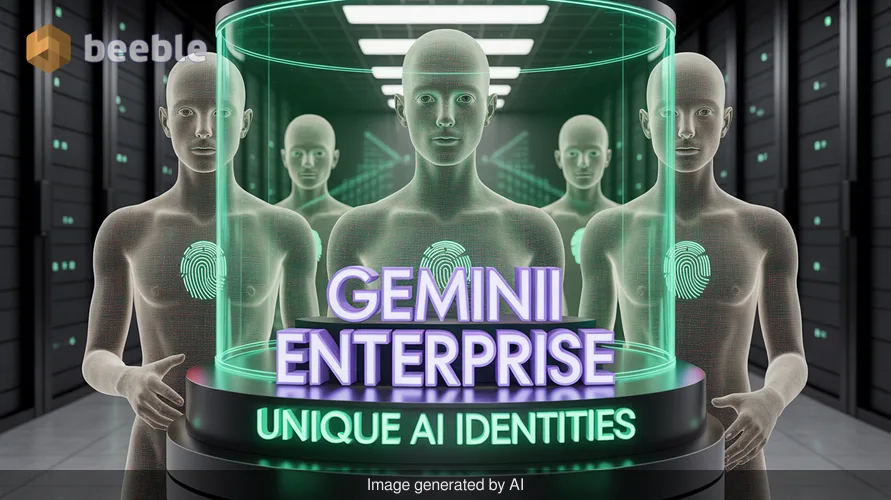
The introduction of unique identities for AI agents within Google’s Gemini Enterprise platform marks a fundamental transition in how we conceptualize the enterprise perimeter. For years, the security industry has struggled to categorize AI: was it a tool, a user, or a service account? By formalizing AI agent identities, Google has effectively ended the era of 'proxy-based' AI interaction. We are no longer securing a human who uses AI; we are securing a semi-autonomous entity that possesses its own cryptographic fingerprint and access rights.
The Core of the Shift: From Impersonation to Agency
Previously, AI interactions were largely tethered to the identity of the human user or a generic service account. This created a significant visibility gap. When an LLM-powered agent accessed a sensitive database to generate a report, the audit logs showed the human user—or worse, a broad-permissions API key—performing the action. This obfuscation acted as an unspoken ally for potential attackers, as malicious lateral movement could be masked within legitimate AI traffic.
Now, the logic shifts to a model where the AI agent is a first-class citizen in the Identity and Access Management (IAM) hierarchy. What this means in practice is that security teams can finally apply granular policies specifically to the agent. However, this architectural breakthrough introduces a new form of complexity: the management of Non-Human Identities (NHIs) at a scale that exceeds human oversight capacities. In modern cloud environments, NHIs already outnumber human users by a factor of 45-to-1; adding unique identities for every deployed AI agent will only widen this access asymmetry.
The Expertise Deficit as an Unspoken Ally
To gauge the scale of the risk, one must look at the current state of vulnerability management. Most enterprises struggle with basic hygiene for static service accounts. Introducing dynamic AI agents—entities that can generate code, call APIs, and interpret data in real-time—requires a level of architectural resilience that few legacy components can support. The threat model has changed: we are no longer just worried about a stolen password; we are worried about 'prompt injection' leading to unauthorized privilege escalation by a trusted internal identity.
If an AI agent has its own identity and a set of permissions, it becomes a high-value target for a stealthy compromise. An attacker does not need to crack the frontier model itself. Instead, they exploit the agent’s delegated authority to bypass traditional friction points in the CI/CD pipeline or the financial reporting structure. When an agent is granted the power to 'act' rather than just 'suggest,' its blast radius expands exponentially.
Architectural Resilience: The Solitary Cell Metaphor
In this new reality, we must accept that a DMZ is not a common area, but an individual solitary cell. The legacy approach of 'trust but verify' within the internal network is effectively dead. To mitigate the risks of unique AI identities, we must adopt a microsegmentation strategy specifically for agentic workflows.
| Feature | Legacy AI Integration | Google Gemini Agent Identities |
|---|---|---|
| Identity Type | Shared Service Account / Human Proxy | Unique Cryptographic AI ID |
| Auditability | Poor (Attributed to human user) | High (Direct attribution to agent) |
| Access Model | Broad, persistent permissions | Granular, session-based (ideally) |
| Risk Profile | Masked lateral movement | Identified but expanded attack surface |
| Governance | Manual/Policy-based | Programmatic/Zero Trust required |
For clarity, the objective is not to prevent the AI from accessing data, but to ensure that its access is strictly bounded by the specific task it was summoned to perform. This is the 'sandbox' mentality applied to identity. Every AI agent identity should be treated as a potential vector for compromise from day zero.
The Impact of Access Asymmetry
One of the most critical transitions in this landscape is the emergence of access asymmetry. An AI agent can scan, interpret, and act upon thousands of documents in the time it takes a human to read a single headline. If an agent identity is over-provisioned, the speed-to-exploit for an attacker who gains control over that agent is nearly instantaneous. Patch management on a 'once a month' rhythm is a luxury we no longer possess when dealing with automated entities.
This speed necessitates a shift toward proactive, automated defense. Security Orchestration, Automation, and Response (SOAR) platforms must now be tuned to monitor for 'behavioral drift' in AI identities. If a Gemini agent that typically handles HR inquiries suddenly begins querying the production database schema, the identity must be revoked in milliseconds, not hours.
Action Plan: The 6–12 Month Horizon
For the CISO, the deployment of unique AI identities is not a 'set and forget' feature. It requires a structured overhaul of the IAM strategy. What exactly needs to be reconsidered is the lifecycle of these identities—from birth to decommissioning.
- Audit Existing AI Footprint (Months 1-2): Identify where Gemini and other LLMs are currently being used via shadow IT or official channels. Map the current service accounts being used as proxies.
- Define Agentic Scoping (Months 3-4): Implement a 'Minimum Viable Permission' set for every AI agent identity. No agent should have broad read access to the entire corporate data lake.
- Implement Microsegmentation for Agents (Months 5-8): Isolate AI agent traffic. Ensure that agents communicating between departments must pass through an identity-aware proxy that validates the specific intent of the request.
- Automated Behavioral Monitoring (Months 9-12): Deploy machine learning models to monitor the machine learning agents. Establish baselines for normal agent behavior and automate the isolation of any identity that deviates from its mission profile.
- Simulate Agent Compromise (Ongoing): Conduct a pentest specifically focusing on lateral movement via AI agents. Test if an attacker can use a compromised Gemini identity to reach critical infrastructure or sensitive PII.
Conclusion
The move by Google to introduce unique AI agent identities is a pragmatic acknowledgment that AI is no longer a peripheral tool, but a systemically important component of enterprise infrastructure. This shift provides the visibility we have long craved, but it removes the safety of obscurity. In this new era, the perimeter has truly dissolved into a million individual identities, each representing a potential open door if not managed with architectural rigor.
Survival in this landscape depends on speed and architecture, not hope. The goal is not to achieve a state of perfect security—which is a fallacy—but to ensure that when an AI identity is compromised, the blast radius is so tightly constrained that the breach is a mere footnote rather than a catastrophe.
Sources:
- Google Cloud Security Blog: Gemini Enterprise Updates.
- NIST Special Publication 800-207: Zero Trust Architecture.
- Infosecurity Magazine: Analysis of AI Agent Identity Management.
- Cloud Security Alliance (CSA): Top Threats to Large Language Models.
Disclaimer: This article is for informational and educational purposes only. It does not replace a professional cybersecurity audit, tailored risk assessment, or incident response service. Every enterprise environment is unique and requires specific technical verification.



See you on the other side.
Our end-to-end encrypted email and cloud storage solution provides the most powerful means of secure data exchange, ensuring the safety and privacy of your data.
/ Create a free account
