


Breakdown: How environmental keying and Telegram C2 bypass traditional EDR

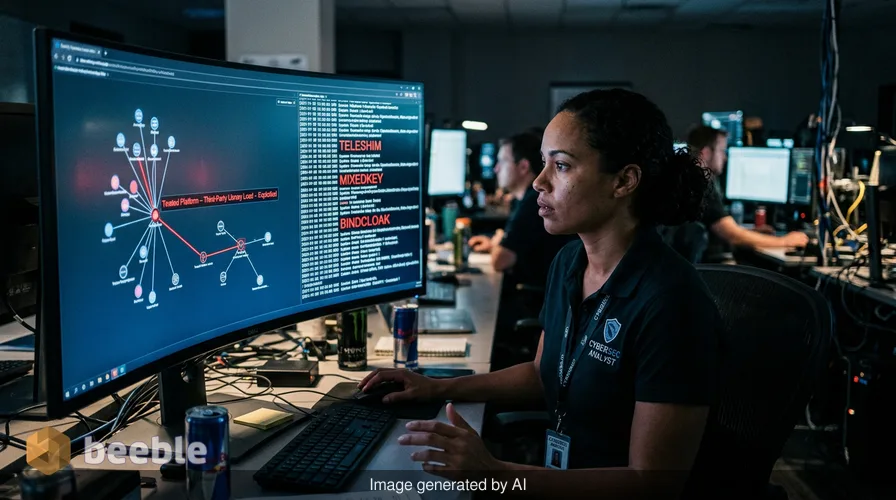
The intrusion campaign detected between July 7 and July 9, 2026, targeting government entities in the Middle East provides a definitive case study in modern access asymmetry. Cybersecurity researchers at Zscaler ThreatLabz identified a sophisticated multi-stage attack chain that weaponizes trusted platforms and deep system reconnaissance to maintain persistence. The technical data reveals an operation characterized by strict temporal discipline and heavy code obfuscation. Operators restricted their command-and-control (C2) activity to an eight-hour window between 4 a.m. and 12 p.m. UTC, with a high concentration of execution between 7 a.m. and 11 a.m. UTC. This schedule matches the standard working day in East Asian time zones. The malware artifacts, specifically TELESHIM, MIXEDKEY, and BINDCLOAK, utilize architectural weaknesses in how operating systems validate third-party library loads.
The multi-stage infection chain
The attack begins with an ISO file that functions as the initial delivery vehicle. This file contains a legitimate, signed Windows executable named RegSchdTask.exe. Attackers use this file to perform DLL side-loading, a technique where a malicious library is placed in the same directory as a trusted application to trick the OS loader. In this instance, the rogue component is AsTaskSched.dll, which contains the TELESHIM backdoor. This 32-bit Windows implant acts as the primary scout and downloader for the campaign. Individual each of these stages creates a dependency on the previous layer, ensuring that security scanners cannot analyze the final payload without the full execution context.
TELESHIM establishes its foothold by abusing the Telegram API for C2 communication. This allows the malware to blend in with legitimate HTTPS traffic, as many enterprise environments allow Telegram for business communication or fail to inspect encrypted traffic to known social media domains. The backdoor supports a specific set of operational commands:
- Host registration via MAC address transmission.
- Command execution and result exfiltration in 1,000-byte chunks.
- Secondary payload delivery via scheduled tasks.
Advanced evasion and code obfuscation
The developers of TELESHIM and MIXEDKEY employ heavy code obfuscation to frustrate static and dynamic analysis. They use Control Flow Flattening (CFF) to break the logical progression of code into a complex switch-case structure, making it difficult for researchers to follow the execution path. Mixed Boolean Arithmetic (MBA) transforms simple mathematical operations into complex, equivalent polynomial expressions that signature-based detection engines often ignore. These techniques are coupled with opaque predicates—conditional branches that always evaluate to the same result but appear complex to a decompiler. To gauge the scale of this effort, one must look at the anti-virtualization checks integrated into the TELESHIM loader. It queries CPUID for hypervisor signatures and uses Windows Management Instrumentation (WMI) to check RAM speed. If the environment exhibits the characteristics of a sandbox or a virtual machine, the malware terminates execution immediately.
Environmental keying and targeted detonation
The most significant barrier to analysis is the use of environmental keying in the MIXEDKEY and BINDCLOAK stages. The final payload is protected by two layers of XOR encryption. The second layer derives its decryption key from the volume serial number of the infected machine's primary drive. What this means in practice is that the malware is inert on any system other than the specific target. This strategy renders traditional sandbox detonation useless. An automated malware analysis platform will never see the true BINDCLOAK implant because it lacks the unique hardware identifier required to unlock the code. This level of targeting reflects a shift from opportunistic infection toward high-assurance surgical strikes. The logic shifts to a model where the attacker knows the target's infrastructure before the final payload is even delivered.
Analysis of the BINDCLOAK implant
The final stage of the intrusion is BINDCLOAK, a 64-bit C++ implant designed for long-term reconnaissance and data theft. It communicates with a specific external server located at cert.hypersnet[.]com. Post-compromise activity observed in the field included extensive system and user reconnaissance. The C2 operator executed commands to map the internal network and identify high-value assets. The use of a 64-bit architecture for the final implant suggests the attackers anticipate modern server environments and prioritize stability over compatibility with legacy 32-bit systems. The entire operation relies on the expertise deficit as an unspoken ally. The attackers assume that SOC analysts will overlook the Telegram traffic or fail to investigate a legitimate Windows process that is sideloading a suspicious DLL.
Architectural implications for the enterprise
Traditional perimeter defense is dead because the perimeter now extends to any trusted API. When an attacker uses Telegram or a similar platform, they are not bypassing the firewall; they are walking through the front door with a valid pass. This campaign demonstrates that signature-based EDR is insufficient. If a security tool does not understand the context of a DLL load or the validity of a WMI query for RAM speed, it is a blind spot. A DMZ is not a common area, but an individual solitary cell. Organizations must adopt an architecture where every process is untrusted until it proves its identity and intent. Unsegmented legacy is an open door, and in the case of Middle Eastern government targets, that door was left open by the assumption that signed executables are inherently safe.
Action plan for security leaders
CISO and CTO leadership must pivot from reactive patching to proactive architectural resilience. This specific threat requires a multi-layered response over the next 6 to 12 months. Patch management on a once-a-month rhythm is a luxury that these targets could not afford. The following steps provide a roadmap for mitigation:
- Audit DLL loading policies: Implement Windows AppLocker or Windows Defender Application Control (WDAC) to restrict the loading of unsigned DLLs or libraries located in user-writable directories. This directly counters the side-loading technique used by TELESHIM.
- Monitor API traffic: Establish a baseline for Telegram and other messaging API usage within the network. Any use of these platforms by system processes or service accounts is a high-fidelity indicator of compromise.
- Baseline WMI activity: Configure EDR tools to alert on non-standard WMI queries, specifically those related to hardware specifications like RAM speed or disk serial numbers. These are common indicators of anti-analysis routines.
- Implement microsegmentation: Isolate critical administrative workstations from the general network. Lateral movement is the primary goal of the BINDCLOAK implant, and strict internal segmentation reduces the blast radius of a single infected host.
- Conduct targeted pentests: Commission a red-team exercise that specifically attempts to use environmental keying and trusted-platform C2. This tests whether the current SOC stack can identify activity that mimics legitimate traffic.
The new reality of targeted threats
Survival in the current threat environment depends on architecture and speed. The TELESHIM campaign proves that attackers have moved beyond simple exploits into the realm of sophisticated software engineering and environmental awareness. The goal is not to prevent every breach. The goal is to ensure that a compromise does not become a catastrophe by limiting the attacker's ability to move and communicate. Organizations that rely on the reputation of signed files or the safety of HTTPS traffic to known domains are essentially defenseless against this class of adversary. Verification is the only currency that matters in a zero-trust architecture.
Sources: Zscaler ThreatLabz, Microsoft Security Response Center, CISA Technical Alerts.
Disclaimer: This article is for informational and educational purposes only and does not replace a professional cybersecurity audit or incident response service.



See you on the other side.
Our end-to-end encrypted email and cloud storage solution provides the most powerful means of secure data exchange, ensuring the safety and privacy of your data.
/ Create a free account
