


China now has the world's fastest supercomputer and it did not use the chips you expect

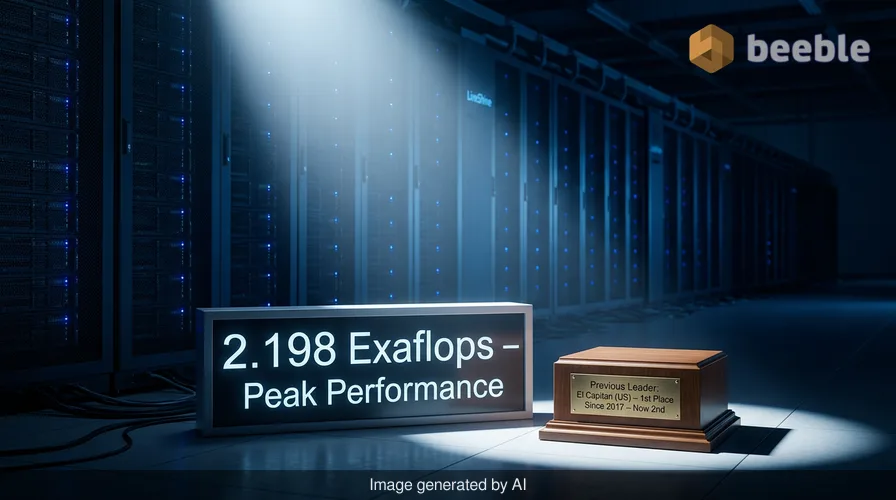
Two quintillion calculations per second. This is the new baseline for global computing power as the LineShine supercomputer in Shenzhen, China, takes the top spot on the TOP500 list. It is the first time since 2017 that a Chinese machine has held this position. In the high-stakes world of high-performance computing, this list is more than a leaderboard. It is a report card for national industrial capacity and a preview of who will lead the next generation of artificial intelligence development.
LineShine achieved a performance of 2.198 exaflops during its debut. To put that in perspective, one exaflop is a billion billion calculations every second. If every person on Earth performed one calculation per second, it would take the entire global population four years to do what this machine does in a single moment. It displaced the previous leader, a US machine named El Capitan, which now sits in second place. This shift marks a change in the technological race that has defined the last decade.
Why conventional chips are back in style
Under the hood, LineShine is a departure from modern trends. Most top-tier supercomputers today rely heavily on graphics processing units, or GPUs. These are the same types of chips that power high-end video games and the current surge in AI tools like ChatGPT. US leaders like El Capitan and Frontier use these specialized processors to crunch massive amounts of data in parallel. LineShine takes a different path by using conventional central processing units, or CPUs.
This choice is significant for the average user because it shows that massive power is possible without the specific hardware that is currently in short supply. While the world's tech giants are fighting over a limited supply of AI chips, China built the world's fastest machine using more traditional architecture. This design requires a massive amount of energy. LineShine consumes 42.2 megawatts of electricity. For context, that is enough power to run a small city of roughly 30,000 homes.
Looking at the big picture, this architecture suggests a focus on versatile computing. While GPUs are excellent for training AI, CPUs are often more flexible for complex simulations in physics and chemistry. This machine is a foundational engine of a digital economy, built to handle everything from traditional weather models to the newest generative AI systems.
Geopolitics at the Summer Davos
The timing of this announcement coincided with the World Economic Forum’s Annual Meeting of the New Champions in Dalian. China’s Premier Li Qiang used the event to address global concerns about his country's rapid tech rise. He described the current era as China Opportunity 2.0. This is a direct response to Western critics who use the term China Shock 2.0 to describe the arrival of low-cost, high-tech Chinese goods in global markets.
Li Qiang argued that state subsidies are not the primary driver of this growth. He pointed to a large domestic market and a massive pool of engineering talent. For the consumer, this debate is about more than trade policy. It determines which technologies become the global standard. If Chinese supercomputing continues to outpace the West, the software and AI models of the future may be optimized for Chinese hardware architectures rather than the Western standards we use today. This competition keeps the market volatile but also drives a rapid pace of innovation that brings new features to your devices faster.
Europe finds its footing in the exascale race
While the US and China trade blows for the top spot, Europe is quietly building its own resilient infrastructure. The top 10 list now includes four European machines. Germany’s Jupiter supercomputer dropped to fifth place but remains a heavy hitter in the region. Other machines in Italy, Switzerland, and Finland show that the continent is not sitting out the race.
European officials recently announced a €20 billion plan to build AI gigafactories. These are not factories that make physical goods, but massive data centers that use supercomputers to train large-scale AI models. The goal is to ensure that European startups and researchers have access to the same level of power as their American and Chinese counterparts. This effort focuses on creating a decentralized network of computing power across universities and private businesses. This ensures that the next big breakthrough in medicine or green energy has a home in Europe.
What this means for your medicine and weather apps
Supercomputers are the invisible backbone of modern life. You likely interact with the results of their work every day without realizing it. When your weather app tells you a storm will arrive at 3:00 PM instead of 5:00 PM, a supercomputer likely ran thousands of simulations to reach that conclusion. When a pharmaceutical company announces a new drug candidate, a supercomputer probably spent months virtually testing millions of chemical combinations to find the right one.
LineShine and its peers are like tireless interns that never sleep. They take the grunt work out of scientific discovery. With more power available, these simulations become more accurate. For the average person, this means better personalized medicine and more reliable climate forecasts. In the realm of AI, these machines allow for larger and more capable models. The voice assistant on your phone or the translation tool you use on vacation gets smarter because a machine like LineShine provided the raw power to train it.
Practically speaking, the rise of LineShine shows that the global supply chain for high-performance tech is shifting. The US national laboratories in Tennessee, Illinois, and California still host three of the top five machines, but they no longer have a monopoly on the top tier of performance. This competition is healthy for the industry because it prevents any single nation from controlling the speed of progress. It also forces engineers to find more efficient ways to use electricity, as 42 megawatts is not a sustainable baseline for every new data center.
Practical foresight for the digital user
As we watch these giants compete, the lesson for the consumer is to stay adaptable. The hardware that runs the internet is changing under the hood. While you may never see a LineShine or an El Capitan in person, their existence dictates the limits of what your apps can do. The shift toward CPU-based supercomputing in China might even influence the design of the next laptop or phone you buy, as manufacturers see that traditional chips still have untapped potential.
Instead of worrying about which country is winning, observe how your digital habits change as these machines come online. Expect AI tools to become more integrated into basic tasks and look for more precise data in areas like healthcare and environmental planning. The exascale era is here, and it is making the world a more calculated place.
Sources:
- TOP500 Official June 2026 Rankings
- World Economic Forum Annual Meeting of the New Champions 2026 Opening Plenary
- National Supercomputing Center, Shenzhen Technical Specifications
- Lawrence Livermore National Laboratory System Reports
- European Commission High-Performance Computing Initiative Update



See you on the other side.
Our end-to-end encrypted email and cloud storage solution provides the most powerful means of secure data exchange, ensuring the safety and privacy of your data.
/ Create a free account
