


Europe is building seven massive brains to break its dependence on Silicon Valley

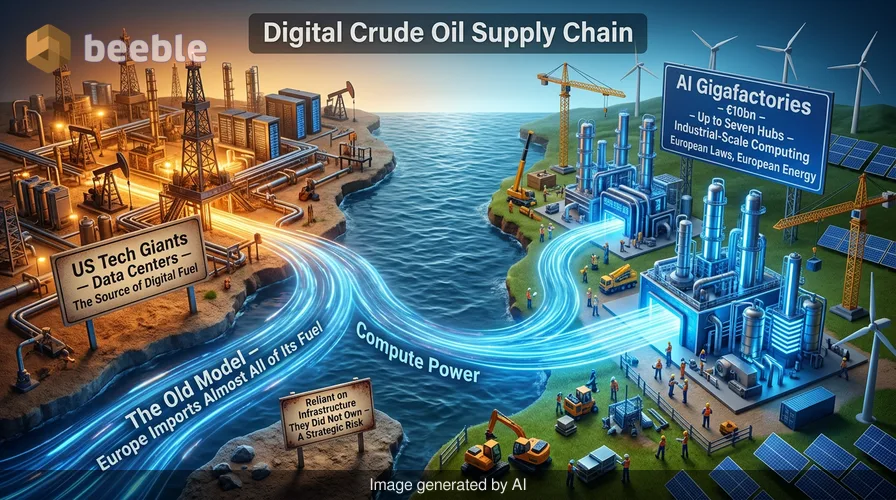
The voice assistant on your phone and the algorithm that suggests your next favorite song start as simple lines of code, but they end as massive draws on the global energy grid. Every time you ask an AI to summarize a document or generate an image, a cluster of high-end processors thousands of miles away works at full capacity to find the answer. For years, most of those processors lived in data centers owned by a handful of American tech giants. This arrangement made computing power feel like an infinite resource, yet it left European businesses and researchers reliant on infrastructure they did not own.
Looking at the big picture, this reliance is a strategic risk. If the supply of computing power is the digital crude oil of the modern economy, Europe has been importing almost all of its fuel. The European Commission is now attempting to change that dynamic with a €10bn initiative to build up to seven AI Gigafactories. These are not just larger server rooms. They are industrial-scale computing hubs designed to train the next generation of artificial intelligence within European borders, under European laws, and powered by European energy.
The architecture of a digital power plant
To understand what a Gigafactory actually is, think of a traditional factory that builds cars. A car factory needs raw steel, specialized robots, and a massive assembly line. An AI Gigafactory replaces the steel with data and the robots with tens of thousands of specialized chips called GPUs. These facilities combine advanced processors with high-speed connectivity and energy-efficient cooling systems to create a single, massive machine capable of processing trillions of data points simultaneously.
Practically speaking, these facilities bridge the gap between a small research lab and a global tech corporation. Currently, a startup in Berlin might have a brilliant idea for a new medical AI but lacks the €50 million required to rent the computing power needed to train it. The AI Gigafactory initiative aims to provide that scale. By pooling resources through the European High Performance Computing Joint Undertaking (EuroHPC JU), the EU is building the "assembly lines" that small and medium-sized enterprises can use to compete with global incumbents.
The two-phase plan to scale up
Behind the jargon of procurement lots and tenders lies a very specific financial strategy. The Commission is not just writing a single check. Instead, it has divided the funding into two distinct categories to ensure both variety and sheer scale in the new infrastructure. This phased approach allows the EU to manage the risk of building such massive facilities while giving operators time to scale their hardware.
| Feature | Lot 1: Specialized Hubs | Lot 2: Frontier Supercenters |
|---|---|---|
| Number of Projects | Up to 4 | Up to 3 |
| Phase 1 EU Funding | Up to €100m | Up to €200m |
| Phase 2 EU Funding | Up to €400m | Up to €800m |
| Initial Capacity | Equal to current largest EU AI Factory | Twice the current largest EU AI Factory |
| Target Capacity | 3x current largest factory | 4x current largest factory |
| Focus | Broad industrial/SME access | High-end frontier model training |
The first lot focuses on creating up to four facilities that serve a wide range of users. These will be the workhorses for universities and smaller industrial organizations. The second lot is more ambitious, funding three massive projects designed to train "frontier" models—the kind of AI that requires the highest level of computing power available today. This structure ensures that Europe has both the volume of computing for everyday business and the raw power for breakthrough research.
Why the hardware handshake matters
Building a Gigafactory is a massive physical undertaking, but the most difficult parts to acquire are the chips themselves. High-end AI processors are currently some of the most sought-after commodities on earth, with lead times often stretching into months or years. To prevent these new European factories from becoming empty shells, the Commission has signed letters of intent with the three biggest names in the business: AMD, NVIDIA, and Qualcomm.
Under the hood, this agreement ensures that the consortia building these factories have a reliable pipeline for hardware. While Europe wants technological sovereignty, it is pragmatic enough to know it cannot yet manufacture all the necessary chips at home. By securing these partnerships, the EU ensures that its €10bn investment translates into actual working machines by the 2027 deadline. There is also a specific provision to include European startups in the supply chain, which helps build a local ecosystem for parts like cooling systems, racks, and specialized software.
Sovereignty is about more than just speed
For the average user, the phrase "technological sovereignty" often sounds like political theater. However, the benefits are tangible when you consider how your data is handled. When an AI model is trained on a server in a different jurisdiction, the rules regarding data protection and ethics can become opaque. By keeping the infrastructure within the EU, these Gigafactories must follow the European AI Act and GDPR from the ground up.
Essentially, this means a European hospital can train a diagnostic AI using patient records without worrying that the data might be processed under less stringent privacy laws elsewhere. It also ensures that the environmental impact of AI is managed locally. The Commission has mandated that these facilities be energy-efficient, a significant requirement given that a single large AI model can consume as much electricity as a small town during its training phase. The transition to local infrastructure allows Member States to integrate these factories into their own renewable energy grids.
The roadmap to 2027
The timeline for this project is aggressive for an industrial build of this scale. The call for proposals is open until late 2026, with the goal of selecting the winning consortia by early 2027. Construction is expected to start immediately afterward, with the first facilities becoming operational within 18 months. This speed is necessary because the global AI race is not waiting for bureaucracy.
Eighteen countries have already joined the agreement, including industrial heavyweights like France, Germany, and Poland, as well as tech-forward nations like Estonia and Finland. This coalition shows a rare level of regional unity on industrial policy. These countries are not just contributing money; they are also committing to buying computing time from the factories once they are finished. This guaranteed demand makes the projects much more attractive to private investors, who are expected to provide an additional €20bn to the effort.
The bottom line for consumers and businesses
What this means for you is a shift in where your digital services come from. In the next few years, the AI tools you use for work or entertainment are more likely to be built by a company in Paris or Warsaw rather than just the usual suspects in Northern California. The availability of local, high-power computing reduces the cost for European startups to enter the market. This should lead to more competition and, ideally, more specialized tools that understand European languages, cultures, and legal requirements better than a generic global model.
Ultimately, the AI Gigafactory initiative is a bet on the idea that computing power is a utility, much like water or electricity. By building these seven massive digital brains, Europe is attempting to ensure that it remains a producer in the AI economy rather than just a consumer. For the person on the street, this might look like a faster app or a more secure healthcare portal. Behind the scenes, it is a massive industrial pivot designed to keep the European economy competitive in a world where the most valuable resource is no longer found in the ground, but in the silicon of a high-performance server.
Sources: European Commission, EuroHPC Joint Undertaking, and the official AI Continent Strategy report.



See you on the other side.
Our end-to-end encrypted email and cloud storage solution provides the most powerful means of secure data exchange, ensuring the safety and privacy of your data.
/ Create a free account
