


Europe's AI Infrastructure Under Strain: Can the Grid Keep Pace with the Boom?

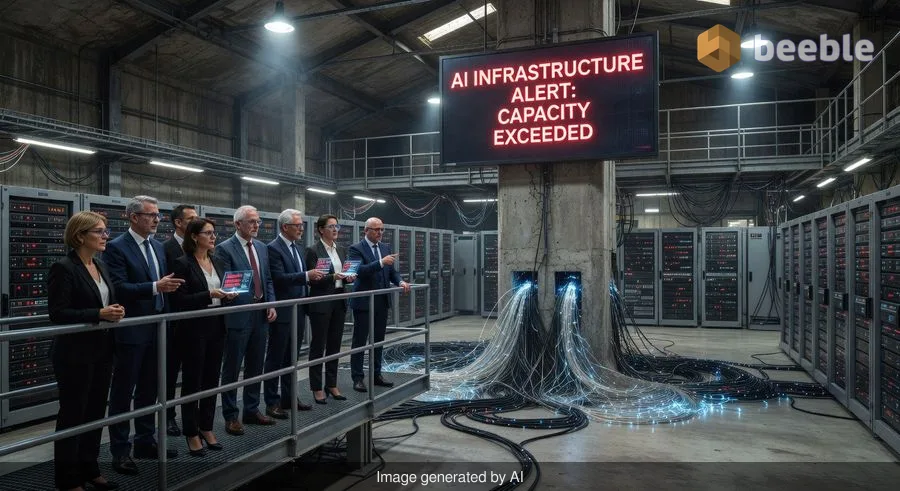
The Warning Signs Are Flashing
More than 1,000 executives across European companies have raised a red flag that's hard to ignore: the continent's infrastructure may not be ready for the artificial intelligence revolution unfolding at breakneck speed. As AI models grow larger and more power-hungry, the twin pillars of energy supply and network connectivity face unprecedented stress.
The concern isn't theoretical. Data centers running AI workloads consume vastly more electricity than traditional computing operations. Training a single large language model can use as much energy as hundreds of homes consume in a year. Now multiply that across thousands of companies deploying AI systems, and the scale of the challenge becomes clear.
Energy Demand: The Invisible Crisis
Europe's electrical grid wasn't designed for the AI age. Recent assessments show that AI-related power consumption could account for 3-5% of total European electricity demand by 2030, up from less than 1% today. Ireland offers a stark preview: data centers already consume roughly 20% of the country's electricity, straining the national grid and prompting regulators to pause new connections in the Dublin area.
The problem extends beyond raw capacity. AI workloads require consistent, uninterrupted power. A momentary outage during model training can waste days of computational work and thousands of euros in energy costs. This demand for reliability pushes data center operators toward fossil fuel backup generators, creating tension with Europe's ambitious climate goals.
France and the Nordic countries, with their nuclear and hydroelectric resources, find themselves in relatively strong positions. Germany and southern European nations, still transitioning away from coal and nuclear power, face harder choices. Renewable energy sources like wind and solar offer clean alternatives but introduce intermittency challenges that AI's 24/7 demands struggle to accommodate.
Connectivity: The Overlooked Bottleneck
While energy grabs headlines, network infrastructure presents equally thorny problems. Modern AI applications require massive data transfers between users, edge devices, and cloud data centers. A single autonomous vehicle can generate terabytes of data daily. Video analysis systems processing security footage demand substantial bandwidth in both directions.
Europe's fiber optic coverage varies dramatically by region. Urban centers in the Netherlands and Estonia boast world-class connectivity, while rural areas in southern and eastern Europe lag behind. This digital divide threatens to become an AI divide, with companies in less-connected regions unable to access or deploy advanced AI services effectively.
Latency matters too. Real-time AI applications—from industrial robotics to medical diagnostics—can't tolerate the delays inherent in routing data across continents. This reality drives demand for edge computing infrastructure closer to end users, requiring substantial investment in regional data centers and network upgrades.
The Investment Gap
Estimates suggest Europe needs €200-300 billion in infrastructure investment over the next decade to support AI growth without compromising existing services. Current spending falls short by roughly half. Private investment gravitates toward markets with clear regulatory frameworks and stable energy costs—areas where Europe's fragmented approach creates uncertainty.
The United States invested approximately $50 billion in AI-related infrastructure in 2025 alone, while China poured even more into its national AI development zones. European investment, spread across 27 EU member states plus the UK and others, struggles to match this coordinated scale.
Some countries are responding. The Netherlands announced a €1.2 billion data center development program in early 2025. Spain committed to upgrading its grid infrastructure with AI loads explicitly factored into capacity planning. France is fast-tracking nuclear reactor approvals partly to serve AI power demands. Yet these remain national efforts rather than a continent-wide strategy.
Real-World Consequences
The infrastructure crunch already affects European businesses. Several companies report delaying AI deployments due to unavailable data center capacity. Others face energy surcharges that make AI adoption economically questionable compared to North American competitors.
A Munich-based automotive supplier recently postponed implementing computer vision quality control systems after discovering the local grid couldn't reliably support the necessary computing infrastructure. A Stockholm fintech startup moved its AI development operations to AWS data centers in Ireland because Swedish capacity was fully subscribed through 2027.
These aren't isolated cases. They represent a competitive disadvantage accumulating gradually as European firms fall behind peers with better infrastructure access.
Potential Solutions Taking Shape
Several promising approaches are emerging from both private and public sectors. Energy-efficient AI chip designs from companies like Graphcore and European research initiatives aim to reduce power consumption per computation. Some estimates suggest next-generation accelerators could cut AI energy use by 40-60% compared to current GPUs.
Distributed AI architectures spread computational loads across multiple smaller facilities rather than concentrating them in massive data centers. This approach reduces peak demand on any single grid connection and creates opportunities for renewable energy integration—solar-powered facilities operating primarily during daylight hours, for example.
Cross-border infrastructure coordination is improving, albeit slowly. The European Commission's Digital Decade initiative targets specific connectivity and computing benchmarks for 2030, creating accountability frameworks that national governments previously lacked.
Industry consortiums are pooling resources to build shared infrastructure. The European High-Performance Computing Joint Undertaking is developing AI-optimized supercomputing facilities available to businesses across member states, reducing the need for every company to build private infrastructure.
What Companies Should Do Now
Business leaders can't simply wait for infrastructure to catch up. Practical steps include:
Audit current and projected AI workloads. Understand how much computing power, energy, and bandwidth your AI initiatives actually require. Many companies overestimate their needs, while others underestimate them—both errors have costly consequences.
Build relationships with infrastructure providers early. Data center capacity books months or years in advance in constrained markets. Early conversations with hosting providers, connectivity partners, and energy suppliers prevent last-minute scrambles.
Consider hybrid and edge deployment models. Not every AI workload needs cloud-scale resources. Edge computing and on-premises solutions reduce infrastructure dependencies while often improving latency and data privacy.
Prioritize energy efficiency. Choose AI models and hardware platforms based partly on power consumption. The energy savings compound over time and improve both costs and environmental footprint.
Monitor regulatory developments. Energy pricing, data center regulations, and grid access rules vary by country and change frequently. Staying informed helps avoid compliance issues and identifies emerging opportunities.
Participate in industry initiatives. Join consortiums, standards bodies, and policy discussions. Collective industry voice influences infrastructure development priorities and speeds solutions.
The Path Forward
Europe's infrastructure challenges are real but not insurmountable. The continent has overcome similar transitions before—the shift to mobile networks, the cloud computing migration, the renewable energy transformation. Each required substantial investment, coordination, and time.
The AI infrastructure question is ultimately about priorities and speed. Europe must decide how aggressively to pursue AI competitiveness and commit resources accordingly. Half-measures risk a widening gap with global competitors while failing to capture AI's economic benefits.
The next two years will prove critical. Infrastructure decisions made now will shape European competitiveness for the decade ahead. Companies voicing concerns about energy and connectivity aren't being alarmist—they're identifying the constraint that could determine whether Europe thrives or struggles in the AI era.
Sources
- European Commission Digital Decade Policy Programme
- International Energy Agency - Electricity Grids and Secure Energy Transitions Report
- EirGrid (Ireland) - Data Centre Grid Connection Updates
- European High-Performance Computing Joint Undertaking Official Reports
- Netherlands Enterprise Agency - Data Center Development Programme Announcements
- Industry reports from European technology sector surveys on AI infrastructure concerns



See you on the other side.
Our end-to-end encrypted email and cloud storage solution provides the most powerful means of secure data exchange, ensuring the safety and privacy of your data.
/ Create a free account
