


Europe will lose the fusion race if it keeps treating reactors like science experiments

The copper wires running through your walls today carry electrons generated by burning gas, splitting heavy atoms, or catching the wind. Trace those wires back past the substation and the high-voltage towers, and you eventually hit a turbine. For decades, the goal of fusion energy has been to replace the furnace at the end of that chain with a controlled star. Building that star requires more than just physics breakthroughs. It requires a massive industrial plumbing job that Europe is currently struggling to organize.
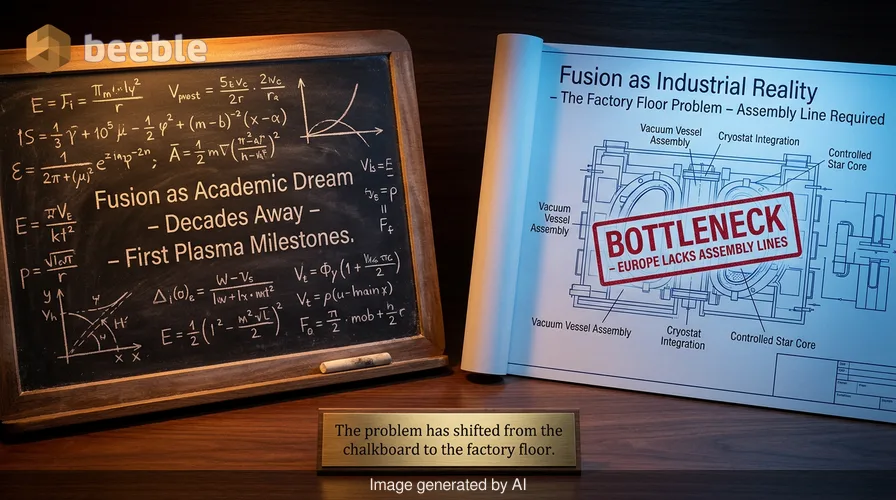
Today, the energy sector treats fusion like a distant academic dream. We talk about it in terms of decades and "first plasma" milestones. However, as of July 2026, the technology has reached a point where the lab work is no longer the primary bottleneck. The problem has shifted from the chalkboard to the factory floor. Tom Reynolds, Head of Communications at the European Fusion Association (EFA), suggests that Europe is at a crossroads. We have the brains, but we lack the assembly lines. If we do not change how we build these machines, we will end up buying the technology from regions that treated fusion like an industry rather than a thesis project.
Physics is no longer the main problem
For the average user, fusion sounds like science fiction. It is the process of squeezing hydrogen atoms together until they fuse, releasing a burst of energy. Unlike current nuclear fission, which splits atoms and leaves behind long-lived waste, fusion is clean and practically bottomless. The technical hurdles are legendary. You have to hold a gas at 150 million degrees Celsius without it touching the walls of its container. We use massive superconducting magnets to create a magnetic cage for this plasma.
Looking at the big picture, the physics of this cage is now well-understood. We have proven we can generate more energy than we put in. The new challenge is endurance and repetition. A science experiment only needs to work for a few minutes to prove a point. A power plant needs to run for months at a time without a single component failing. Under the hood, this means we need new materials that can survive constant neutron bombardment and cooling systems that do not leak. These are engineering problems, not theoretical ones.
Reynolds points out that the framing of the fusion debate is outdated. We shouldn't ask when fusion will arrive. We should ask where the industrial capability to build it will take root. The transition from scientific feasibility to industrial execution is the defining struggle of the current decade. If Europe continues to focus only on the next research milestone, it will miss the chance to build the supply chains that make those milestones permanent.
The global race for industrial muscle
Fusion is becoming a global contest over industrial capacity. In the United States, private capital is flooding into startups that promise smaller, cheaper reactors. The American policy environment is built to move fast and break things, which attracts investors who want to see a return on their capital. China is taking a different path by investing at an unprecedented scale, using state power to build a domestic supply chain for magnets and specialized steel. They are treating fusion as a foundational part of their future grid.
Conversely, Europe has a more fragmented approach. We have a world-class research base and an experienced industrial supply chain, but these pieces do not always fit together. The European model still centers on large-scale public research projects like ITER. While these projects provide essential data, they do not necessarily create a nimble market for private companies. To put it another way, Europe is great at building the first of something, but we struggle to build the thousandth.
This matters for the consumer because the winner of this race will set the standards for the next century of energy. If the U.S. or China captures the market first, European utilities will become customers rather than providers. We will be importing the magnets, the control systems, and the expertise needed to keep our lights on. The EFA is pushing for a shift that prioritizes project pipelines over individual experiments to ensure European companies stay in the game.
Why the red tape is stickier than the plasma
Regulatory uncertainty is a silent killer for emerging tech. Right now, fusion sits in a legal gray area. Is it a nuclear reactor? In simple terms, no. It does not carry the risk of a meltdown and does not produce high-level radioactive waste. However, if governments try to regulate fusion using the same rules as old-school fission plants, the costs will skyrocket. The paperwork alone could add years to construction timelines.
Practically speaking, a company cannot commit a billion euros to a project if the rules might change halfway through. We need a regulatory framework that recognizes the specific safety profile of fusion. The United Kingdom has already started this process by separating fusion regulation from fission regulation. This move gives developers the clarity they need to start building. Europe needs to match this speed.
Reynolds emphasizes that these risks are cumulative. If you combine regulatory delays with a lack of clear financing and a fragmented supply chain, you get a sector that is too risky for private capital. The EFA acts as an interface here. They bring developers and policymakers together to show where the delivery assumptions do not match the reality on the ground. The goal is to create a predictable environment where a company can order ten thousand specialized sensors and know there will be a buyer for them in five years.
From lab coats to hard hats
Building a fusion industry requires a massive shift in the workforce. We have plenty of plasma physicists. We do not have enough technicians who know how to weld exotic alloys or operate the massive cryogenic systems needed for superconducting magnets. This is the invisible backbone of the industry. For the average worker, the growth of fusion could mean a new generation of high-tech manufacturing jobs that cannot be easily automated or outsourced.
Historically, heavy industry has been the heart of the European economy. Fusion offers a way to revitalize that sector. But this requires a coordinated effort to build a supply chain that can scale. We need factories that produce high-temperature superconductors by the mile. We need specialized foundries that can cast reactor vessels with millimeter precision.
Behind the jargon, this is a question of confidence. Suppliers will not invest in new machinery if they only have one customer. They need to see a sequence of projects. The EFA argues that fusion will not be commercialized in a single leap. It will happen through a series of increasingly complex projects. The regions that provide a coherent environment for these projects will ultimately own the sector. Europe has the industrial depth to lead, but it must align that capability at a faster pace.
The price of waiting for perfection
From a consumer standpoint, the "so what" of fusion is simple: energy price stability. Our current grid is volatile because it relies on fuels that fluctuate in price or weather patterns that we cannot control. Fusion offers a baseline that doesn't depend on the wind blowing or the sun shining. It is a resilient source of power that could eventually lower the cost of everything from home heating to industrial manufacturing.
However, these benefits will only materialize if we move beyond the research phase. The cost of fusion will not drop because of a breakthrough in a lab. It will drop because we built ten reactors and learned how to make the eleventh one cheaper. This is the "learning curve" that has already made solar and wind power affordable. Fusion needs to start its own learning curve now.
Ultimately, the defining question for Europe is one of execution. We can continue to produce the best research papers in the world, or we can start building the star-powered furnaces of the future. The transition from science to industry is messy and expensive, but the alternative is becoming a spectator in the next great energy revolution. We should stop looking at fusion as a future possibility and start treating it as a present-day industrial priority.
Sources:
- European Fusion Association (EFA) Annual Strategy Report 2026
- International Energy Agency (IEA) Special Report on Fusion Commercialization
- European Commission White Paper on Industrial Energy Transition
- Tom Reynolds, Interview for The Innovation Platform



See you on the other side.
Our end-to-end encrypted email and cloud storage solution provides the most powerful means of secure data exchange, ensuring the safety and privacy of your data.
/ Create a free account
