


Forget the Hype—OpenAI is No Longer the Only Name That Matters in the AI Race

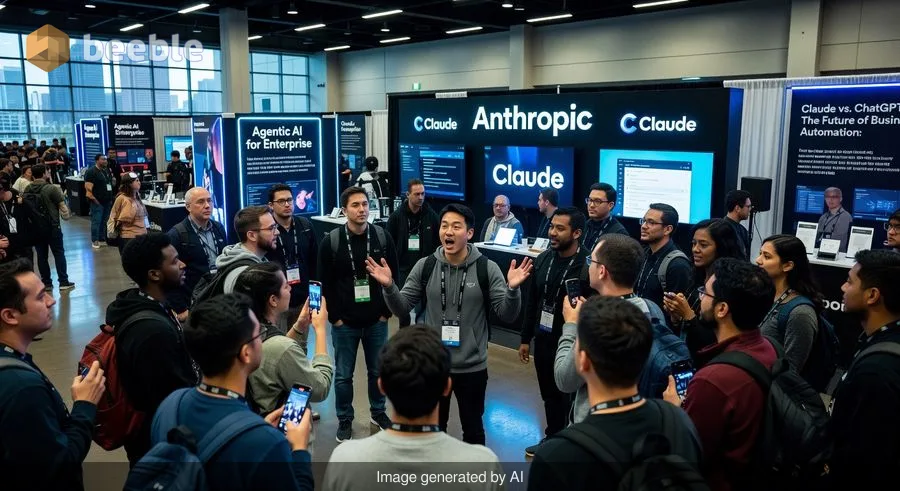
If you follow the money, OpenAI looks like an unstoppable juggernaut. With a fresh $122 billion in the bank and a looming IPO, the standard narrative suggests that Sam Altman’s empire has already won the AI wars. But walk the floor of the Moscone Center during this week’s HumanX conference in San Francisco, and you’ll hear a very different story. The air of inevitability surrounding ChatGPT has started to thin, replaced by a growing, pragmatic consensus: the most serious work is now happening on Claude.
At HumanX, the conversation has shifted away from chatbots that simply chat and toward "agentic AI." These are systems designed to act as a tireless intern—digital entities that don't just answer questions but actually execute multi-step business and coding tasks. While OpenAI has spent the last year navigating high-profile departures and experimental side-quests, Anthropic’s Claude has quietly become the darling of the developer community.
The Vibe Shift at Moscone Center
Throughout the week, thousands of tech professionals descended upon San Francisco to discuss how AI is being integrated into the foundational layers of industry. In panel after panel, the name "Claude" was dropped with the kind of frequency usually reserved for household brands. Conversely, ChatGPT—the tool that started the revolution—was often mentioned as an afterthought or, more pointedly, as a platform that has "fallen off."
One vendor on the convention floor was particularly blunt, noting that his team had almost entirely migrated their workflow to Anthropic’s models. To him, OpenAI’s flagship product had become volatile and less reliable for complex coding tasks. Behind the jargon of "model weights" and "context windows," the sentiment was simple: users feel that OpenAI is losing its focus while Anthropic is doubling down on being the most robust tool for professionals.
The Problem with Being Everything to Everyone
Part of this shifting perception stems from OpenAI’s recent identity crisis. Over the past few months, the company has flirted with a variety of disruptive but ultimately distracting projects. We saw the hype around Sora, their AI video generator, and rumors of a more "personable" version of ChatGPT. However, many of these initiatives were recently scaled back or abandoned as the company attempted to pivot back to its core business and coding services.
This vacillation has created an opening for competitors. While OpenAI was managing internal governance drama and public skepticism regarding Sam Altman’s leadership, Anthropic stayed in its lane. Looking at the big picture, OpenAI is behaving like a massive media conglomerate trying to find its next hit show, while Anthropic is acting like a precision engineering firm. For the average user who just wants their code to work or their data analyzed without a "sexy" personality layer, the engineering firm is winning.
Comparing the Titans: A Market Snapshot
While the public perception favors Claude right now, it is important to remember that both companies are experiencing unprecedented growth. They are, quite literally, the fastest-growing businesses in the history of technology. However, their paths to the top look very different.
| Feature | OpenAI (ChatGPT) | Anthropic (Claude) |
|---|---|---|
| Primary Focus | Consumer ecosystem & multi-modal creative tools | Enterprise reliability & precise coding |
| Market Perception | The "First Mover" facing a mid-life crisis | The "Rising Challenger" with high trust |
| Recent Strategy | Massive funding ($122B) and IPO preparation | Rapid adoption among business power users |
| Key Strength | Brand recognition and massive user base | High-quality reasoning and "steerability" |
The Trust Gap and the "Agentic" Future
During one of the more heated discussions at HumanX, Bret Taylor—the chairman of OpenAI’s board—was forced to defend Sam Altman against claims of being untrustworthy, following a critical profile in the New Yorker. While Taylor praised Altman’s leadership, the very fact that trust has become a recurring theme is telling. In the world of enterprise software, transparency is often more valuable than charisma.
For the average user, this isn't just corporate drama; it’s a signal of where the technology is headed. We are moving away from "AI as a toy" and toward "AI as infrastructure." When you are building a system that handles a company’s logistics or customer service, you need a partner that is resilient and predictable. The injecting of advertising into ChatGPT and the company's shifting political alignments have made some corporate partners nervous, viewing OpenAI as a shifting target rather than a stable foundation.
What This Means for Your Digital Toolkit
In simple terms, the "falling off" of OpenAI doesn't mean the company is failing—it means it is no longer the undisputed champ. For you, the consumer, this is actually good news. Competition breeds better products and more transparent pricing.
Practically speaking, if you have been relying solely on ChatGPT for your productivity needs, you might be missing out on a more streamlined experience. Many users find that Claude’s ability to follow complex instructions without "hallucinating" (making things up) makes it a superior choice for professional writing and data synthesis.
Ultimately, the takeaway from HumanX is that the AI landscape is becoming more specialized. We are entering a cyclical phase where the initial "wow factor" is being replaced by a demand for tangible results. As a result, the most successful users won't be those who stick to one brand, but those who understand which tool fits the specific task at hand.
Instead of viewing AI as a single, monolithic entity, start observing your own digital habits. Notice when your current tools feel sluggish or overly "chatty" when you just need a result. The next time you hit a wall with one assistant, try the other. In this rapidly evolving market, your loyalty is a commodity—don't give it away for free to a company that is still trying to find its own footing.
Sources
- Financial analysis of OpenAI and Anthropic growth trends, The Wall Street Journal.
- On-site reporting and panel transcripts from the HumanX AI Conference, San Francisco, April 2026.
- Executive interviews and leadership profiles, The New Yorker.
- Industry reports on the deployment of agentic AI in enterprise environments.



See you on the other side.
Our end-to-end encrypted email and cloud storage solution provides the most powerful means of secure data exchange, ensuring the safety and privacy of your data.
/ Create a free account
