


GPUBreach: How a Single Bit Flip in GPU Memory Can Topple the Entire Host System

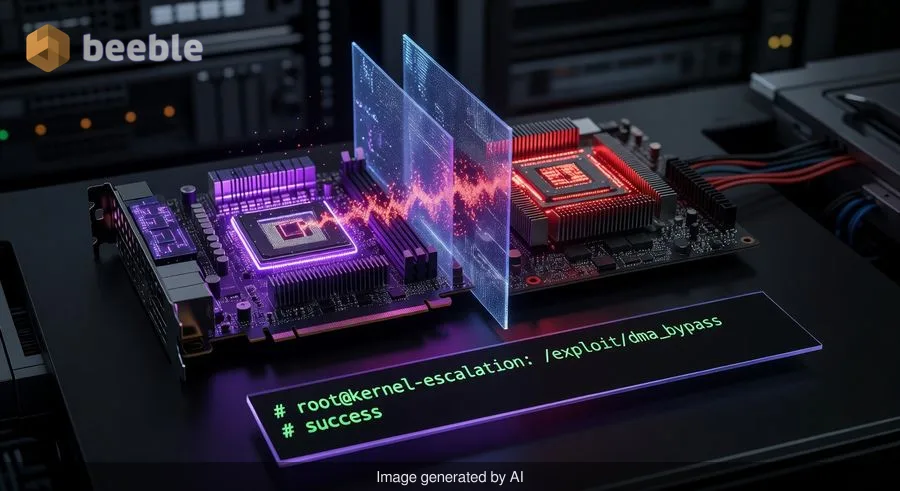
A single bit flip, occurring in the microscopic transistors of a graphics card, can now grant an attacker full administrative control over a multi-million dollar server. While the cybersecurity industry has long viewed the GPU as a high-performance sandbox for AI and rendering, new research suggests this sandbox has a trapdoor leading directly to the heart of the operating system. At the upcoming 47th IEEE Symposium on Security & Privacy (Oakland 2026), researchers from the University of Toronto will unveil GPUBreach, a sophisticated attack that leverages memory corruption to achieve root-level access on host systems.
This discovery marks a significant escalation in the history of Rowhammer attacks. Historically, Rowhammer was a curiosity of CPU-managed DRAM, where rapidly accessing memory rows would cause electrical leakage, flipping bits in adjacent rows. GPUBreach proves that the high-speed GDDR6 memory found in modern GPUs is not only vulnerable but can be used as a precision tool for systemic compromise. Behind the scenes, this research transforms a hardware instability into a surgical strike against the kernel.
The Anatomy of a GPU-Based Takeover
To understand why GPUBreach is so potent, we must look at the architectural level of how a GPU manages its memory. Unlike previous iterations of GPU-based Rowhammer, such as GPUHammer, which primarily focused on degrading the accuracy of machine learning models, GPUBreach targets the Page Table Entries (PTEs). These entries are essentially the map the hardware uses to know which piece of data belongs to which process.
By reverse-engineering NVIDIA’s proprietary driver behavior, the researchers discovered that GPU page tables are often allocated in contiguous 2-MB regions. Using Unified Virtual Memory (UVM) and a timing side-channel, the team developed a method to densely populate these regions, ensuring that their malicious page tables were physically adjacent to the rows they intended to hammer. When a bit flip occurs in a PTE, the map is redrawn. Suddenly, the attacker’s process is no longer confined to its own memory; it can point its "map" to any other location in GPU memory, effectively seizing control of the entire execution context.
Bypassing the IOMMU: The Jump to the CPU
Perhaps the most alarming aspect of GPUBreach is its ability to leap from the GPU to the CPU. In modern security architectures, the IOMMU (Input-Output Memory Management Unit) acts like a VIP club bouncer at every internal door, theoretically preventing peripheral devices like GPUs from accessing unauthorized areas of system RAM. However, GPUBreach demonstrates that this bouncer can be tricked.
By manipulating specific "aperture bits" within the corrupted GPU page tables, the compromised GPU can initiate Direct Memory Access (DMA) writes to CPU memory regions that the IOMMU explicitly allows—such as buffers managed by the NVIDIA kernel driver. Once the attacker has a foothold in these driver-managed buffers, they can exploit memory-safety vulnerabilities within the driver itself. This triggers an out-of-bounds write, creating an arbitrary kernel write primitive. Ultimately, this chain allows the attacker to spawn a root shell on the host, rendering the IOMMU protection moot without ever needing to disable it.
Real-World Implications for AI and the Cloud
From an end-user perspective, particularly for those in the AI and research sectors, the risks are multifaceted. The researchers demonstrated that GPUBreach could be used to extract secret keys from NVIDIA’s cuPQC post-quantum cryptography library. In a world where we are racing to secure data against future quantum threats, having the keys stolen from GPU memory today is a sobering reality.
Furthermore, the attack poses a severe threat to the integrity of Large Language Models (LLMs). An attacker could stealthily modify low-level cuBLAS instructions to degrade model performance or, more dangerously, leak sensitive model weights. In shared GPU environments—the backbone of modern cloud computing—this enables cross-process data access. For a multi-tenant cloud provider, this is the digital equivalent of an oil spill; the contamination from one customer's compromised instance can seep into the data of every other customer sharing that hardware.
The Defense Dilemma: Is ECC Enough?
When the researchers disclosed these findings to NVIDIA in late 2025, the response highlighted a precarious gap in current hardware defenses. NVIDIA recommends enabling Error-Correcting Code (ECC) memory on server-grade hardware like the RTX A6000 used in the study. In principle, ECC is designed to detect and correct single-bit flips, acting as a resilient first line of defense.
In practice, however, ECC is not a shatterproof digital vault. It can be overwhelmed by multi-bit flips, and more importantly, it is almost entirely absent from consumer-grade GPUs found in laptops and desktops. For the millions of workstations used by developers and data scientists that lack ECC support, there is currently no comprehensive mitigation. Patching this is not as simple as plugging holes in a ship's hull; it requires a fundamental rethink of how drivers and hardware interact.
Assessing the Threat Landscape
As someone who has spent years analyzing complex APT attacks and interacting with the white-hat community, I find GPUBreach particularly fascinating because it bridges the gap between theoretical hardware flaws and actionable exploitation. It reminds us that security is only as strong as the weakest link in the hardware-software stack. While Google has acknowledged the severity with a bug bounty and NVIDIA is updating its advisories, the systemic nature of Rowhammer means this issue will likely persist for years.
Looking at the threat landscape, we must move away from the idea that hardware isolation is absolute. We are entering an era where the "human firewall" is not enough; we need hardware that is secure by design and software that assumes the hardware beneath it might be lying.
What to Do Next: A Proactive Checklist
If you are managing high-performance compute clusters or sensitive AI workloads, you cannot afford to wait for a perfect patch. Here are the steps you should take today:
- Audit Hardware for ECC: Ensure that all GPUs in mission-critical environments have ECC enabled. While not a silver bullet, it significantly raises the bar for an attacker.
- Implement Granular Monitoring: Monitor for unusual GPU driver crashes or memory errors. GPUBreach attempts often leave a forensic trail of instability before they succeed.
- Isolate High-Value Workloads: In cloud environments, consider using "confidential computing" instances or dedicated hardware for tasks involving sensitive cryptographic keys or proprietary LLM weights.
- Update Drivers Religiously: While GPUBreach exploits a hardware flaw, the escalation to the CPU relies on driver vulnerabilities. Keeping the NVIDIA kernel driver up to date is essential to breaking the attack chain.
GPUBreach is a stark reminder that in the world of cybersecurity, the ground we stand on—the hardware itself—is often less solid than we think.
Sources
- University of Toronto Research Paper: "GPUBreach: Achieving Root Access via GPU Rowhammer"
- IEEE Symposium on Security & Privacy (Oakland 2026) Proceedings
- NVIDIA Product Security Incident Response Team (PSIRT) Advisory Updates
- Google Vulnerability Reward Program (VRP) Disclosure Reports



See you on the other side.
Our end-to-end encrypted email and cloud storage solution provides the most powerful means of secure data exchange, ensuring the safety and privacy of your data.
/ Create a free account
