


How 28 Days of Digital Silence Reveal the Fragility of Modern Corporate Belonging

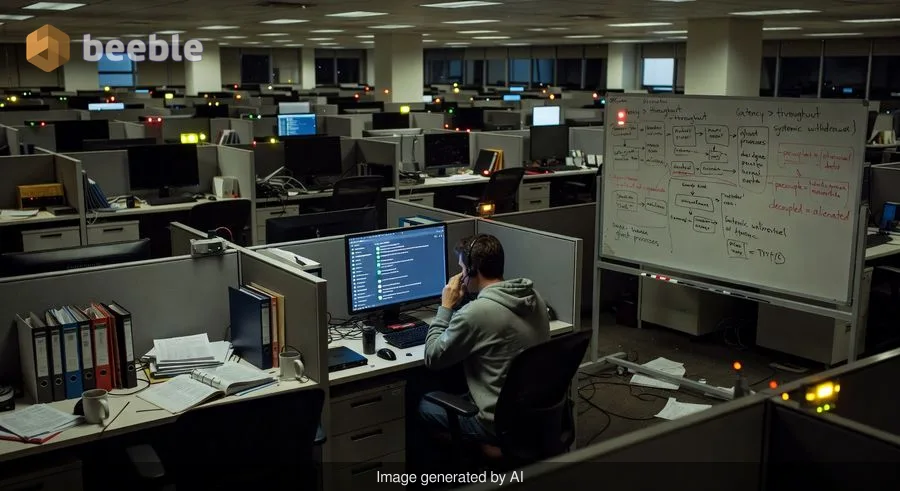
The notification pings. Hearts stop. Eyes scan. No news today. Maybe tomorrow. The calendar mocks. A month of silence. Twenty-eight days. Hell is a spreadsheet. The screen glows late into the night. Conversations happen in whispers. Slack channels become ghost towns. The green status light feels like a stay of execution. This is the new rhythm of the modern workplace. It is a slow, digital erosion of the self.
In sociological terms, the reports emerging from Meta regarding a '28-day' waiting period for layoffs represent more than just a logistical delay in human resources management; they are a visceral manifestation of systemic alienation. This specific temporal stretch functions as a psychological stress test designed by algorithmic necessity rather than human empathy. It represents the structural shift from stable career trajectories to the ephemeral nature of project-based existence in a late-capitalist digital landscape, where the employee’s habitus is forcibly decoupled from their professional identity through a process of opaque institutional withdrawal.
The Linguistic Mask of Corporate Efficiency
Linguistically speaking, the discourse surrounding corporate downsizing has undergone a profound transformation. We no longer speak of people being 'fired' or 'let go,' terms that, while harsh, at least acknowledged a human action. Instead, we see the rise of the 'impacted' individual. This shift into the passive voice is symptomatic of a larger cultural move toward de-personalization. When an employee is 'impacted,' the agency of the employer vanishes into the ether of 'strategic realignments' and 'efficiency gains.'
Curiously, the phrase '28 days of hell' serves as a linguistic counter-rebellion. It is a raw, emotional descriptor clashing against the sanitized, clinical language of the boardroom. While the organization views the period as a fiscal transition, the individuals within it experience it as a profound disruption of their daily routines—the anchors that keep them grounded. Behind the scenes of this trend, we find that the more technology attempts to streamline the 'human capital' experience, the more it amplifies the visceral anxiety of the person behind the screen.
The Archipelago of the Home Office
On an individual level, the experience of waiting for a layoff in a remote or hybrid environment creates what we might call a social archipelago. In the traditional office, trauma was shared in breakrooms and over desks; it was a collective weight. Today, employees sit in their private spaces, densely packed into digital directories yet completely atomized. They are islands of anxiety connected only by the thin, flickering fiber-optic cables of a corporate VPN.
Zooming out, this isolation is a hallmark of what sociologists call 'liquid modernity.' In this state, social structures—like long-term employment—no longer hold their shape long enough for individuals to rely on them. The 'Metaverse' was promised as a new theater stage for human performance and connection, yet, paradoxically, it has become the site of a very modern kind of loneliness. In practice, being 'together' in a digital workspace while facing systemic job insecurity creates a hall of mirrors where one’s own fear is reflected and amplified by the silence of colleagues who are equally afraid to speak out.
The Anatomy of a Corporate Ghost Town
Through this lens, the '28 days' become a period of liminality—a threshold where the employee is neither fully in nor fully out. During my observations of digital professional communities, I’ve noticed a peculiar shift in how people perform their professional identities during these periods. There is an over-performance of 'busyness,' a desperate attempt to prove one’s utility to an algorithm that may have already decided their fate. It is a digital version of the modern city as a theater stage, where we perform the role of the 'resilient worker' even as the floorboards are being removed from beneath us.
Consequently, the psychological toll of this waiting period is often more damaging than the layoff itself. The human brain is poorly evolved for prolonged, high-stakes ambiguity. Historically, we dealt with immediate threats; today, we deal with the 'phantom ping' of a potential termination notice. This creates a state of pervasive hyper-vigilance that leaches into mundane everyday routines. One worker I spoke with mentioned that they couldn't even enjoy a cup of coffee without checking their phone every thirty seconds, transforming a simple anchor of daily life into a source of potential trauma.
The Attention Economy of Dread
Ultimately, this trend is a byproduct of the attention economy applied to the internal workforce. Just as social media feeds compete for our clicks, the modern corporate structure competes for our psychological bandwidth, even—and perhaps especially—when it is preparing to discard us. The uncertainty is not a bug; in a structural sense, it is a feature that ensures the remaining 'survivors' are sufficiently atomized and compliant, having been witness to the 'hell' of the transition.
From a societal standpoint, we are witnessing the breakdown of the 'tech family' mythos. For a decade, Silicon Valley sold a narrative of work as a community, a tribe, a source of meaning. Now, as the economic winds shift, that narrative is revealed as a digital communication fast-food diet: quick and accessible when times are good, but lacking the deep emotional nutrition required to sustain a person during a crisis. The realization that one is just a line item in a 28-day efficiency sprint is a profound cultural anesthetic, numbing the ambition of a generation that once believed work could be a home.
Key Takeaways for the Digital Citizen
- Recognize the Mask: When corporate language becomes overly clinical (e.g., 'optimization' or 'right-sizing'), it is often a defensive mechanism to distance the institution from the human consequences of its decisions. Understanding this helps depersonalize the rejection.
- Rebuild the Anchor: Amidst systemic chaos, focus on mundane routines that exist outside of your digital identity. Whether it's physical exercise, a tactile hobby, or face-to-face community work, these act as anchors in the 'liquid' world.
- Audit Your Digital Tribe: Digital connection is ephemeral. Ensure your support network includes 'analog' relationships that are not tied to your professional Slack or LinkedIn circles.
- Question the Performance: Recognize that the urge to 'over-perform' during a period of instability is a natural coping mechanism, but one that often leads to burnout rather than job security.
Reclaiming the Human Scale
As we look toward the future of work, the '28 days of hell' at Meta should serve as a cautionary archaeological site for future sociologists. It reveals the layers of cultural change where human dignity was momentarily sacrificed for the sake of a cleaner balance sheet. To put it another way, we must ask ourselves if we are comfortable living in a society where our livelihoods are treated as transient data points.
Perhaps the most profound act of resistance we can perform is to reclaim our sense of self from our job titles. In a world that is increasingly fragmented and opaque, there is a quiet power in embracing silence, in looking away from the screen, and in remembering that our value is not determined by a green status light or a sudden, 'impactful' notification. We are more than the sum of our digital outputs, and it is time our social structures reflected that truth.
Sources:
- Bauman, Z. (2000). Liquid Modernity. Polity Press.
- Bourdieu, P. (1977). Outline of a Theory of Practice (regarding Habitus).
- Business Insider (April 2026). "Meta Employees React to Pending Job Cuts: '28 Days of Hell'."
- U.S. Bureau of Labor Statistics (2025-2026). Quarterly reports on tech sector volatility.
- Internal Meta Employee Surveys (Leaked/Aggregated Discourse Analysis 2026).



See you on the other side.
Our end-to-end encrypted email and cloud storage solution provides the most powerful means of secure data exchange, ensuring the safety and privacy of your data.
/ Create a free account
