


How a 23-Year-Old Space Simulation Became the Final Frontier for Artificial Intelligence

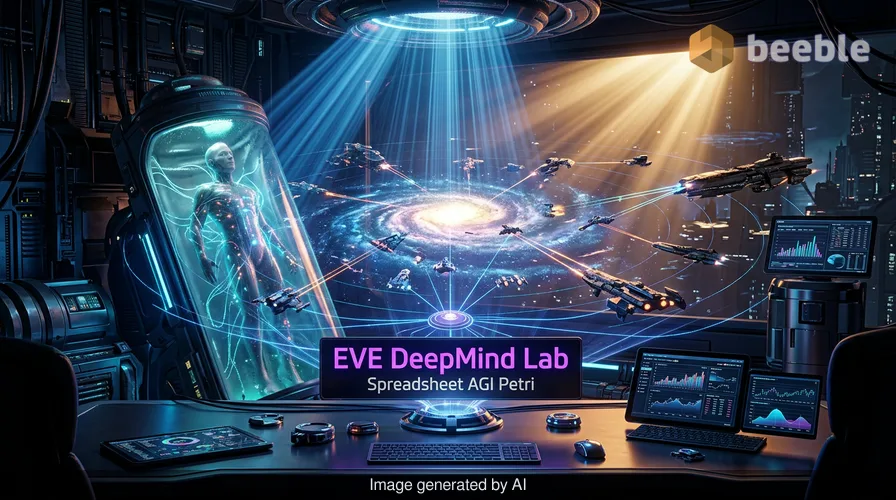
You wake up in a sterile clone bay, staring at a user interface that promises you the entirety of the galaxy—thousands of solar systems, a player-driven economy that rivals small nations, and the absolute liberty to be a pirate, a tycoon, or a deep-space spy. It feels like the ultimate sandbox, a place where the social contracts of the real world are replaced by the cold, hard logic of laser fire and market manipulation, offering a sense of agency that modern life rarely affords. You can spend months plotting a corporate coup or years building an industrial empire, drifting through a digital vacuum where the only limit is your own ambition.
Except, every market transaction you finalize is a data point in a vast behavioral archive. Until the freedom you feel is actually a boundary condition for a machine to learn how to outmaneuver human intuition. Inevitably, your "living world" becomes a petri dish, and your spontaneous human chaos is refined into a training manual for Google DeepMind’s next generation of general-purpose intelligence.
This is the reality of EVE Online in 2026. Behind the scenes of the recent announcement that CCP Games has rebranded as Fenris Creations and bought back its independence from Pearl Abyss for $120 million, a much more profound shift is occurring. By partnering with Google DeepMind, the creators of the world’s most notorious "spreadsheet simulator" are turning their universe into a high-stakes laboratory for the future of synthetic thought.
The $120 Million Divorce and the Quest for Sovereignty
To understand why a tech giant like Google is taking a minority stake in an Icelandic game developer, we first have to look at the industry-level divorce that made it possible. In 2018, the South Korean publisher Pearl Abyss purchased CCP Games for $225 million, a move that many players feared would lead to the "gamification" of EVE’s notoriously opaque mechanics through aggressive monetization.
Paradoxically, the recent $120 million buyout—at nearly half the original price—isn't a sign of failure, but a strategic retreat into sovereignty. Pearl Abyss, currently focused on the high-fidelity action of Crimson Desert, found that the slow-burn, politically dense nature of EVE didn't align with their portfolio of explosive, immediate gratification titles. For Fenris Creations, the newly minted independent entity, this loss in valuation is the price of breathing room.
Historically, EVE has survived by ignoring industry trends rather than chasing them. While other MMOs were streamlining their experiences to capture the mobile market, EVE remained clunky, demanding, and deeply interconnected. This independence allows Fenris to double down on the "EVE Forever" philosophy, ensuring that the game’s ecosystem remains stable enough to support not just players, but the sophisticated AI models Google is eager to deploy.
Why AI Needs a Galaxy to Think
DeepMind’s interest in EVE Online isn't about teaching a computer how to win a dogfight. We’ve already seen AI master Go, StarCraft II, and Atari classics. Those games, while complex, have clearly defined win states and finite timelines. EVE is different. It is a persistent, “continual learning” environment where the consequences of an action today might not manifest for six months.
From a creator’s standpoint, EVE is the only simulation that mimics the "long-horizon planning" required in the real world. If an AI wants to dominate a sector of space, it can't just be better at clicking; it has to understand diplomacy, resource scarcity, and the psychological impact of a market crash. DeepMind Director Alexandre Moufarek noted that EVE is a "one-of-a-kind simulation" because it behaves like a living world.
DeepMind is moving its research into an offline, local server version of EVE to prevent its models from accidentally bankrupting the player base—a necessary precaution given how disruptive these systems could be. This is the "virtual world" model of AI development: using a simulated reality to teach machines how to navigate the complexities of physical reality. When an AI learns to manage a supply chain in New Eden, it is inadvertently learning how to optimize global logistics in our own world.
The Cost of Innovation and the Blockchain Pivot
Despite the prestige of the DeepMind partnership, Fenris Creations is navigating a fragmented financial landscape. The company reported annual losses of nearly $20 million in both 2023 and 2024. These weren't the result of EVE Online failing, but rather the massive overhead of experimental spinoffs like the blockchain-integrated EVE Frontier and the extraction shooter EVE Vanguard.
| Project | Status (2026) | Strategic Purpose |
|---|---|---|
| EVE Online | Profitable | The core engine and "living laboratory" for DeepMind. |
| EVE Frontier | Alpha Testing | Testing decentralized economies and digital ownership. |
| EVE Vanguard | Late Development | Aiming to bridge the gap between FPS players and EVE's grand strategy. |
| DeepMind Collab | Active Research | Developing AI for long-term planning and new gameplay experiences. |
Through this audience lens, we see a company caught between the nostalgia of its 20-year legacy and the disruptive pressure to find a new hit. The $70 million revenue in 2025 suggests that the core EVE experience is still a financial bedrock, but the pivot to AI research might be the most stable long-term play. By becoming a utility for AI researchers, Fenris ensures that EVE remains indispensable to the broader tech industry, not just the gaming world.
The Mirror in the Screen
As players, we often view our gaming time as a form of digital leisure—a way to escape the algorithmic curation of our social media feeds and the rigid structures of our work lives. Yet, the DeepMind partnership highlights how the boundary between "play" and "work" is dissolving. Every time a player in EVE outsmarts a rival or navigates a diplomatic crisis, they are providing the blueprint for an intelligence that may eventually automate those very skills.
There is a mild irony in the fact that EVE—a game famous for its "spreadsheets in space" reputation—is now the primary school for the ultimate spreadsheet: an artificial general intelligence. The players who pride themselves on their autonomy are, de facto, the teachers for the very systems that threaten to make human decision-making obsolete in complex logistics.
Fenris CEO Hilmar Veigar Pétursson’s "EVE Forever" philosophy isn't just a marketing slogan; it’s a recognition that the game has transcended its status as entertainment. It has become a permanent infrastructure. By breaking free from Pearl Abyss and partnering with Google, Fenris is betting that the most valuable thing they own isn't a game, but a seamless, resonant simulation of human society itself.
Reclaiming the Sandbox
Zooming out to the industry level, this move signals a shift in how we value digital spaces. We are moving away from the era of "content"—where games are consumed and discarded like digital buffets—and into an era of "systems," where the longevity of a platform is measured by the depth of the data it generates.
For the average person scrolling through a streaming library or picking up a controller on a Friday night, the lesson is one of awareness. Our digital environments are no longer just stages for our stories; they are mirrors reflecting our collective intelligence back at us, refined and optimized by the companies that own the servers.
As EVE Online enters this new chapter as a research sandbox, it challenges us to consider our own role in these systems. Are we the pilots of our own experience, or are we simply providing the training data for the next occupant of the clone bay? The "EVE Forever" mission requires New Eden to endure, but as it evolves into an AI testing ground, we must ask what version of humanity will be left to inhabit it once the machines have finished their lessons.
Sources:
- Inven Global: Interview with Pearl Abyss regarding CCP Games buyout.
- Fenris Creations (formerly CCP): Open letter from CEO Hilmar Veigar Pétursson, May 2026.
- Google DeepMind: Research blog on "Intelligence in complex, dynamic, player-driven systems."
- Internal Revenue Reports: Fenris Creations 2023-2025 financial disclosures.
- EVE Fanfest 2025: Keynote on "EVE Forever" and EVE Frontier status updates.



See you on the other side.
Our end-to-end encrypted email and cloud storage solution provides the most powerful means of secure data exchange, ensuring the safety and privacy of your data.
/ Create a free account
