


How a defunct Unicode block bypassed million-dollar security filters

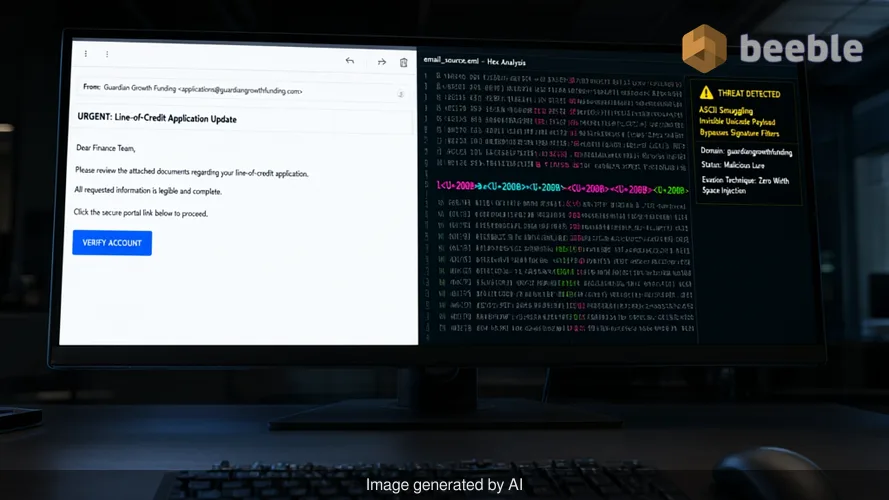
Sarah from the finance department opened an email that looked identical to a dozen other loan applications she reviewed that week. The message was crisp, professional, and originated from a sender domain that appeared legitimate. It requested information regarding a line-of-credit application. Within the text, every word was readable, and no red flags triggered her suspicion. Behind the scenes, the email was a digital Trojan horse. It contained millions of invisible characters designed specifically to slip past the enterprise-grade email filters her company paid thousands of dollars to maintain. This incident was not an isolated event. It was part of a high-volume phishing campaign that sent millions of messages daily during the first half of 2026.
I spent my morning analyzing the byte sequences of several lures recovered from the guardiangrowthfunding domain. From a risk perspective, this campaign represents a significant shift in how threat actors adapt AI-era evasion techniques to traditional spam. The attackers used a method called ASCII smuggling. This technique leverages non-rendering Unicode characters to conceal instructions or break apart keywords. To a human reader, the text is perfectly normal. To an email filter or a Large Language Model, the text is a fragmented mess that fails to trigger signature-based detections. This is the architectural paradox of modern security. We build systems to understand human intent, yet these systems are easily confused by the very building blocks of digital text.
The deceptive simplicity of a financial lure
Phishing remains the primary vector for initial access because it exploits the most vulnerable component of any network: the user. In the 2026 campaign, the attackers targeted Small Business Administration (SBA) loan applicants. They used lures that mimicked business loans, advances, and lines of credit. The goal was to collect detailed business and financial information. This data is a toxic asset. Once compromised, it allows threat actors to conduct highly targeted spear-phishing attacks in the future. They can impersonate vendors, initiate fraudulent wire transfers, or sell the data to other criminal groups.
The Fortra Intelligence and Research Experts team first identified the roots of this operation in late 2025. By February 2026, the campaign entered a high-volume phase. The emails reached peak volumes of 2.37 million messages in a single day. The attackers operated on a professional weekly cadence. The volume surged on Monday mornings and went almost silent on weekends. This suggests a structured operation that aligns with the business hours of their targets. It also reflects a level of discipline common in sophisticated cyber-criminal organizations.
Anatomy of the Unicode tag block bypass
The technical brilliance of this attack lies in the choice of characters. The attackers focused on the Unicode Tags block, which ranges from U+E0000 to U+E007F. This block is a shadow copy of the printable ASCII characters. For example, U+E0041 mirrors the capital letter 'A,' and U+E0061 mirrors the lowercase 'a.' The Unicode Consortium originally intended this block for language tagging, but it is now largely deprecated. Because these characters have no visual representation in modern user interfaces, they are invisible to the recipient.
The attackers inserted these invisible characters inside common financial keywords. Instead of writing 'funding,' the attacker wrote 'fun' followed by the invisible tag character for a space (U+E0020) and then 'ding.' When the email filter scans the message, it looks for the literal string 'funding.' It finds 'fun' and 'ding' as separate entities. The filter concludes the email is safe because it does not contain the blacklisted keyword. However, when the email reaches Sarah's inbox, the mail client ignores the invisible characters. She sees the word 'funding' and trusts the message.
When I tested this in my own lab using a standard regex script, the results were consistent. A basic filter that does not account for interleaved code points will miss every single one of these lures. This technique turns the flexibility of the Unicode standard against the security tools meant to protect us.
The scale of the 2026 offensive
Between February and May 2026, Microsoft Security Research tracked a massive distribution effort. The campaign leveraged hundreds of disposable, finance-themed domains. These domains were not just random strings of characters. They were carefully chosen to sound like legitimate financial institutions. Some of the most active domains included:
- guardiangrowthfunding[.]com
- digitalcapitalboost[.]com
- thebusinessloanexpress[.]com
- yourlocfunding[.]com
- advancefundingboost[.]com
The attackers did not send these emails from their own servers. They weaponized the ActiveCampaign marketing and automation platform. By using a reputable service, the attackers inherited the platform's established IP reputation. This is a common tactic to bypass reputation-based filtering. If an email originates from a known marketing provider with proper SPF and DKIM authentication, a filter is less likely to mark it as spam. Every outbound link in these emails was routed through ActiveCampaign's click-tracking domains, such as acemlnd[.]com and activehosted[.]com. This made the malicious traffic appear identical to legitimate marketing newsletters.
Why ActiveCampaign became the preferred delivery vehicle
ActiveCampaign provides AI-powered marketing automation features. The threat actors used these tools to vary the design, content, and flow of their emails. This allowed them to mass-produce convincing, tailored websites and messages at a scale that was previously impossible. It is a classic case of dual-use technology. A tool designed to help small businesses grow is used by criminals to destroy them. ActiveCampaign stated that they have since updated their content-moderation systems to treat the heavy use of invisible Unicode characters as a suspicious signal. However, the period between February and May showed just how difficult it is for platforms to keep up with adaptive adversaries.
From an architectural level, the use of a shared sending service complicates the defense. If a security team blocks all traffic from a major provider like ActiveCampaign, they also block legitimate communications from thousands of other businesses. The attackers know this. They hide in the noise of legitimate commerce. They treat the network perimeter as an obsolete castle moat, knowing that the real gates are opened by the users themselves.
The intersection of prompt injection and traditional spam
While this campaign targeted humans, the technique of ASCII smuggling is also a threat to AI systems. Large Language Models often ingest data from third-party sources like emails or web pages. Because these models cannot draw a reliable boundary between user instructions and embedded content, they are vulnerable to prompt injection. An invisible instruction hidden in a document could tell an AI assistant to forward sensitive data to an external address. The AI sees the invisible text as a valid command, while the user sees nothing.
Microsoft noted that the findings show how AI-era evasion techniques are now part of the standard toolkit for traditional phishing. The same methods used to trick an LLM into leaking a secret are being used to trick a bank employee into revealing account details. This systemic vulnerability in how we parse and render text is a mission-critical issue. It requires a move toward zero trust at the data level. We can no longer assume that what we see on a screen is what the underlying system is processing.
Practical steps for defending the inbox
Proactively speaking, organization leaders must realize that signature-based detection is no longer sufficient. If your security strategy relies on matching keywords, it is already broken. The human firewall is important, but we cannot expect employees to detect invisible characters. The solution must be technical and granular.
I recommend three specific actions for IT and security teams:
- Implement Unicode normalization. Before an email filter scans a message, it should normalize the text. This process involves stripping out deprecated tag blocks and non-rendering characters. This ensures the filter sees exactly what the human eye sees.
- Audit third-party marketing traffic. If your organization receives a high volume of mail from platforms like ActiveCampaign or Mailchimp, monitor for anomalies. Look for spikes in traffic from newly created domains that use these platforms as relays.
- Enhance user training with concrete examples. Show employees how a legitimate-looking email can be used for credential harvesting. Explain that even emails from 'reputable' sources can be compromised.
Encryption is a shatterproof digital vault for data in transit, but it does nothing to protect the integrity of the message content itself. As threat actors refine their methods, our defensive posture must become more resilient. Patching a server is like plugging holes in a ship's hull, but addressing ASCII smuggling requires a fundamental change in how we handle the very language of the internet. We must verify every character, not just the ones we can see.
Sources: Microsoft Security Research Team, Fortra Intelligence and Research Experts (FIRE), Unicode Consortium Standards, MITRE ATT&CK Framework.
Disclaimer: This article is for informational and educational purposes only and does not replace a professional cybersecurity audit or incident response service.



See you on the other side.
Our end-to-end encrypted email and cloud storage solution provides the most powerful means of secure data exchange, ensuring the safety and privacy of your data.
/ Create a free account
