


How a Flawless Security Architecture Failed the Ten-Second Speed Test

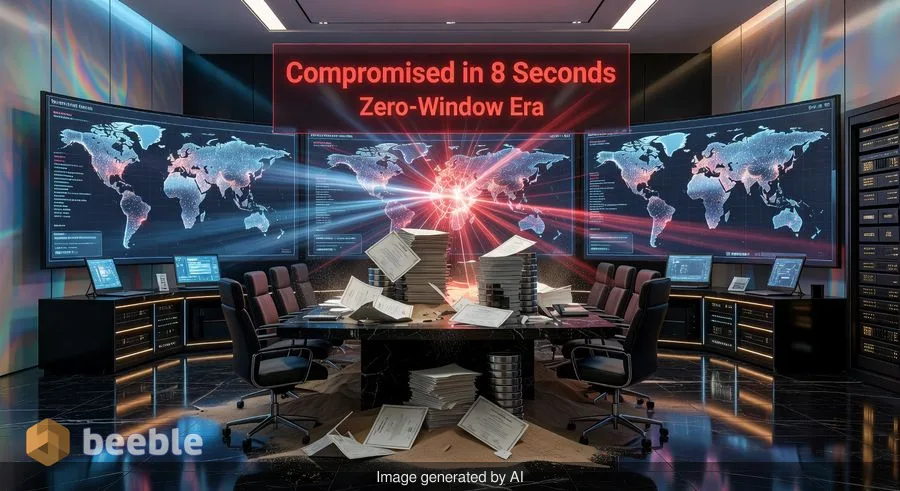
The boardroom at the target firm looked like a temple to modern cybersecurity. There were curved monitors displaying real-time global threat maps, a Tier-4 data center with biometric access, and a stack of compliance certificates that could stop a bullet. They had invested over twelve million dollars in a flagship Next-Generation Firewall and an AI-driven Extended Detection and Response (XDR) suite. On paper, they were a fortress. In reality, they were compromised in exactly eight seconds.
Behind the scenes, the failure was not a lack of budget but a fundamental misunderstanding of the Zero-Window era. While the security team expected a perimeter that could withstand a siege, the actual exploitability rested on a single misconfigured API gateway that had been left in 'debug' mode by a tired developer. From a risk perspective, the contrast was jarring: the company had military-grade encryption for its primary databases, but an unauthenticated endpoint provided a direct path to the administrative console. This is the architectural paradox of the post-Mythos landscape. We build skyscrapers of security on foundations of sand, and in a world where the window between a vulnerability being discovered and weaponized has shrunk to nearly zero, the sand is shifting faster than we can react.
The Ghost of Mythos and the Death of the Patching Cycle
To understand where we are on this April morning in 2026, we have to look at the threat landscape shaped by the Mythos event of last year. Before Mythos, we lived in a world of 'windows.' A vendor would release a patch on a Tuesday, and IT teams would spend the next two weeks testing and deploying it. There was a grace period—a brief, breathing space where human defenders could race against malicious actors.
Mythos changed the physics of this race. By integrating large-scale linguistic models with automated fuzzing tools, threat actors essentially automated the creation of functional exploits. Now, the moment a patch is reversed or a vulnerability is hinted at in a commit message on GitHub, an AI-driven script generates a payload. The window of vulnerability did not just shrink; it vanished. We are now in the Zero-Window era, where reaction is no longer a viable strategy. If you are waiting for a scan to tell you that you are vulnerable, you have already been compromised.
I remember sitting in a secure facility last November, communicating via PGP with a source who monitors the dark web's automated exploit exchanges. They showed me a dashboard where over five hundred unique exploits were generated and sold within minutes of a major framework update. This is why I maintain a healthy paranoia. In my own workflow, I assume every system is compromised until proven otherwise, and I never rely on a single vendor's promise of a 'complete solution.'
Zero Trust as a VIP Club Bouncer
Looking at the architectural level, the old way of thinking about networks—the castle moat—is officially an obsolete relic. In the Zero-Window era, we must treat the internal network as being just as hostile as the public internet. This is where the concept of Zero Trust becomes mission-critical, though it is often misunderstood as a product you can buy.
Think of Zero Trust not as a wall, but as a VIP club bouncer standing at every single internal door. Just because you made it through the front entrance doesn't mean you get into the kitchen, the VIP lounge, or the office. You are checked at every threshold. By design, this architecture assumes the breach has already happened. It moves the focus from 'How do we keep them out?' to 'How do we stop them from moving once they are in?'
In the event of a breach, a robust Zero Trust framework uses granular micro-segmentation to isolate the attacker. If that misconfigured API gateway I mentioned earlier had been behind a Zero Trust proxy, the attacker would have found themselves in a digital cul-de-sac. They might have compromised one service, but they wouldn't have been able to pivot to the crown jewels. Consequently, the blast radius of a zero-day exploit is contained by the architecture itself, rather than by a frantic human response.
Reframing Data as a Toxic Asset
One of the most profound shifts in the post-Mythos playbook involves how we view information. For decades, the mantra was 'data is the new oil.' In terms of data integrity and risk, we should start viewing data as a toxic asset. The more of it you store, the more liability you carry.
Proactively speaking, organizations need to conduct a ruthless audit of their attack surface. If you are holding onto unencrypted legacy customer data from 2018 'just in case,' you are essentially storing digital dynamite in your basement. Stealthy actors look for these forgotten pockets of data—the shadow IT that represents the dark matter of the corporate network. It is invisible to the SOC but exerts a massive gravitational pull on the organization's risk profile.
Assessing the attack surface means more than just scanning IP addresses. It means questioning the necessity of every data point. If a piece of data is not essential for a mission-critical process, it should be purged or moved to a decentralized, encrypted vault that is physically air-gapped from the primary network.
The Move Toward Immutable Infrastructure
Patching aside, the Zero-Window era demands a move away from 'living' servers that we nurture and update over years. Instead, we are seeing the rise of immutable infrastructure. In this model, you don't patch a server; you kill it and replace it with a fresh, pre-configured image that already includes the latest security updates.
This approach is scalable and resilient. It treats infrastructure like a disposable paper cup rather than a fine china plate. From an end-user perspective, this happens behind the scenes and results in zero downtime. From a forensic perspective, it allows us to keep the compromised 'dead' instance in a sandbox for analysis while the business continues to operate on a clean slate.
This is the only way to beat an AI that writes exploits in seconds. You cannot out-patch the machine, but you can out-architect it. By ensuring that your environment is constantly being refreshed and that no configuration can be changed manually, you eliminate the 'configuration drift' that malicious actors rely on to find their way in.
Practical Playbook for the Zero-Window Era
If you are managing a network or advising a business today, the old playbooks belong in the shredder. Here is how to build a posture that survives the post-Mythos reality:
- Enforce Identity-Based Micro-segmentation: Move beyond VLANs. Every connection between services should require an identity-based handshake, regardless of whether it originates inside or outside the network.
- Audit Your API Surface Monthly: APIs are the new perimeter. Use automated tools to find 'shadow APIs' and ensure every endpoint requires stringent authentication.
- Automate the Kill Switch: Develop automated incident response playbooks that can isolate segments of your network the moment an anomaly is detected by your XDR. Waiting for a human to click 'Approve' is a luxury you no longer have.
- Adopt an 'Identity-First' Security Model: Phishing remains a digital Trojan horse, but its impact is neutralized if the compromised credentials cannot be used to bypass MFA or access sensitive segments from an unrecognized device.
- Practice Forensic Readiness: Ensure your logging is granular and stored in a write-once, read-many (WORM) format. In the Zero-Window era, you need to be able to reconstruct an attack chain that may have lasted only a few minutes.
Toward a Systemic Resilience
The goal of cybersecurity in 2026 is no longer to be unhackable; that is a dangerous fantasy. The goal is to be resilient. We must build systems that can take a punch, lose a limb, and keep on walking. As a journalist who has spent years dissecting the aftermath of systemic failures, I can tell you that the organizations that survive aren't the ones with the biggest firewalls. They are the ones that accepted their own vulnerability and built their architecture to fail gracefully.
Do not wait for the next major breach to audit your third-party vendors or revise your incident response plan. Start by enforcing MFA on every single entry point, no exceptions. The window has closed. It’s time to change how we see the light.
Sources:
- NIST Special Publication 800-207 (Zero Trust Architecture)
- MITRE ATT&CK Framework: Focus on AI-Automated Exploit Generation
- The 2025 Mythos Incident Post-Mortem Report (Consolidated Community Analysis)
- CISA Guidelines on Automated Vulnerability Management and Response
Disclaimer: This article is for informational and educational purposes only. It does not replace a professional cybersecurity audit, tailored risk assessment, or dedicated incident response service. Always consult with certified security professionals before making significant changes to your infrastructure.



See you on the other side.
Our end-to-end encrypted email and cloud storage solution provides the most powerful means of secure data exchange, ensuring the safety and privacy of your data.
/ Create a free account
